

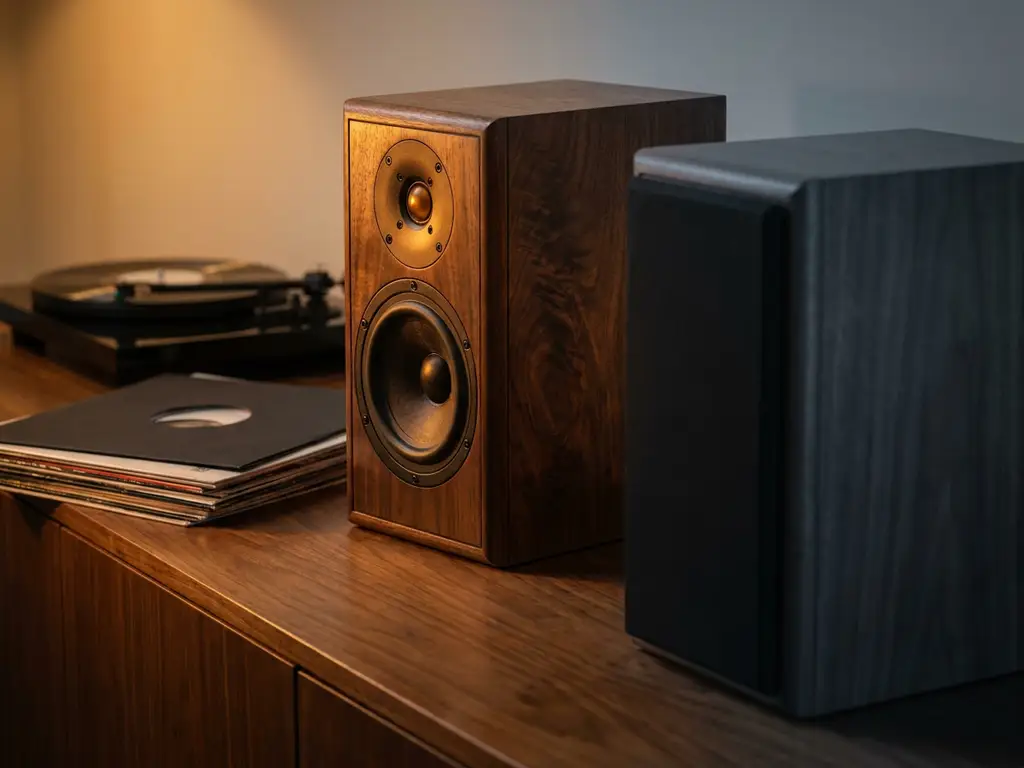
If you have ever played the same album on a friend’s system and been surprised by how different it sounded compared to your own setup at home, you are not imagining things. The same recording can feel warm and enveloping on one system, bright and fatiguing on another, or flat and lifeless on a third. Understanding why this happens is the first step toward building a listening experience that genuinely moves you.
What parts of an audio system affect sound quality the most?
Every component in the signal chain shapes the final sound you hear, but the source component, preamplifier, power amplifier, and loudspeakers carry the greatest influence. The source determines how much musical information enters the chain, the amplification stages control how faithfully that signal is strengthened, and the speakers translate electrical energy into the physical sound waves that reach your ears.
Each of these stages introduces its own character. A high-end audio component with tight tolerances and premium parts will preserve more of the original signal than a budget equivalent that cuts corners on capacitors, resistors, or circuit topology. The interconnects and speaker cables between components also play a role, though their effect is typically smaller than that of the components themselves. Taken together, the cumulative effect of every link in the chain determines whether the music arrives at your ears intact or altered.
How does component quality change the way music sounds?
Component quality affects music playback by determining how accurately electrical signals are amplified, converted, and transmitted without adding noise, distortion, or coloration. Higher-quality parts maintain tighter tolerances, reject interference more effectively, and preserve the subtle timing and harmonic relationships within a recording that give music its emotional texture.
Consider the difference between a standard electrolytic capacitor and a high-grade film capacitor in an amplifier’s signal path. The latter stores and releases energy more precisely, which translates into cleaner transient response and a more natural decay on instruments like piano or acoustic guitar. Similarly, a well-engineered D/A converter in a CD player or streaming source recovers fine detail from digital files that cheaper converters smear or lose entirely. These are not abstract engineering differences; they are audible distinctions that listeners notice as the sense of space around instruments, the texture of a vocalist’s breath, or the weight of a kick drum.
Power supply quality is another often-overlooked factor. An amplifier fed by a robust, well-regulated power supply maintains composure during loud, complex passages, whereas one with a weaker supply will compress dynamics and lose definition when the music demands the most from it.
What’s the difference between accurate sound and pleasant sound?
Accurate sound reproduces a recording as faithfully as possible to the original performance, while pleasant sound describes a reproduction that has been colored or shaped to be immediately appealing, regardless of whether it reflects the source material truthfully. The two can overlap, but they are not the same thing.
Some audio systems are deliberately voiced to flatter music by boosting bass, softening high frequencies, or adding a warm midrange glow. This can feel enjoyable at first listen, but over time it misrepresents the recording and can mask details the artist and engineer intended you to hear. An accurate system, by contrast, reveals everything on the recording, including its flaws.
Many experienced audiophiles come to prefer accuracy because it delivers a deeper, more honest connection to the music. When a system gets out of the way and simply reproduces what is on the recording, you hear the performance rather than the equipment. This is the distinction between a system that entertains and one that genuinely communicates. That said, accuracy does not mean harshness. A truly accurate system should sound natural and engaging, because live music itself is natural and engaging.
How does the room affect how music sounds on any system?
The room is effectively an additional component in your audio system, and it can have as much influence on the final sound as the electronics themselves. Sound waves reflect off walls, floors, and ceilings, and these reflections interact with the direct sound from your speakers to create peaks and dips in frequency response, smear imaging, and reduce clarity.
Low frequencies are particularly susceptible to room effects. Bass waves are long enough to bounce between parallel walls and build up at certain frequencies, a phenomenon known as room modes or standing waves. This is why bass can sound boomy and exaggerated in some rooms and thin in others, even when the same speakers and amplifier are used. Higher frequencies are affected by the reflective or absorptive surfaces in the room, which is why a room full of soft furnishings sounds different from a bare, hard-walled space.
Speaker placement is one of the most powerful tools for managing room effects without acoustic treatment. Moving speakers away from walls, angling them toward the listening position, and experimenting with the distance between them can dramatically improve imaging and reduce unwanted reflections. Acoustic panels, rugs, bookshelves filled with books, and diffusers all help to control the room’s behavior and allow your system’s true quality to come through.
How can you tell if an audio system is reproducing music accurately?
An accurately reproducing audio system presents music with a stable, three-dimensional soundstage, natural tonal balance across all frequencies, clear separation between instruments, and dynamic range that reflects the ebb and flow of the original performance. Voices and acoustic instruments should sound like themselves rather than like a processed version of themselves.
A few practical ways to evaluate a system’s accuracy include:
- Use familiar recordings: Tracks you know intimately reveal whether a system is adding or removing something from the sound you expect.
- Listen for spatial information: An accurate system places instruments in a convincing three-dimensional space rather than compressing everything into a flat wall of sound between the speakers.
- Check tonal balance: No frequency range should dominate consistently. Bass should be defined rather than bloated, treble should be extended without being harsh, and the midrange should sound open and natural.
- Assess dynamics: Sudden loud passages should feel effortless and controlled, while quiet passages should retain detail rather than disappearing into a noise floor.
- Listen for fatigue: Accurate, natural reproduction is rarely fatiguing over long listening sessions. If a system tires your ears quickly, it is likely adding distortion or emphasizing frequencies unnaturally.
Live recordings are particularly useful for this kind of evaluation because most listeners carry an intuitive sense of what instruments and voices sound like in real acoustic spaces. When a system reproduces that sense of reality convincingly, it is doing its job well.
How ACCUSTIC ARTS helps you achieve true hi-fi sound reproduction
Everything described in this article, from component quality and signal integrity to dynamic range and emotional engagement, is exactly what we at ACCUSTIC ARTS have dedicated ourselves to addressing since 1997. Our philosophy, “Absolute Sound Fidelity Through Reproduction,” is not a marketing phrase. It is the engineering brief behind every product we build.
Here is how we put that commitment into practice:
- Uncompromising component selection: We use only precise, high-grade parts across every product line, from preamplifiers and power amplifiers to CD players, D/A converters, and tube hybrid components.
- Rigorous testing: Every component undergoes individual testing that can last up to two weeks before it leaves our facility in Lauffen am Neckar, Germany. Nothing ships until it meets our standards.
- Real-world musical experience: Our engineering is informed by decades of work in recording studios and professional live sound environments, meaning our products are designed around the way music actually sounds, not just how it measures on a test bench.
- Emotionally engaging midrange reproduction: Our signature achievement is a midrange that communicates the emotional heart of music, the quality that audiophiles and music professionals around the world have come to recognize as distinctly ours.
- Optimised price-to-value ratio: Reference-grade performance does not have to mean inaccessible pricing. We design every product with a no-holds-barred approach to quality while keeping value firmly in mind.
If you are ready to hear what your music is truly capable of, we invite you to explore our full range of high-end audio components or get in touch with us directly to find the right system for your listening space and musical taste.
—
Disclaimer: This article was created with the assistance of Artificial Intelligence and has been reviewed by our editorial team.