

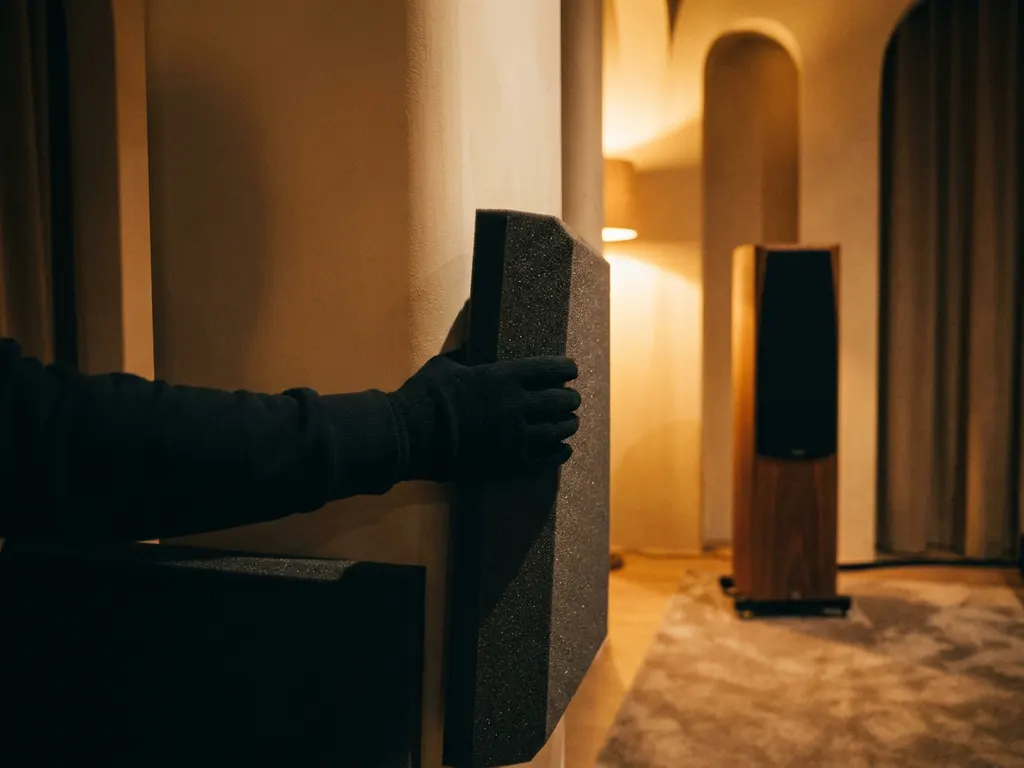
If you have ever noticed that the bass in your listening room sounds boomy in one spot but disappears entirely two feet away, you are almost certainly dealing with standing waves. This is one of the most common and frustrating acoustic challenges in high-end audio, and it affects even the most carefully assembled systems. The good news is that with the right understanding and a few targeted solutions, you can bring your room’s acoustics under meaningful control.
What are standing waves and why do they affect sound quality?
Standing waves are stationary patterns of sound pressure that form when sound waves reflect off parallel surfaces and interfere with each other. In a listening room, they create areas of excessive bass buildup and areas of near-total cancellation, making it impossible to hear an accurate, balanced sound regardless of how good your equipment is.
These acoustic phenomena occur at specific frequencies determined by your room’s dimensions. Because the wave is effectively “trapped” between two surfaces, its energy does not dissipate evenly. Instead, it reinforces itself at certain points and cancels itself out at others. The result is a frequency response that varies dramatically depending on where you sit in the room. Even the finest electronics and speakers cannot compensate for what the room itself is doing to the sound. This is why listening room acoustics are considered just as important as the components themselves in any serious high-end audio setup.
What causes standing waves in a listening room?
Standing waves in a listening room are caused by sound waves bouncing between parallel surfaces, such as opposite walls, the floor and ceiling, or the front and back walls. When a reflected wave aligns with the original wave at certain frequencies, they combine to create a resonant buildup known as a room mode.
Every rectangular room has three primary types of room modes:
- Axial modes occur between two parallel surfaces and are the strongest and most problematic
- Tangential modes involve four surfaces and are less intense but still audible
- Oblique modes involve all six surfaces and have the least impact on the overall sound
The lower the frequency, the longer the wavelength, and the more likely it is to create a persistent, hard-to-treat resonance. This is why bass frequencies between roughly 20 Hz and 300 Hz are the primary culprits in most domestic listening rooms. Rooms with perfectly square dimensions or proportions that share a common denominator are particularly susceptible, as their room modes stack up at the same frequencies.
How do you identify standing waves in your room?
You can identify standing waves by walking slowly through your room while playing a sustained bass tone or bass-heavy music. If the bass sounds significantly louder or quieter as you move around, you are hearing the pressure variations caused by room modes. A more precise method uses a measurement microphone and free software such as REW (Room EQ Wizard).
Here is a practical approach to locating standing waves:
- Play a sine wave sweep or a bass-heavy track at moderate volume
- Walk from the front wall to the back wall in a straight line, pausing every half metre
- Note where the bass sounds exaggerated and where it seems to disappear
- Repeat along the side-to-side axis
- For precise analysis, use a measurement microphone with REW software to generate a frequency response graph at your listening position
A graph generated by measurement software will show clear peaks and dips in the bass region, giving you an accurate picture of which frequencies are affected and by how much. This information is invaluable before you invest in any acoustic treatment.
What are the most effective ways to reduce standing waves?
The most effective ways to reduce standing waves are physical acoustic treatment using bass traps, strategic speaker and listening position placement, and room correction software. Physical treatment is the most reliable long-term solution, while placement adjustments are free and should always be tried first.
A combined approach works best:
- Repositioning speakers and the listening seat can avoid the worst pressure nodes without spending anything
- Bass traps absorb low-frequency energy at the boundaries where it is most concentrated
- Broadband absorbers and diffusers address mid and high-frequency reflections that compound the problem
- Room correction software or DSP equalisation can reduce the perceived effect of modes at the listening position
No single method eliminates standing waves entirely. The most effective results come from addressing the problem at its source through physical treatment, then refining the outcome with measurement and, where appropriate, digital correction. Trying to equalise your way out of a room problem without any physical treatment tends to produce diminishing returns and can introduce new issues.
Where should you place bass traps for the best results?
Bass traps deliver the best results when placed in the corners of the room, particularly the floor-to-ceiling corners. Corners are where low-frequency pressure is highest because all three axial modes converge there. Filling these corners with thick, dense absorptive material targets the root cause of bass buildup more efficiently than placing treatment elsewhere.
For practical placement guidance:
- Prioritise the front corners behind the speakers first, as these are closest to the primary sound source
- Add treatment to the rear corners to address reflections travelling back toward the listening position
- Floor-to-ceiling corner placement maximises surface area contact and improves absorption at lower frequencies
- Thick panels of at least 10 to 15 centimetres of dense rockwool or mineral wool outperform thin foam panels significantly
- Tri-corner placement, where two walls meet the ceiling or floor, is especially effective
The effectiveness of a bass trap is directly related to its thickness and density. Thin acoustic foam products marketed as bass traps rarely absorb frequencies below 200 Hz in any meaningful way. For genuine low-frequency control, mass and depth are essential. As part of a complete high-end audio setup, proper bass trapping is one of the highest-return investments you can make.
Can room correction software replace physical acoustic treatment?
Room correction software cannot fully replace physical acoustic treatment. Digital correction tools can reduce the perceived impact of standing waves at a specific listening position, but they do not remove the acoustic energy from the room. Physical treatment addresses the problem at its source, while software only compensates for what the microphone measures at one point in space.
That said, room correction software is a genuinely useful complement to physical treatment:
- It can tighten up residual bass peaks that remain after treatment
- It corrects for speaker and room interaction across a broader frequency range
- It is particularly effective for mid and upper bass frequencies where physical treatment becomes impractical
The limitation of software correction is that it applies equalisation, which means it reduces the output at problem frequencies rather than absorbing the energy. Move even half a metre from the measurement position and the correction may no longer apply accurately. Physical acoustic treatment, by contrast, improves the sound throughout the room. The ideal approach is to treat the room as thoroughly as practically possible, then use room correction software to refine what remains.
How Accustic Arts Can Help You Achieve Your Best Sound
We understand that even the most resolving, emotionally engaging audio system can be undermined by an untreated room. At Accustic Arts, our components are engineered to reveal every nuance of a recording with absolute fidelity, which means they are also honest about the acoustic environment they operate in. When your room is properly treated, our electronics reward you with everything they were designed to deliver.
Here is how we support your journey toward the ideal listening experience:
- Our preamplifiers, power amplifiers, and integrated amplifiers are built to reproduce the full frequency spectrum with precision, making the improvements from acoustic treatment immediately and clearly audible
- Our D/A converters and CD players retrieve fine musical detail that would otherwise be masked by room-induced bass smear and resonance
- Every Accustic Arts component undergoes up to two weeks of individual testing before dispatch, ensuring that what arrives in your listening room performs exactly as intended
- Our roots in recording studios and professional live sound venues mean our products are voiced in acoustically demanding environments, giving you a reference point for what genuinely accurate sound reproduction feels like
If you are ready to hear what your music truly sounds like, get in touch with us to discuss which Accustic Arts components are the right match for your system and listening space.
—
Disclaimer: This article was created with the assistance of Artificial Intelligence and has been reviewed by our editorial team.
Related Articles
- How do you pair an amplifier with a DAC and CD player for a coherent system?
- Why do some amplifiers run hot, and does that affect longevity?
- What is jitter in digital audio and how does it degrade sound?
- How does a D/A converter affect the sound of digital music?
- What is imaging in audio and how do you improve it?