

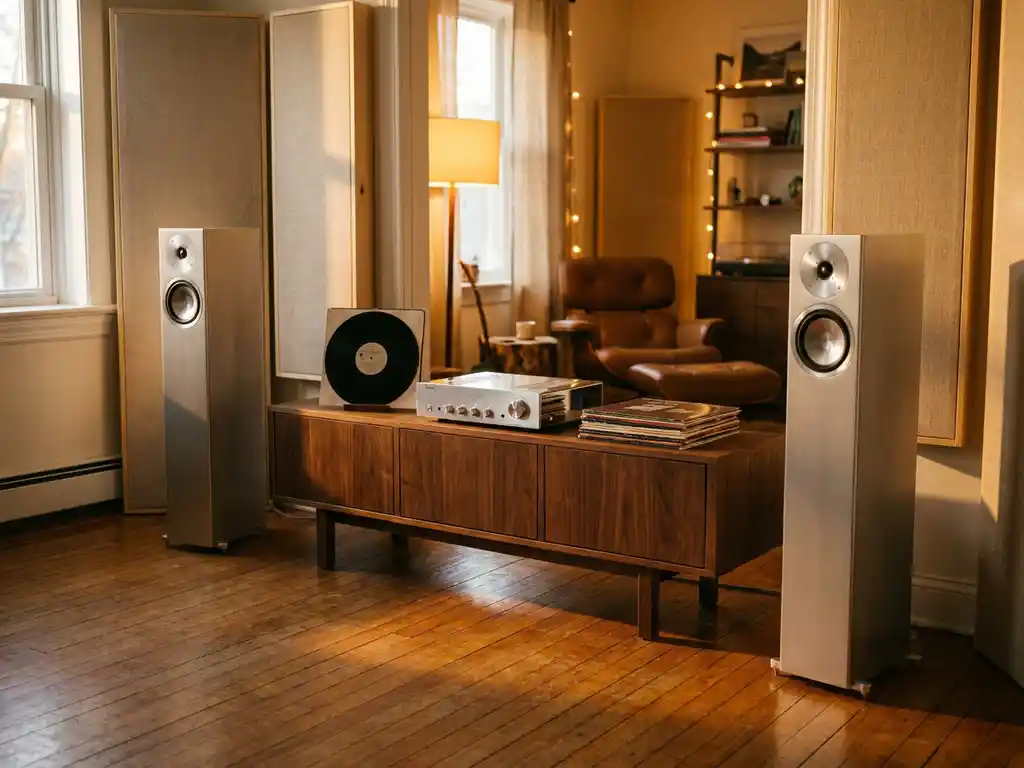
For many music lovers, the gap between a live performance and what they hear at home can feel frustratingly wide. Voices lose their warmth, instruments blur together, and the emotional weight of a recording simply fails to land. Achieving natural sound reproduction at home is not a matter of luck or budget alone — it is the result of understanding what accurate sound actually means, choosing the right audio components, and setting up your home audio setup with intention. This guide answers the most important questions audiophiles ask when pursuing genuine audiophile sound quality.
What does natural sound reproduction actually mean?
Natural sound reproduction means that a hi-fi system plays back recorded music in a way that faithfully reflects the original performance — preserving tonal balance, spatial information, dynamic range, and the emotional character of the recording without adding coloration, distortion, or artificial enhancement. It is the sonic equivalent of a clear window rather than a painted one.
This concept sits at the heart of serious high-end audio. A naturally reproducing system does not make recordings sound better or worse than they are — it simply tells the truth. That means a well-recorded jazz trio should sound intimate and three-dimensional, while a dense orchestral recording should feel expansive and layered. The goal is not to flatter music, but to reveal it. Every nuance the recording engineer captured — the breath before a vocal phrase, the resonance of a piano body, the decay of a cymbal — should reach the listener intact.
This is a demanding standard. It requires every link in the audio chain to introduce as little alteration as possible, from the source component all the way to the loudspeaker.
Why does your home audio setup affect sound quality so much?
Your home audio setup affects sound quality because every component, cable, and room surface in the signal path either preserves or degrades the original audio signal. Even a single weak link — a poor-quality digital-to-analogue converter, an underpowered amplifier, or an acoustically untreated room — can undermine an otherwise excellent system.
Several factors interact to shape what you ultimately hear:
- Room acoustics: Hard parallel walls create reflections and standing waves that color the sound, adding bass buildup in corners and smearing high-frequency detail.
- Component matching: Amplifiers and loudspeakers must be electrically and tonally compatible. Mismatches cause frequency imbalances and dynamic compression.
- Speaker placement: Even small adjustments to speaker position — toe-in angle, distance from walls, listening triangle — can dramatically change imaging and bass response.
- Cabling and power: Signal cables and power conditioning affect noise floors and micro-dynamic resolution in ways that are subtle but audible on a resolving system.
Understanding these interactions is what separates a frustrating listening experience from a deeply satisfying one. The room itself is often the largest single variable, and modest acoustic treatment can yield improvements that no component upgrade can match.
What audio components are essential for accurate sound reproduction?
The essential audio components for accurate sound reproduction are a high-quality source (such as a CD player, streaming device, or turntable), a preamplifier, a power amplifier, and loudspeakers. Each component must handle the audio signal with precision and minimal distortion for the chain to deliver truthful playback.
Here is what each component contributes:
- Source component: Retrieves or decodes the original recording. A high-performance CD player or DAC (digital-to-analogue converter) determines how much musical information enters the system from the start.
- Preamplifier: Controls volume and selects between sources while maintaining signal integrity. A transparent preamplifier adds nothing and removes nothing from the signal.
- Power amplifier: Drives the loudspeakers with sufficient current and voltage, tracking the input signal precisely across all frequencies and dynamic levels.
- Loudspeakers: Convert the electrical signal into acoustic energy. They are often the most character-defining component in any hi-fi system.
Some listeners choose integrated amplifiers, which combine pre and power amplification in a single chassis, offering a practical and often cost-effective path to excellent performance. D/A converters have also become a central component as streaming and digital playback have grown in importance. Explore the full range of high-end audio components available to understand what each format brings to a complete system.
What’s the difference between warm sound and accurate sound?
Warm sound describes a tonal character where the midrange and upper bass are slightly emphasised, giving music a rich, full-bodied quality. Accurate sound means the system reproduces the recording without adding or subtracting any tonal character. The two are not mutually exclusive — a recording made with warmth will sound warm on an accurate system.
This distinction matters because many audiophiles confuse the two when evaluating components. A warm-sounding amplifier may be pleasing at first but will eventually obscure detail and misrepresent recordings that were not intended to sound that way. An accurate system, by contrast, lets each recording speak for itself.
That said, accuracy does not mean brightness or clinical coldness. The best high-end components achieve what might be called natural warmth — a quality that emerges organically from truthful reproduction of music that was recorded with warmth, rather than from electronic coloration added by the component itself. When a system is genuinely accurate, the emotional weight of music comes through not because the electronics flatter it, but because nothing stands in the way.
Is tube sound more accurate than solid-state?
Neither topology is inherently more accurate. Tube amplifiers introduce specific harmonic characteristics that some listeners find natural and musically satisfying. Solid-state designs can achieve extremely low distortion and high control over loudspeakers. Tube hybrid designs combine elements of both, aiming to preserve the organic quality of tube reproduction while benefiting from the precision of solid-state circuitry.
How do you choose the right hi-fi components for your home?
Choosing the right hi-fi components starts with defining your priorities: the music you listen to most, the size of your listening room, your budget, and whether you value simplicity or flexibility. From there, work outward from your loudspeakers, since they define the system’s character more than any other component and should drive amplifier selection.
A practical approach to building a resolving hi-fi system:
- Start with loudspeakers: Choose speakers that suit your room size and listening preferences. Audition them with music you know well.
- Match amplification to your speakers: Check impedance curves and sensitivity ratings. Some speakers demand high current; others work well with lower-powered amplifiers.
- Invest in the source: The quality of your source component sets a ceiling on everything downstream. A high-performance DAC or CD player pays dividends across the entire system.
- Consider the room: Before upgrading components, assess whether basic acoustic treatment — a rug, bookshelves, wall panels — would deliver greater improvement.
- Audition before buying: Whenever possible, listen to components in your own home or a controlled environment. Showroom conditions rarely reflect real-world listening.
It is also worth considering the long-term serviceability and build quality of any component. High-end electronics built to exacting standards will often outlast and outperform budget alternatives many times over, making them a genuinely better value across a decade of use.
How can you improve the sound quality of your existing system?
You can improve the sound quality of your existing system without replacing components by addressing room acoustics, optimising speaker placement, upgrading interconnects and power conditioning, and isolating components from vibration. These changes are often more impactful than a component upgrade at a similar cost.
Specific steps worth taking:
- Reposition your speakers: Experiment with toe-in angle and distance from the front wall. Even a few centimetres can sharpen imaging and tighten bass.
- Add acoustic treatment: A thick rug between the speakers and listening position reduces floor reflections. Bookshelves filled with books act as diffusers on side walls.
- Isolate components: Placing amplifiers and sources on isolation platforms or using quality feet reduces microphonic interference and improves low-level resolution.
- Upgrade your power supply: A dedicated mains circuit or a quality power conditioner lowers the noise floor and can reveal detail that was previously masked.
- Reconsider your listening position: Sitting too close to the back wall reinforces bass frequencies unevenly. Moving forward even slightly can improve overall balance.
If you have made these adjustments and still feel the system is not reaching its potential, the next step is to identify the weakest component in the chain. Often this is the source or the amplification stage, where a meaningful upgrade unlocks performance that was always present in the loudspeakers but was never properly driven.
How Accustic Arts helps you achieve natural sound reproduction
We at Accustic Arts have built our entire philosophy around one goal: Absolute Sound Fidelity Through Reproduction. Every product we design is developed to remove barriers between the listener and the music — not to add a signature sound, but to let recordings speak with full emotional honesty. Here is what sets our approach apart:
- Uncompromising component quality: We use only precise, high-grade components across every product line, from preamplifiers and power amplifiers to CD players, DACs, and tube hybrid designs.
- Rigorous testing: Every component passes an individual product test that can last up to two weeks before it leaves our facility in Lauffen am Neckar, Germany.
- Real-world informed design: Our engineering draws on experience from professional recording studios and live PA systems, ensuring our products perform under the demands of real music.
- Emotionally engaging midrange: Our signature achievement is midrange reproduction that allows the emotional core of music to come through naturally — warm where the recording is warm, precise where precision is required.
- A complete system solution: From source to amplification, we offer every component needed for a reference-level home audio setup, so every element is designed to work in harmony.
If you are ready to experience what genuinely accurate, emotionally involving sound reproduction feels like, we invite you to get in touch with us and find the right Accustic Arts components for your listening room and musical tastes.
—
Disclaimer: This article was created with the assistance of Artificial Intelligence and has been reviewed by our editorial team.