

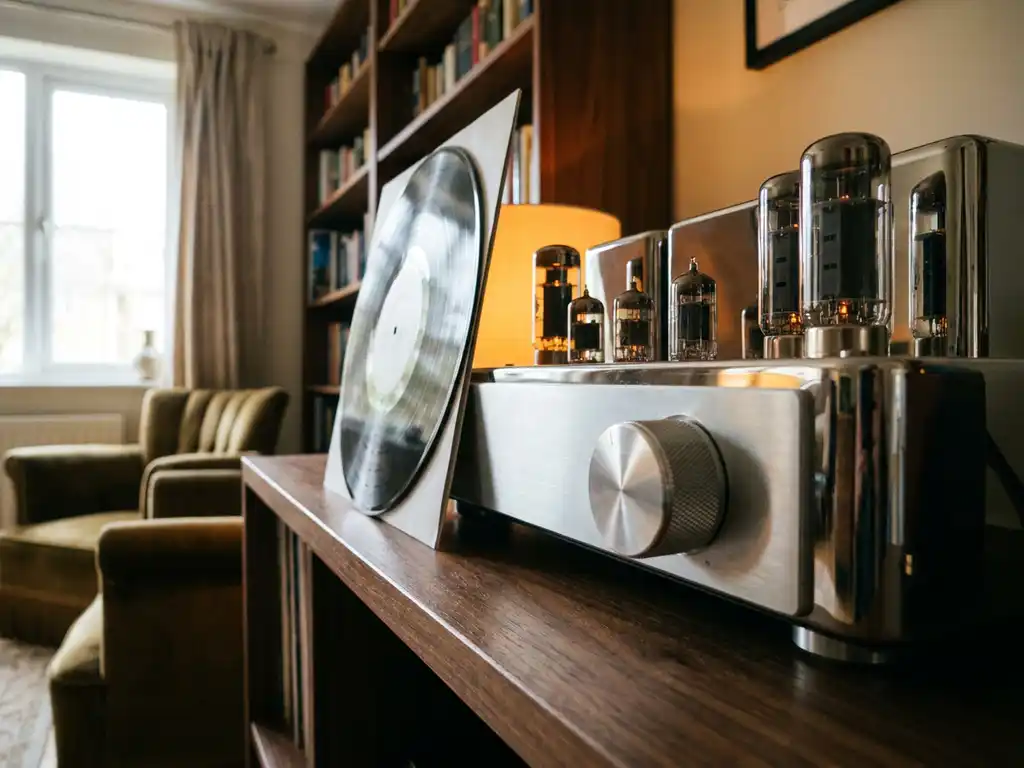
For audiophiles who care deeply about their listening experience, one question comes up again and again: can a system be both technically accurate and emotionally moving? It sounds like a contradiction, but the most rewarding hi-fi setups manage to achieve both. Understanding how sound accuracy and emotional engagement relate to each other is the key to building a system that truly satisfies.
What does sound accuracy actually mean in hi-fi audio?
Sound accuracy in hi-fi audio means how faithfully a system reproduces the original recorded signal without adding, removing, or distorting any information. An accurate system preserves the timing, frequency response, dynamics, and spatial characteristics of a recording exactly as they were captured, so what you hear reflects what the artist and engineer intended.
In practical terms, accuracy covers several interconnected qualities:
- Frequency neutrality: No part of the frequency spectrum is artificially boosted or rolled off
- Low distortion: The signal passes through each component cleanly, without unwanted coloration
- Timing precision: Transients and micro-dynamics arrive at the correct moment, preserving the rhythmic structure of music
- Channel consistency: Stereo imaging is stable and coherent, placing instruments and voices in a believable space
Accuracy is often measured objectively through specifications, but experienced audiophiles know that measurements alone do not tell the full story. A component can measure well and still sound flat or uninvolving. This is where the relationship between accuracy and emotional engagement becomes genuinely interesting.
Why does emotional engagement matter in audio reproduction?
Emotional engagement matters because music is not a technical exercise — it is a human experience. A system that reproduces sound with clinical precision but fails to convey the energy, phrasing, and feeling of a performance has missed the fundamental purpose of audio reproduction. Emotional engagement is what makes you forget about the equipment and simply listen.
Emotionally engaging playback communicates the subtle qualities that make music powerful: the breath before a vocal phrase, the decay of a piano note, the tension before a crescendo. These are not separate from accuracy — they are deeply connected to it. When a system resolves fine detail faithfully, those expressive nuances survive the journey from recording to listener.
The risk of prioritizing emotion without accuracy is that the result becomes a kind of pleasant fiction — a warm, flattering sound that feels good but does not genuinely reflect the recording. Audiophiles who have lived with such systems often describe a growing sense of sameness: every record starts to sound similar, because the system’s own character dominates. True emotional engagement comes from the music itself, not from the playback chain imposing its own personality.
Are sound accuracy and emotional engagement opposites?
Sound accuracy and emotional engagement are not opposites — they are complementary qualities that reinforce each other when a system is well designed. The perceived conflict usually arises from poorly implemented accuracy, where a technically correct but sterile-sounding component strips away the organic qualities that make music feel alive.
The confusion is understandable. Many audiophiles have encountered equipment described as “accurate” that sounded harsh, thin, or fatiguing. In those cases, the problem is not accuracy itself but incomplete accuracy — a system that gets some measurements right while introducing distortions in other areas, such as phase coherence or dynamic compression, that are harder to quantify but easy to hear.
Genuinely accurate sound reproduction preserves everything in the signal, including the warmth of acoustic instruments, the weight of a bass line, and the emotional arc of a performance. When a system achieves this honestly, emotional engagement follows naturally. The two qualities are not in tension; they are two descriptions of the same goal, approached from different perspectives.
How does component design affect the balance between accuracy and emotion?
Component design directly shapes how a system handles the boundary between technical precision and musical expressiveness. The quality of parts, circuit topology, power supply design, and mechanical construction all influence whether a component resolves fine detail while remaining musically natural, or whether it sacrifices one quality for the other.
Several design factors are particularly significant:
- Power supply quality: A stable, low-noise power supply allows a component to handle dynamic peaks cleanly, preserving the energy of live-sounding music without compression or smearing
- Component matching and tolerances: High-grade, precisely matched components reduce channel imbalances and subtle colorations that accumulate across a signal chain
- Circuit layout and shielding: Careful physical construction minimizes interference between stages, keeping the signal path as clean as possible
- Output stage design: The way a component drives the next stage in the chain affects transient response and the sense of immediacy that makes music feel present and alive
The midrange is often considered the most emotionally revealing part of the frequency spectrum, because it is where voices and the core body of most instruments live. Components that handle the midrange with particular care tend to produce the most involving listening experiences, because this is where musical expression is most concentrated. Achieving a natural, detailed midrange without artificial warmth or harshness is one of the most demanding challenges in high-end audio electronics design.
What should audiophiles listen for when evaluating this balance?
When evaluating whether a system balances sound accuracy and emotional engagement well, listen for naturalness, coherence, and the ability to disappear. A well-balanced system does not call attention to itself — it presents music in a way that feels honest and involving, without obvious colorations or a sense that anything is being added or taken away.
Specific things to listen for during an audition:
- Vocal reproduction: Voices should sound like real people, with natural breath, texture, and weight — not smoothed over or edged with artificial sheen
- Acoustic instrument timbre: A piano should sound like wood and metal, a cello like gut or steel over spruce — not like a generic “string sound”
- Dynamic contrast: The system should handle both soft passages and loud peaks without compressing the difference between them
- Sustained listening comfort: A system that is truly accurate should not cause fatigue over long sessions — harshness is usually a sign of distortion, not accuracy
- Engagement across genres: A genuinely balanced system makes jazz, classical, rock, and electronic music equally compelling, rather than flattering one style at the expense of others
It also helps to bring familiar recordings to any audition — music you know well enough to notice when something is missing or added. The goal is a system that makes you want to keep listening, not because it flatters the music, but because it reveals more of it.
How Accustic Arts Helps You Achieve Both Sound Accuracy and Emotional Engagement
At Accustic Arts, we have spent nearly three decades working on exactly this challenge: building electronics that are technically uncompromising without sacrificing the musical qualities that make listening deeply rewarding. Our approach is grounded in a simple belief — absolute sound fidelity and emotional engagement are not competing goals, they are the same goal.
Here is how we put that into practice:
- Uncompromising component selection: We use only high-grade, precisely matched components across every product line, minimizing the subtle colorations that accumulate in a signal chain
- Rigorous testing: Every component undergoes an individual testing process that can last up to two weeks before it leaves our facility in Lauffen am Neckar — because we know that consistency and reliability are inseparable from sonic performance
- Midrange excellence: Our signature achievement is midrange reproduction that audiophiles and music industry professionals consistently describe as emotionally engaging and naturally detailed
- Real-world experience: Our design philosophy is informed by work in professional recording studios and live venues, which means we build electronics that handle real music, not just test signals
- A complete product range: From preamplifiers and CD players to D/A converters, monoblock amplifiers, and tube hybrid components, we offer everything needed to build a coherent, high-fidelity system
If you are ready to experience what genuine sound fidelity feels like, we invite you to explore our full range of high-end audio components or get in touch with us directly to find the right combination for your listening space.
—
Disclaimer: This article was created with the assistance of Artificial Intelligence and has been reviewed by our editorial team.