

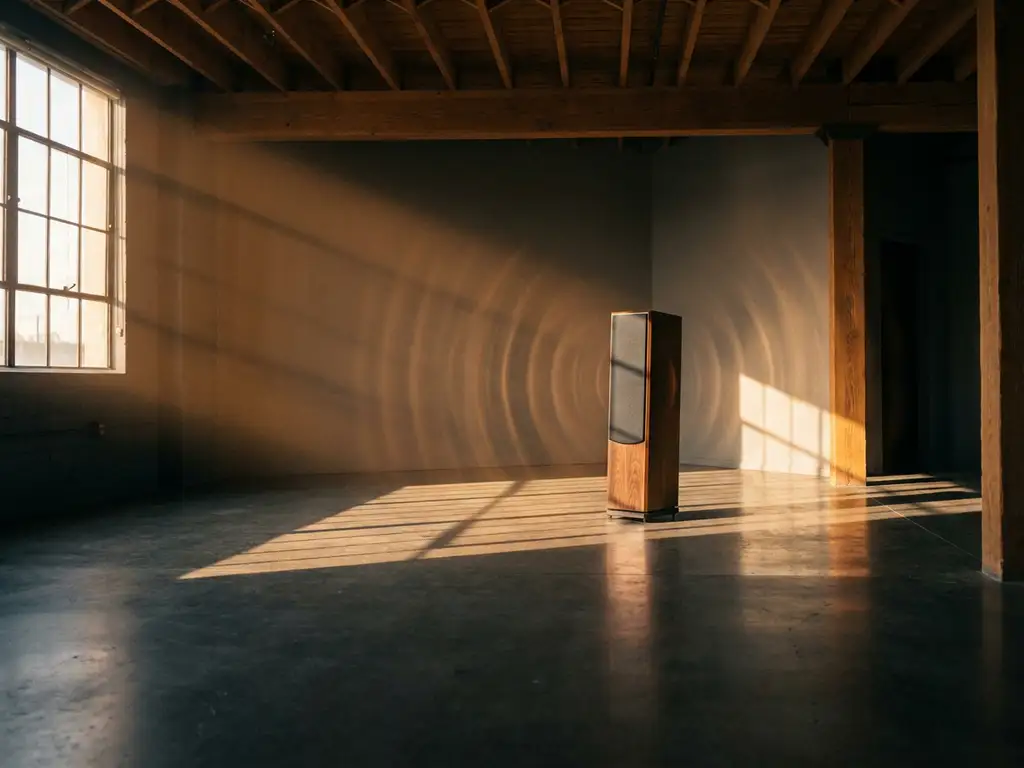
If you have ever noticed that bass sounds different depending on which room you play music in, you are not imagining things. The physical dimensions of a room have a profound effect on how low frequencies behave, and understanding this relationship is one of the most valuable things any hi-fi enthusiast can do. Whether you are setting up a dedicated listening room or simply trying to get the best out of your current space, room acoustics and bass response are inseparable topics worth exploring in depth.
What are room modes and why do they cause bass problems?
Room modes are resonant frequencies that form when sound waves reflect between parallel surfaces in an enclosed space. At certain frequencies, these reflections align to create standing waves, which cause some bass notes to sound unnaturally loud while others seem to disappear entirely. The result is an uneven, coloured bass response that misrepresents what your hi-fi system is actually producing.
When a bass frequency has a wavelength that fits neatly between two walls, the floor and ceiling, or the front and back of a room, the outgoing and reflected waves reinforce each other. This reinforcement is called a standing wave, and the frequencies at which this happens are the room’s modal frequencies. At these points, you may hear a single bass note boom dramatically while notes just above or below it seem thin and weak.
Room modes fall into three categories:
- Axial modes — the strongest, occurring between two parallel surfaces
- Tangential modes — involving four surfaces, slightly less powerful
- Oblique modes — involving all six surfaces, generally the weakest
Axial modes are the most audible and the most problematic for hi-fi listening. They are the primary reason why bass response in a hi-fi system can feel inconsistent, even when the electronics and speakers are of the highest quality.
How does room shape influence low-frequency performance?
Room shape directly determines where standing waves form and how many modal frequencies cluster together. Rooms with dimensions that share common mathematical ratios — such as a room where the width is exactly half the length — produce modes that stack on top of each other, causing severe bass peaks and nulls. Rooms with non-parallel walls or irregular shapes distribute modes more evenly, which generally improves low-frequency performance.
A perfectly square room is the most problematic shape for bass reproduction. Because all walls are equidistant, the same modal frequencies appear on multiple axes simultaneously, dramatically amplifying certain bass frequencies. Rectangular rooms are better, but the ideal is a room where length, width, and height share no simple mathematical relationship with each other.
Sloped ceilings, alcoves, and angled walls all help break up the regularity of standing waves. This is one reason why many professional recording studios are deliberately built with non-parallel surfaces. For home listeners, this level of architectural control is rarely possible, which is why speaker placement and room treatment become the primary tools for managing bass acoustics.
What’s the difference between a small room and a large room for bass reproduction?
The key difference is that small rooms have modal frequencies that fall within the audible bass range and are spaced far apart, making peaks and nulls more audible and harder to manage. Large rooms have more densely packed modes and generally smoother bass response, though they introduce their own challenges such as longer decay times and more complex reflections.
In a small room, the lowest room mode often falls above 100 Hz, meaning the room actively colours a significant portion of the bass range you can hear. The gaps between modal frequencies are wide, so the peaks and dips in bass response are dramatic and clearly audible. Bass in small rooms can feel exaggerated, one-note, or inconsistent as you move around the space.
In a large room, modal frequencies are lower and more closely spaced. This means the bass response tends to be smoother overall, as the modes blend into each other rather than creating isolated peaks. However, large rooms can suffer from excessive reverberation at low frequencies, where bass notes hang in the air longer than they should, reducing clarity and definition. The challenge shifts from managing peaks to controlling decay.
For most home listeners, the reality is a medium-sized room where both types of problem can coexist, requiring a balanced approach to treatment and placement.
How can room treatment improve bass response in a hi-fi setup?
Room treatment improves bass response by absorbing or diffusing low-frequency energy at the points where standing waves are most problematic. Bass traps placed in room corners are the single most effective treatment for reducing modal buildup, as corners are where low-frequency energy concentrates most intensely. Effective treatment can smooth out bass response significantly without requiring any changes to your equipment.
Bass traps work by converting sound energy into heat through friction within an absorptive material. Thick panels of mineral wool or specialised acoustic foam placed floor-to-ceiling in corners target the axial modes that cause the most audible problems. Unlike mid and high-frequency treatment, bass absorption requires substantial material depth, often 30 cm or more, to be effective at the lowest frequencies.
Beyond bass traps, other treatments that contribute to better low-frequency performance include:
- Broadband absorbers on the front wall behind the speakers to reduce early reflections
- Diffusers on the rear wall to scatter reflections without over-deadening the room
- Thick rugs and upholstered furniture, which provide some incidental absorption
- Bookshelf diffusion, where irregularly filled bookshelves scatter mid-bass reflections
Room treatment works best when combined with careful speaker and listening position placement. Treatment alone cannot fully compensate for a poorly optimised layout.
Where should you position speakers and your listening seat for the best bass?
For the best bass, position your speakers away from walls and avoid placing your listening seat at the exact midpoint of the room. Speakers close to walls reinforce bass frequencies and exaggerate room modes, while sitting at the room’s midpoint places you in a bass null at certain frequencies. Experimenting with placement is often the most cost-effective way to improve bass response in a hi-fi setup.
A widely used starting point is the rule of thirds: place your speakers approximately one-third of the room’s length from the front wall, and sit approximately one-third from the rear wall. This positioning avoids the strongest bass nulls that occur at the exact midpoints between surfaces. However, every room is different, and this is a starting point rather than a fixed rule.
Practical steps for optimising placement include:
- Start with speakers pulled well away from the front wall, at least 50 to 80 cm
- Avoid placing speakers symmetrically close to side walls, which reinforces lateral modes
- Move your listening seat forward or backward in small increments while playing a bass-heavy track
- Listen for the position where bass sounds most even and controlled, rather than boomy or thin
- Use a bass-heavy test track with sustained notes across different pitches to identify problem frequencies
Toe-in angle and speaker height also play a role in how bass integrates with the rest of the frequency range, so treat placement as a holistic process rather than focusing on bass alone. Exploring our full range of high-end audio components can also give you a sense of how well-engineered electronics contribute to the overall listening experience once your room is optimised.
How Accustic Arts Supports Your Pursuit of Perfect Bass
Understanding room acoustics is essential, but the electronics at the heart of your system matter just as much. Even the best-treated room cannot compensate for components that colour, compress, or misrepresent low frequencies. This is where we come in.
At Accustic Arts, we engineer every component with the goal of absolute sound fidelity, which means delivering bass that is accurate, controlled, and emotionally engaging rather than artificially enhanced. Here is how our approach directly supports better bass performance in your listening room:
- Precise, high-grade components — We use only carefully selected parts that maintain signal integrity at every frequency, including the demanding low-frequency range
- Rigorous testing — Every product undergoes individual testing for up to two weeks before dispatch, ensuring consistent and reliable performance from day one
- Neutral, accurate output — Our amplifiers and preamplifiers are designed to reproduce bass as it was recorded, without added warmth or artificial weight that would mask room problems
- Experience from professional environments — Our design philosophy is informed by work in recording studios and live venues, giving us a deep understanding of how low frequencies behave in real acoustic spaces
If you are ready to experience bass reproduction that is as accurate as your room allows, we invite you to get in touch with us to discuss which Accustic Arts components are the right fit for your system and listening environment.
—
Disclaimer: This article was created with the assistance of Artificial Intelligence and has been reviewed by our editorial team.