

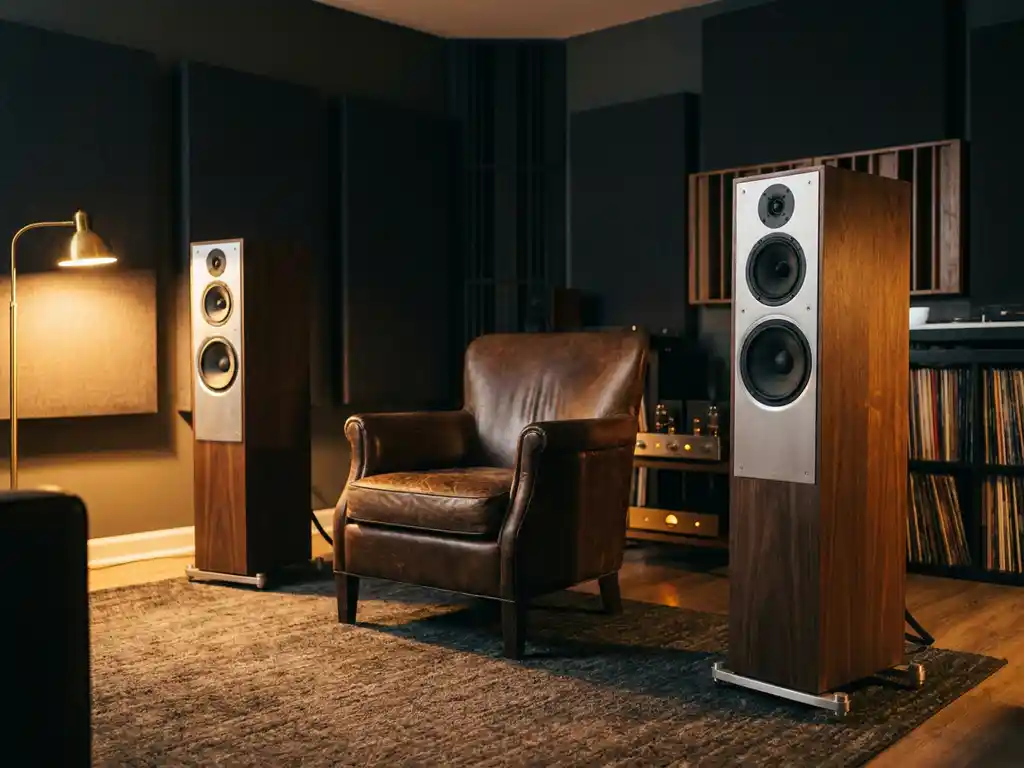
For anyone serious about hi-fi listening, soundstage is one of those concepts that transforms the way you hear music. It is the difference between sound coming from two speakers and sound that surrounds you, places instruments in space, and makes a recording feel alive. Understanding how soundstage works, and how to get the most from it, is essential for any audiophile who wants their system to perform at its best.
What is soundstage in hi-fi audio?
Soundstage in hi-fi audio is the three-dimensional sonic space that a stereo system recreates between and beyond the speakers. It describes the perceived width, depth, and height of a musical performance as reproduced through your system, giving instruments and voices distinct positions in an imaginary acoustic space rather than collapsing everything into a flat line between two loudspeakers.
A well-developed soundstage allows you to hear a violinist positioned to the left, a pianist centered slightly behind, and a double bass further back to the right. This spatial information is encoded in the original recording and unlocked by a system capable of resolving the subtle timing, phase, and level differences between channels. The better the system, the more convincingly it recreates the acoustic environment of the original performance space, whether that is a concert hall, a recording studio, or a jazz club.
Why does soundstage matter to audiophiles?
Soundstage matters to audiophiles because it is central to the emotional realism of a musical performance. A convincing soundstage removes the sense that you are listening to a playback device and replaces it with the sensation of being present at a live event. It is one of the most powerful ways a hi-fi system communicates the humanity and space of recorded music.
When soundstage collapses or sounds congested, music loses its air and dimensionality. Instruments blur together, the sense of space disappears, and the emotional connection weakens. Audiophiles invest heavily in components, room treatment, and speaker placement precisely because a wide, deep, and stable soundstage is one of the clearest signs that a system is performing at a high level. It is not merely a technical benchmark; it is a gateway to a more moving listening experience.
How is soundstage created by a hi-fi system?
Soundstage is created by a hi-fi system through the precise reproduction of spatial cues encoded in a stereo recording. These cues include minute differences in timing, amplitude, and phase between the left and right channels. When a system resolves these differences accurately, the brain interprets them as positional information and constructs a three-dimensional image of the performance.
Every component in the signal chain plays a role. A source component such as a CD player or DAC must extract fine detail without smearing transients. The preamplifier must preserve channel separation and pass the signal without adding noise or coloration. The power amplifier must drive the speakers with control and accuracy. The loudspeakers themselves must radiate sound in a coherent, time-aligned way. When each link in the chain performs its job, the result is a soundstage that feels natural and stable rather than vague or artificially wide.
What factors affect soundstage width and depth?
Soundstage width and depth are affected by speaker placement, room acoustics, component quality, and recording quality. No single factor dominates; all of them interact. A system with excellent electronics will still produce a compressed soundstage in an acoustically poor room, and perfect room treatment cannot fully compensate for a source component that smears fine spatial detail.
The most significant factors include:
- Speaker placement: The distance between speakers, their toe-in angle, and their distance from side and rear walls all shape how wide and deep the soundstage appears. Speakers placed too close to walls suffer from boundary reflections that blur the image.
- Listening position: Sitting at the correct distance to form an equilateral triangle with the speakers is a widely used starting point for achieving a focused center image and natural width.
- Room acoustics: First reflection points on side walls, floors, and ceilings create early reflections that can smear imaging. Absorptive or diffusive treatment at these points significantly improves soundstage clarity.
- Component resolution: High-resolution electronics preserve the low-level detail that carries spatial information. Components that introduce noise or distortion erode the fine cues the brain uses to locate sound in space.
- Recording quality: The soundstage on a recording is ultimately defined by how it was captured and mixed. Some recordings are engineered with exceptional spatial depth; others are deliberately narrow or compressed.
What’s the difference between soundstage and stereo imaging?
Soundstage and stereo imaging are closely related but distinct concepts. Soundstage refers to the overall three-dimensional space a system creates, including its width, depth, and height. Stereo imaging, or audio imaging, refers specifically to the precision and stability with which individual instruments and voices are located within that space. You can have a wide soundstage with poor imaging, or tight imaging within a relatively narrow soundstage.
Think of soundstage as the stage itself and imaging as the placement of performers on it. A large concert hall creates a vast acoustic environment, but individual musicians still need to be clearly positioned within it. In hi-fi terms, a system with excellent soundstage but poor imaging will sound spacious yet diffuse, with instruments seeming to float or shift rather than occupy a stable point in space. The best systems achieve both: a convincing, expansive soundstage populated by precisely located, stable sonic images.
How can you improve soundstage in your listening room?
You can improve soundstage in your listening room by optimizing speaker placement, addressing first reflection points, and ensuring your electronics are resolving enough to convey fine spatial detail. These three areas deliver the most meaningful improvements and can be approached progressively without major investment.
Start with these practical steps:
- Experiment with speaker positioning. Pull speakers away from rear and side walls, try different toe-in angles, and adjust your listening distance. Small changes, even a few centimetres, can noticeably shift soundstage depth and focus.
- Treat first reflection points. Place absorptive panels or diffusers at the points on the side walls where sound from each speaker reflects toward the listening seat. This reduces smearing and allows the direct sound to dominate, sharpening the image.
- Use quality cables and connections. While cables are often debated, poor connections and high-resistance contacts genuinely degrade channel separation and fine detail, both of which matter for imaging.
- Upgrade your source components. The source is where spatial information either survives or is lost. A high-quality DAC or CD player that retrieves fine low-level detail gives the rest of your system something real to work with.
- Minimize vibration and interference. Mechanical vibration in components and electrical interference between units can degrade the subtle cues that create imaging. Use dedicated shelving, proper grounding, and adequate component separation where possible.
How ACCUSTIC ARTS Elevates Your Soundstage
At ACCUSTIC ARTS, we design every component with soundstage and audio imaging in mind. Our engineering philosophy, rooted in decades of work in recording studios and live venues, means we understand exactly what spatial information a recording contains and what it takes to reproduce it faithfully. Our products are built to preserve the fine timing, phase, and amplitude cues that create a convincing, three-dimensional soundstage.
Here is what sets our approach apart:
- Uncompromising component selection: We use only precision, high-grade components across every product line, ensuring that low-level spatial detail survives the entire signal path.
- Rigorous testing: Every unit undergoes individual testing for up to two weeks before dispatch, so you receive electronics that perform exactly as designed, with the channel separation and resolution that soundstage demands.
- Complete signal chain solutions: From CD players and DACs to preamplifiers and power amplifiers, we offer a full range of components engineered to work together and independently at the highest level.
- Real-world acoustic experience: Our development is informed by professional recording and live sound environments, giving us a reference point that purely laboratory-based design cannot replicate.
If you are ready to experience what a truly resolved, emotionally engaging soundstage sounds like, we invite you to explore our full product range or get in touch with us directly. We would love to help you find the right components for your listening room and your music.
—
Disclaimer: This article was created with the assistance of Artificial Intelligence and has been reviewed by our editorial team.
Related Articles
- What Is Oversampling and Does It Improve Sound?
- How do you choose between a monoblock and stereo power amplifier?
- Why is German engineering trusted in high-end audio manufacturing?
- How does power supply quality affect audio component performance?
- What is the difference between accuracy and musicality in hi-fi?