

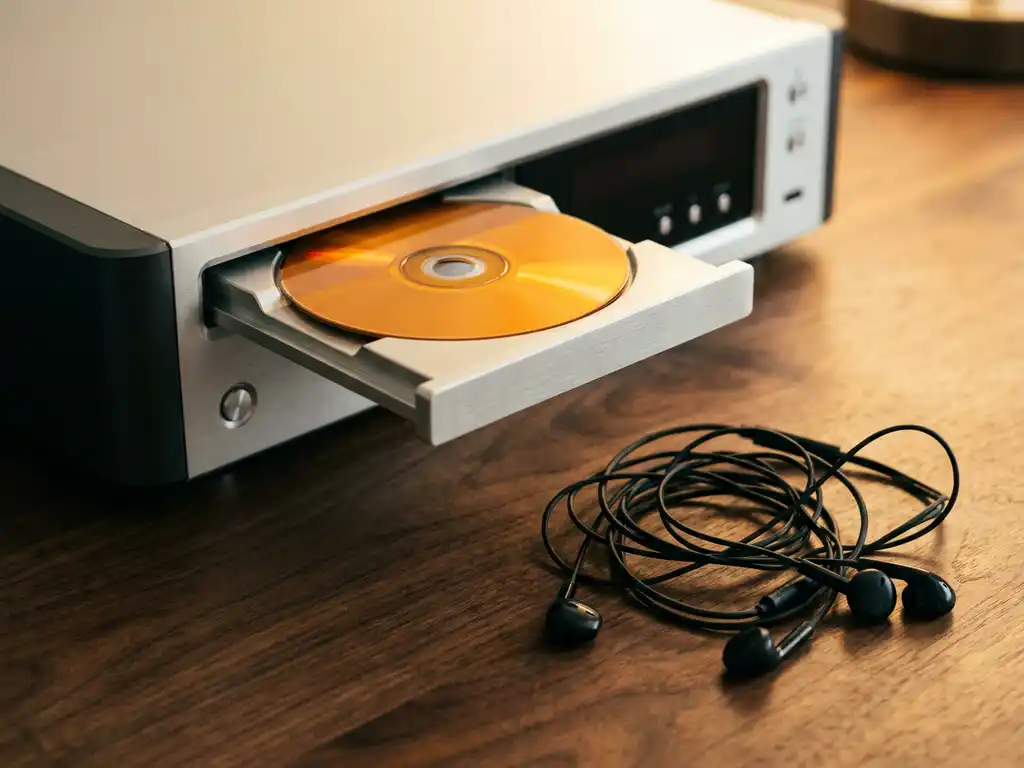
Streaming has transformed how most people listen to music, but among serious audiophiles, the high-end CD player remains a deeply valued source component. The debate between physical media and digital streaming is far from settled in audiophile circles, and for good reason. Understanding why requires a closer look at what actually happens to music during playback, and what separates a genuinely great listening experience from a merely convenient one.
Why do audiophiles still prefer CD players over streaming?
Audiophiles prefer CD players over streaming because the CD format delivers a fixed, lossless digital signal that is immune to network variability, compression artifacts, and server-side processing. The listener has complete control over the playback chain, and the source data itself never changes from one listen to the next. That consistency is fundamental to serious high-fidelity listening.
Streaming services, even those offering lossless tiers, introduce variables that are difficult to control. Network jitter, buffering behavior, and the unpredictable quality of server-side master files all affect what ultimately reaches your DAC. With a CD, the data is fixed on the disc and read locally. There are no subscription changes, no catalog removals, and no sudden shifts in the master version of an album you love. For audiophiles who have spent years building a reference system, that kind of reliability matters enormously. The physical ritual of selecting and playing a disc also encourages focused, intentional listening, which many audiophiles consider inseparable from the experience itself.
Does a CD player actually sound better than streaming?
A high-end CD player can absolutely sound better than streaming, though the comparison depends heavily on the quality of each component in the chain. When a well-engineered CD transport and DAC combination is compared against a streaming service using a budget streamer, the CD almost always wins. At equivalent price points and quality levels, the differences become more nuanced but remain audible to trained ears.
The CD format stores audio at 16-bit/44.1 kHz, which is sufficient to capture the full range of human hearing. The advantage of a dedicated CD player is not necessarily in the raw format specification, but in how precisely that data is read and converted. High-end CD players invest heavily in vibration control, precision laser mechanisms, and sophisticated digital-to-analogue conversion, all of which reduce the noise floor and preserve micro-detail in the music. Streaming, by contrast, adds a layer of network dependency and digital processing that even the best streamers must work to overcome.
What makes a high-end CD player different from a budget one?
A high-end CD player differs from a budget model primarily in the quality of its transport mechanism, power supply design, digital-to-analogue conversion stage, and internal shielding against electrical interference. These are not cosmetic differences. Each element directly affects how accurately the musical signal is retrieved and reproduced.
Budget CD players use mass-produced laser mechanisms with limited vibration damping. Any mechanical resonance during disc reading introduces read errors that the player’s error correction must compensate for, and that compensation, however subtle, affects the integrity of the output. High-end players use precision-machined transports, often with proprietary mechanisms, that retrieve data with far greater accuracy. The power supply in a premium player is typically heavily regulated and separated from the audio circuitry to prevent electrical noise from contaminating the signal. The DAC stage in a high-end unit is designed with audiophile-grade components, careful circuit layout, and often features analogue output stages built around discrete components rather than off-the-shelf integrated circuits. The result is a player that resolves more detail, presents a wider and more stable soundstage, and reproduces the emotional texture of music with greater fidelity.
How does CD playback preserve the original recording?
CD playback preserves the original recording by storing audio as a fixed, lossless digital file that is read optically and converted to analogue without any compression, streaming artifacts, or real-time encoding. The data on a CD is identical every time it is played, meaning the recording as the mastering engineer intended it is what reaches your amplifier.
When a recording is mastered for CD, the engineer works to a specific 16-bit/44.1 kHz standard. That master is then pressed directly onto the disc. Nothing is added, removed, or reprocessed between the studio and your listening room. With audiophile music playback via streaming, the signal path is longer and less predictable. Files may be transcoded, resampled, or processed by the streaming platform before delivery. Even lossless streaming formats pass through server infrastructure and network transmission before reaching the listener. A CD bypasses all of that, delivering a direct, stable representation of the original recording session.
Which is better for an audiophile system: CD or streaming?
For a reference-level audiophile system, CD playback from a high-quality transport and DAC combination typically offers a more controlled and consistent source than streaming. That said, streaming has a legitimate place in an audiophile setup, particularly for discovery, convenience, and access to recordings not available on physical media. The two approaches are not mutually exclusive.
The practical answer depends on your priorities. If sonic accuracy and the integrity of the source signal are paramount, a dedicated high-end CD player remains the more reliable choice. The signal path is shorter, the data is fixed, and there is no dependency on external infrastructure. If breadth of catalog and ease of access matter more, a high-quality streaming setup using a dedicated network streamer and an outboard DAC can perform impressively. Many serious audiophiles maintain both, using their CD collection as their primary listening format and streaming as a secondary tool for exploration. The key insight is that in a high-end system, the source component is never an afterthought. Whether you choose CD or streaming, the quality of the hardware doing the work defines the ceiling of what your system can achieve.
What should audiophiles look for when choosing a CD player?
When choosing an audiophile CD player, the most important factors are the quality of the transport mechanism, the design of the DAC stage, power supply isolation, and build quality. Beyond specifications, the player should be evaluated by listening, because the way a component handles the analogue output stage and manages noise has a direct impact on how music feels, not just how it measures.
Here are the key considerations to guide your decision:
- Transport quality: Look for a player with a precision-engineered laser mechanism and effective vibration isolation. The transport is where data retrieval begins, and its accuracy shapes everything downstream.
- DAC implementation: A dedicated, high-quality DAC stage with discrete analogue output components will outperform a player that relies on generic integrated circuits.
- Power supply design: Separate, regulated power supplies for the digital and analogue sections reduce interference and lower the noise floor significantly.
- Build and shielding: Heavy chassis construction and internal shielding protect sensitive circuitry from electromagnetic interference, which is audible in lesser designs.
- Connectivity: Consider whether you want the option to use the player as a transport feeding an external DAC. Many high-end players offer digital outputs for this purpose.
- Brand heritage and testing standards: A manufacturer’s commitment to quality control, including extended burn-in and testing periods before dispatch, is a meaningful indicator of long-term reliability and sonic consistency.
Listening before buying is always advisable. A CD player at this level is a long-term investment, and the right choice is the one that connects you most directly to the music you love.
How Accustic Arts elevates your CD listening experience
We at Accustic Arts have spent decades engineering CD players and source components that reflect our core belief: music should be reproduced with absolute fidelity, not approximated. Our approach to high-end CD playback is built on a set of uncompromising principles that directly address everything audiophiles care about most.
- Precision transport mechanisms: Our CD players use carefully selected, high-tolerance laser transports with extensive vibration control to ensure the most accurate data retrieval possible.
- Reference-grade DAC stages: We design our digital-to-analogue conversion around audiophile-grade components and discrete analogue output stages, preserving the emotional texture and micro-detail of every recording.
- Rigorous quality testing: Every component we produce undergoes individual testing that can last up to two weeks before it leaves our facility in Lauffen am Neckar. That is not a marketing claim, it is a standard we hold ourselves to without exception.
- German engineering heritage: Our products are built on over two decades of development informed by real-world experience in recording studios and professional audio environments, giving us a perspective on musical accuracy that goes beyond the listening room.
- Emotionally engaging sound: Our signature midrange reproduction has earned recognition from publications including The Absolute Sound, and it reflects our philosophy that great audio is not just technically correct, it is musically moving.
If you are ready to experience what a truly high-end CD player can do for your system, we invite you to get in touch with us or explore our full range of source components and amplification on our products page. Your music deserves nothing less than the most faithful reproduction possible.
—
Disclaimer: This article was created with the assistance of Artificial Intelligence and has been reviewed by our editorial team.