

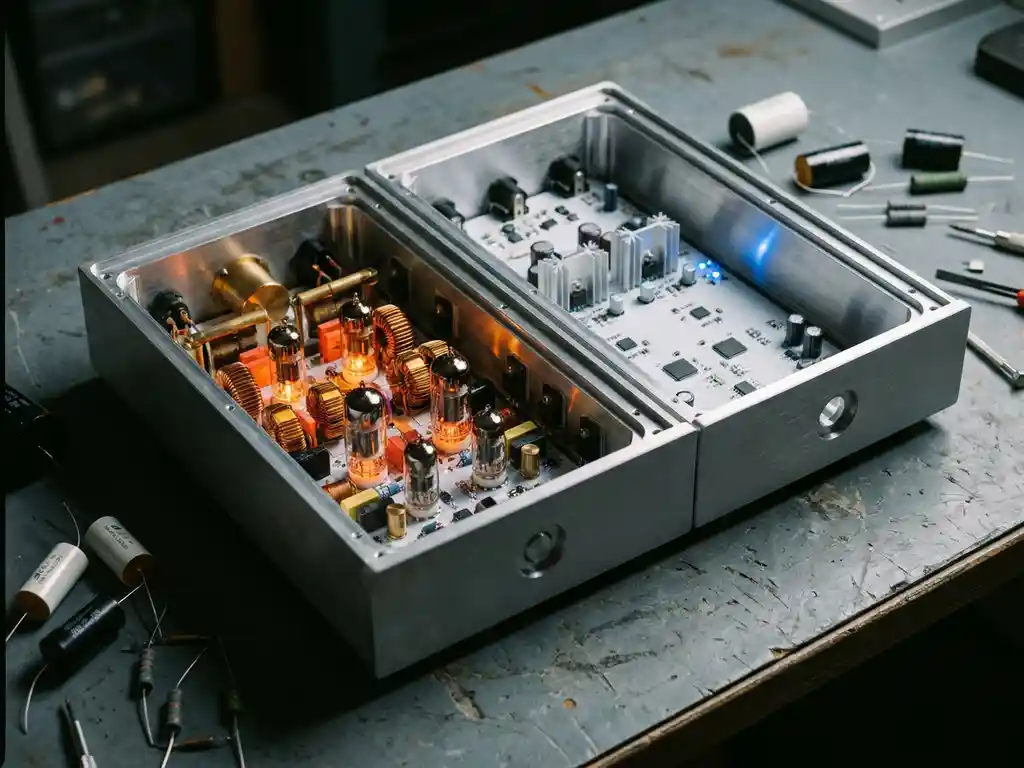
A Class AB amplifier is a circuit design that combines elements of both Class A and Class B operation, switching between the two modes depending on the signal level. At low power, it behaves like a Class A amplifier for smooth, linear reproduction. At higher power, it transitions into Class B territory to improve efficiency. The result is a practical middle ground that delivers good sound quality without the heat and energy demands of pure Class A designs. This article walks through how Class AB works, how it compares to Class A, and which might be the right choice for your listening setup.
How does a Class AB amplifier actually work?
A Class AB amplifier works by keeping both output transistors conducting for a small overlap period beyond their individual half-cycles. This overlap, called the quiescent bias current, is deliberately set to eliminate the crossover distortion that plagues pure Class B designs, while allowing the amplifier to reduce power consumption compared to Class A. The transistors share the workload across the signal waveform rather than one device handling everything at all times.
In practice, the output stage is biased so that both transistors are slightly “on” even when no signal is present. When a signal arrives, the positive half-cycle drives one transistor and the negative half-cycle drives the other, with a brief handover period where both are active simultaneously. This handover is what gives Class AB its name: it operates in Class A during that small overlap, and in Class B for the rest of the waveform. The width of the bias window can be tuned by the designer, and this decision has a direct influence on both the sonic character and the thermal behavior of the amplifier.
What are the main differences between Class A and Class AB amplifiers?
The key difference between Class A and Class AB amplifiers lies in how the output transistors conduct. In a Class A amplifier, one or more output devices conduct continuously for the full 360 degrees of the signal cycle. In a Class AB amplifier, each output device handles roughly half the cycle with a small overlap. This fundamental difference drives everything else: efficiency, heat, cost, and ultimately, sound character.
- Efficiency: Class A amplifiers are notoriously inefficient, converting as little as 25% of drawn power into audio output. Class AB designs typically achieve 50 to 70% efficiency, which translates directly into less wasted heat and lower running costs.
- Heat output: A Class A amplifier runs hot all the time, even at idle, because its output stage is always fully conducting. Class AB amplifiers run cooler at rest and only generate significant heat under load.
- Distortion profile: Class A operation produces very low distortion, particularly at low signal levels, because there is no crossover point between transistors. Class AB introduces a small amount of crossover distortion, though well-designed circuits reduce this to inaudible levels.
- Cost and size: Because Class A amplifiers waste so much energy as heat, they require larger power supplies, heavier heatsinks, and more robust components. Class AB designs can achieve similar output power in a more compact and affordable package.
Which sounds better: Class A or Class AB?
Class A amplifiers are widely regarded as having a sonic edge at low to moderate listening levels, particularly in terms of midrange smoothness and the absence of crossover distortion artifacts. However, the real-world difference between a well-engineered Class AB amplifier and a Class A design is far smaller than the theory suggests, and many listeners cannot reliably distinguish between them in blind listening tests.
The honest answer is that implementation matters far more than amplifier class. A poorly designed Class A amplifier will sound worse than an excellently engineered Class AB design. Factors such as power supply quality, component selection, output stage topology, and overall circuit layout all have a greater influence on the listening experience than the operating class alone. That said, audiophiles with highly revealing speaker systems and a preference for low-level late-night listening often gravitate toward Class A for its effortless character at quiet volumes.
Why do high-end amplifiers often run Class A at low power?
Many high-end amplifiers are designed to operate in pure Class A up to a certain power threshold, often between 5 and 30 watts, and then transition into Class AB for higher output levels. This approach is called Class A biased or high-bias Class AB, and it is a deliberate engineering choice to capture the sonic benefits of Class A where they matter most, while maintaining practical efficiency at higher volumes.
The reasoning is straightforward: most music, most of the time, is reproduced at relatively low power levels. Peaks and dynamic transients may demand more, but the majority of the listening experience sits well within the Class A window. By setting the bias point high enough to keep the amplifier in Class A for typical listening levels, designers deliver the smooth, distortion-free character of Class A without the extreme heat and energy consumption of a full Class A design. This is a common approach in reference-grade high-end audio amplifiers where sonic performance at realistic listening volumes is the primary goal.
What are the practical trade-offs of choosing Class AB?
Choosing a Class AB amplifier means accepting a small theoretical compromise in distortion purity in exchange for significant practical advantages. For most listeners, these trade-offs strongly favor Class AB in everyday use.
- Cooler operation: Class AB amplifiers are far less demanding on ventilation and placement. You do not need to keep them away from shelving or worry about heat affecting nearby components.
- Lower running costs: Because Class AB is more efficient, it draws less power from the wall for the same audio output. Over years of use, this adds up.
- Greater output power: Class AB designs can deliver higher sustained power output without the thermal constraints that limit Class A amplifiers.
- Crossover distortion risk: The one genuine weakness is crossover distortion if the bias is set too conservatively. In quality designs, this is effectively eliminated through careful biasing and feedback strategies.
- Faster warm-up: Class A amplifiers often need extended warm-up time before they reach their optimal operating temperature. Class AB designs typically perform well much sooner after switch-on.
Should you choose a Class A or Class AB amplifier for your system?
For most audiophiles, a well-engineered Class AB amplifier, particularly one biased heavily toward Class A at typical listening levels, offers the best balance of sonic quality, practicality, and long-term reliability. Pure Class A makes sense when you listen at moderate volumes in a controlled environment, value absolute midrange smoothness above all else, and are comfortable with the heat and energy demands. Class AB is the better choice when output power, room temperature, or running costs are meaningful considerations.
The most important question is not which class the amplifier belongs to, but how well it has been designed and built. Amplifier class is one variable among many. The quality of the power supply, the precision of the output stage, the matching of components, and the care taken during manufacturing all shape the final sound far more than the operating class label alone. When evaluating any amplifier, listen critically, consider the full engineering picture, and prioritize measured performance and build quality over theoretical classifications.
How Accustic Arts approaches amplifier design
At Accustic Arts, we do not treat amplifier class as a marketing shortcut. Our amplifier designs are built around the principle of Absolute Sound Fidelity Through Reproduction, which means every engineering decision, including operating class, bias point, and output stage topology, is made in service of authentic, emotionally engaging sound rather than specification sheet performance.
Here is what sets our approach apart:
- Precision component selection: We use only high-grade components chosen for their measured performance and long-term reliability, not their cost or convenience.
- Rigorous testing: Every amplifier passes through an individual product test that can last up to two weeks before it leaves our facility in Lauffen am Neckar, Germany.
- Real-world listening experience: Our development draws on decades of work in recording studios and professional live sound environments, so our amplifiers are tuned to reproduce music as it was intended to be heard.
- Emotionally engaging midrange: Our signature sonic character, a natural, detailed midrange that lets emotion through without artificial warmth, is the result of deliberate engineering choices across every stage of the circuit.
Whether you are building your first reference system or refining an established setup, we would love to help you find the right amplifier for your listening goals. Get in touch with us to discuss your system and explore which Accustic Arts component belongs at its heart.