

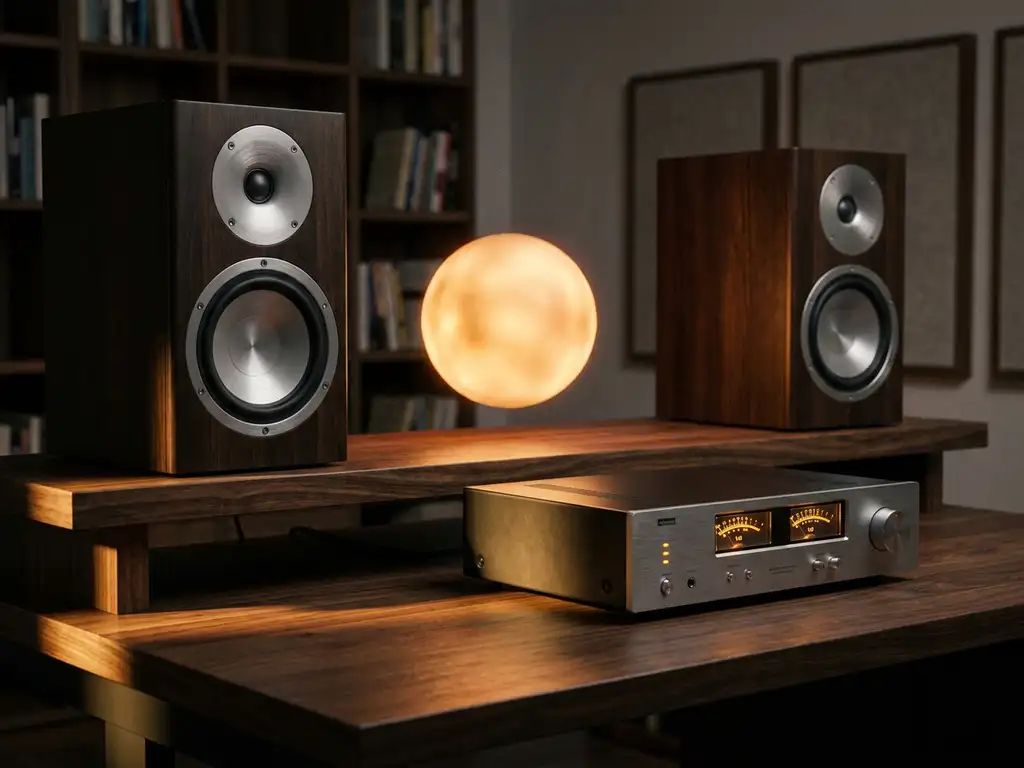
If you have ever closed your eyes during a piece of music and felt like you could pinpoint exactly where each instrument was sitting in the room, you have experienced great audio imaging. It is one of those qualities that separates a truly involving listening session from simply having sound playing in the background. Whether you are new to hi-fi or a seasoned audiophile looking to fine-tune your setup, understanding stereo imaging is one of the most rewarding steps you can take toward a more emotionally engaging musical experience.
What is imaging in audio?
Audio imaging is a stereo system’s ability to place individual sounds, instruments, and voices at precise, stable locations within the listening space. When imaging is strong, you can close your eyes and point to where the guitarist is standing, where the vocalist is positioned, and how far back the drummer sits. Imaging is about specificity, focus, and the convincing illusion of real performers occupying real space.
Good stereo imaging depends on the accurate reproduction of the subtle timing and level differences between your left and right speakers. Your ears and brain use these tiny cues to locate sounds in everyday life, and a well-designed audio system recreates them faithfully. The result is a three-dimensional sonic picture that feels natural rather than flat or vague. Poor imaging, by contrast, makes music feel smeared, congested, or locked to the speakers themselves rather than floating freely between and beyond them.
Why does imaging matter for high-end audio?
Imaging matters for high-end audio because it is central to the emotional realism of a recording. A system with strong imaging does not just play music accurately in terms of frequency response; it recreates the spatial relationships of a live performance, allowing you to feel present in the recording venue. This is what transforms listening from a passive activity into an immersive experience.
For audiophiles who invest in reference-grade components, imaging is often the quality that reveals the true capability of their equipment. A system that images well communicates the intent of the recording engineer, the acoustic character of the studio or concert hall, and the physical presence of each performer. It is also one of the most immediate ways to hear improvements when you upgrade a component, change your speaker placement, or swap cables. When imaging snaps into focus, the entire musical presentation becomes more believable and more moving.
What’s the difference between imaging and soundstage?
Imaging and soundstage are closely related but describe different aspects of a stereo system’s spatial performance. Imaging refers to the precision and stability of individual sound sources within the stereo field — how sharply and convincingly each instrument or voice is placed. Soundstage refers to the overall size and shape of the perceived listening space — how wide, deep, and tall the sonic picture appears.
Think of soundstage as the stage itself and imaging as the performers standing on it. A system can have a wide, expansive soundstage but poor imaging if instruments blur into one another without clear separation. Conversely, a system might image with pinpoint accuracy but present a narrow or shallow soundstage. The ideal is both: a generous, believable soundstage filled with precisely located, stable images. Soundstage and imaging, when both qualities work together, are what give you the sensation of sitting in the best seat of a concert hall.
What causes poor imaging in a stereo system?
Poor imaging in a stereo system is most commonly caused by speaker placement problems, acoustic reflections, mismatched components, or low-quality source equipment. Any factor that corrupts the precise timing and level relationships between channels will degrade the clarity and focus of the stereo image.
The most frequent culprits include:
- Asymmetric speaker placement: If one speaker is closer to a wall or a reflective surface, early reflections arrive at different times from each side, smearing the image.
- Poor room acoustics: Bare, parallel walls create strong reflections that compete with the direct sound and blur stereo positioning.
- Phase issues: Incorrectly wired speaker cables (swapping positive and negative on one channel) collapse the stereo image almost entirely.
- Low-quality or mismatched electronics: Preamplifiers and amplifiers that add noise, distortion, or channel imbalance directly compromise imaging precision.
- Poor source material or conversion: Compressed digital files or low-quality D/A conversion lose the fine detail that imaging depends on.
Addressing even one of these factors can produce a noticeable improvement in how focused and stable your speaker imaging becomes.
How does speaker placement affect audio imaging?
Speaker placement has a greater effect on audio imaging than almost any other variable in a hi-fi system. The geometry of your speakers relative to your listening position determines whether the stereo image is focused and stable or vague and wandering. Small adjustments in position can produce dramatic changes in imaging quality.
The equilateral triangle rule
A widely trusted starting point is to form an equilateral triangle between your two speakers and your listening seat. Each speaker should be the same distance from you as the two speakers are from each other. This geometry ensures that the timing relationships between channels are symmetrical, which is the foundation of good stereo imaging.
Toe-in and its effect on focus
Angling your speakers inward toward the listening position, known as toe-in, sharpens the focus of the central image and improves instrument separation. Too little toe-in can make the image feel wide but diffuse; too much can make it feel narrow and artificially pinched. Experiment gradually, listening for the point where voices and solo instruments lock into a stable, three-dimensional position between the speakers.
Distance from walls
Pulling speakers away from the rear wall reduces bass reinforcement and, crucially, reduces early reflections that blur imaging. Even gaining an extra 30 to 50 centimetres of clearance can noticeably tighten the stereo image. Side wall distance should also be symmetrical to keep both channels acoustically balanced.
How can you improve imaging in your hi-fi system?
Improving hi-fi imaging involves a combination of physical setup, acoustic treatment, and component quality. The good news is that many of the most effective steps cost little or nothing, and the gains can be substantial.
Start with these practical steps:
- Check speaker polarity: Confirm that both speakers are wired with matching polarity. A single reversed connection will collapse your stereo image immediately.
- Optimize speaker placement: Use the equilateral triangle as a starting point, then experiment with toe-in and distance from walls as described above.
- Treat your room: Add soft furnishings, rugs, or purpose-built acoustic panels to reduce early reflections, particularly on the side walls at the first reflection points.
- Upgrade your source quality: High-resolution audio files and a quality D/A converter preserve the fine spatial information that imaging depends on.
- Invest in low-noise electronics: Preamplifiers and amplifiers with low distortion and excellent channel separation allow the imaging information in your recordings to pass through cleanly.
- Use quality interconnects and speaker cables: While cables are not a substitute for good electronics, well-shielded, matched-length speaker cables support consistent channel performance.
Improving your listening position can also make a meaningful difference. Sitting too close to a rear wall introduces bass buildup and reflections that muddy the image. A slight forward shift in your chair can sometimes clarify the entire soundstage without touching the speakers at all. Explore our full range of high-end audio components to see how the right electronics can elevate every aspect of your system’s performance.
How Accustic Arts Elevates Your Stereo Imaging
At Accustic Arts, we understand that imaging is not a feature you can bolt on — it is the result of precision at every stage of the signal chain. Our components are engineered from the ground up to preserve the exact timing, phase, and channel balance that stereo imaging depends on. Here is how we deliver that precision:
- Elaborate quality testing: Every component undergoes individual testing for up to two weeks before it leaves our facility, ensuring that channel matching and noise performance meet the exacting standards that imaging requires.
- High-grade component selection: We use only precise, high-grade parts across every product line, from our preamplifiers to our D/A converters, so that fine spatial detail in recordings is never lost in the electronics.
- Studio-informed engineering: Our development draws on real-world experience from recording studios and live PA environments, which means we build components that reveal what was actually captured in the recording, including its spatial character.
- Emotionally engaging midrange reproduction: Our signature midrange performance is the quality that brings vocalists and lead instruments into sharp, believable focus — the heart of convincing stereo imaging.
- Complete signal chain coverage: From source to amplification, our product range covers every link in the chain, allowing you to build a system where every component is optimized to work together.
If you are ready to experience what truly precise, emotionally involving imaging feels like, we would love to help you find the right components for your system. Get in touch with us and let us guide you toward the listening experience your music deserves.
—
Disclaimer: This article was created with the assistance of Artificial Intelligence and has been reviewed by our editorial team.