

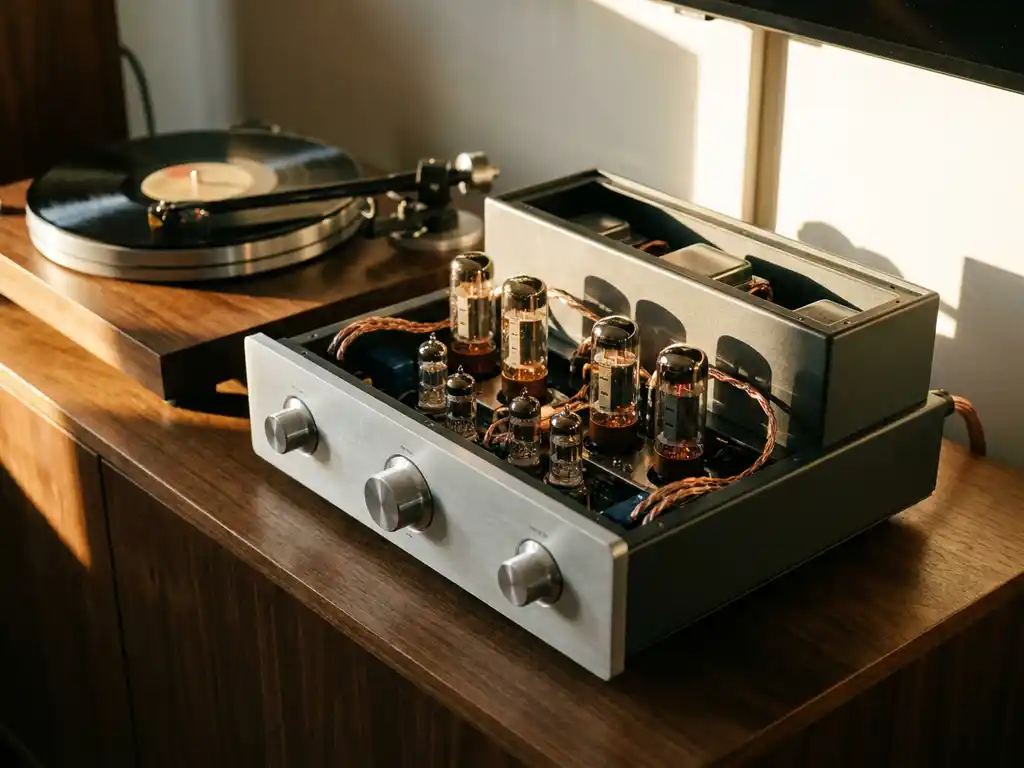
There is a moment in every audiophile’s journey when a piece of music stops being background noise and starts feeling like a live event happening in the room. That shift is not accidental. It is the result of owning a resolving audio system — one that retrieves enough musical information to make the difference between a recording and a performance feel genuinely small. If you have ever wondered whether your hi-fi system is truly resolving, the questions below will help you find out.
What does it mean for an audio system to be truly resolving?
A truly resolving audio system is one that accurately retrieves and reproduces the fine detail embedded in a recording — including subtle tonal textures, spatial cues, dynamic micro-contrasts, and the natural decay of instruments — without adding coloration, compressing information, or losing low-level signals in the noise floor.
Resolution in audio is not simply about clarity or loudness. It is about the system’s ability to separate and present layers of musical information in a way that mirrors what was captured at the source. A resolving system lets you hear the breath before a vocal phrase, the room ambience around an acoustic guitar, and the difference in weight between a pianist’s soft and firm keystrokes. These are not audiophile luxuries — they are the details that make music emotionally convincing. Sound fidelity at this level requires every component in the chain to perform without bottlenecking the signal, which is why system-level thinking matters as much as individual component quality.
What are the key signs your system is resolving?
The clearest signs that your hi-fi system is resolving include the ability to hear distinct instrument placement within a soundstage, audible differences between recordings and masterings of the same track, natural decay and reverb tails on acoustic instruments, and low-level detail that remains intelligible even at quiet listening volumes.
Here is what to listen for specifically:
- Layered soundstage depth: Instruments occupy distinct positions in three-dimensional space rather than collapsing into a flat wall of sound.
- Tonal individuality: Two violins in an ensemble sound like two different instruments, not a single blended texture.
- Dynamic nuance: A performer’s subtle shifts in intensity come through clearly, not just the loud-to-soft extremes.
- Silence between notes: The space around musical events is as informative as the events themselves.
- Recording differences: You can tell immediately when switching between a well-engineered and a poorly mastered album.
If your system sounds pleasant but every album sounds roughly the same, that is a strong indicator that resolution is being compromised somewhere in the chain.
How does a resolving system differ from one that just sounds loud or bright?
A resolving system retrieves genuine musical information, while a loud or bright system simply emphasizes certain frequency ranges — typically the upper midrange and treble — to create the illusion of detail. The difference becomes obvious on complex material: a bright system sounds fatiguing and harsh, while a resolving system sounds effortless and natural regardless of volume.
Brightness is often mistaken for resolution because it makes cymbals shimmer and voices sound more present. But that perceived clarity comes at a cost. High-frequency emphasis masks midrange nuance and compresses dynamic gradients, making everything sound similarly energetic. A genuinely resolving system, by contrast, presents detail across the full frequency spectrum — including the warmth and body of the midrange, which is where most musical emotion lives. This is why audiophile sound quality is measured not by how impressive a system sounds on a single impressive track, but by how accurately it handles everything from a solo cello to a full orchestral climax.
Which component in your system limits resolution the most?
The component that most limits resolution is almost always the weakest link in the signal chain — and that is typically the source component or the digital-to-analogue converter (DAC). If the source cannot retrieve the information, no downstream component can recover it. However, the preamplifier and interconnects also play a significant role in preserving or degrading fine detail.
Think of the signal chain as a pipeline. The source — whether a CD transport, streaming device, or turntable — determines how much musical information enters the system. The DAC converts that data into an analogue signal, and any imprecision here introduces noise or smearing that cannot be corrected later. The preamplifier then controls gain and routing; a preamplifier with a high noise floor or poor channel matching will obscure low-level detail. Power amplifiers and loudspeakers add their own coloration, but they can only work with what they receive.
The practical implication is that upgrading your loudspeakers while leaving a mediocre source in place will rarely deliver the improvement you expect. Improving the source first tends to produce the most dramatic gains in overall hi-fi system performance.
How can you test your system’s resolution at home?
You can test your system’s resolution at home by using familiar recordings with known acoustic characteristics, listening specifically for low-level detail, soundstage depth, and tonal individuality between instruments. A well-recorded acoustic or classical album is the most revealing test material available.
Follow these practical steps:
- Choose a reference recording: Select an album you know well, ideally one recorded live or in an acoustic space with natural reverb. Acoustic jazz, classical chamber music, and solo vocal recordings are particularly revealing.
- Listen at moderate volume: Resolving systems do not need high volume to reveal detail. If you need to turn it up to hear nuance, the system is masking low-level information.
- Focus on decay and space: After a piano note or plucked string, listen to how long the sound sustains and how it fades into the room. A resolving system makes this decay audible and natural.
- Compare two recordings of the same piece: A resolving system will make the differences between two performances or masterings immediately obvious.
- Listen in silence: Ambient noise in your room competes with low-level detail. Even modest acoustic treatment or listening at night can reveal how much your system is actually retrieving.
You can also explore the full range of high-end audio components to understand what reference-level resolution looks like from a hardware perspective, which helps calibrate your expectations when evaluating your own system.
When should you upgrade to improve your system’s resolution?
You should consider upgrading to improve resolution when your system consistently obscures low-level detail, when all recordings sound tonally similar, or when you have already optimized your room acoustics and cabling and still feel that musical nuance is missing. Upgrades are most worthwhile when the limiting component is clearly identified.
Before investing in new hardware, it is worth ruling out environmental factors. Room acoustics, vibration from nearby surfaces, and poor power quality are all capable of degrading resolution in ways that mimic component limitations. Addressing these first is both cost-effective and revealing — sometimes the system is more capable than the environment allows it to demonstrate.
When hardware is genuinely the constraint, upgrade in order of signal priority: source and DAC first, then preamplifier, then amplification, and finally loudspeakers. Each step should produce a noticeable improvement in the qualities described earlier — soundstage depth, tonal individuality, and dynamic nuance. If an upgrade does not make those qualities more apparent, the limiting factor may lie elsewhere in the chain.
How Accustic Arts Elevates Your System’s Resolution
We at Accustic Arts have built our entire product philosophy around the principle of Absolute Sound Fidelity Through Reproduction. Every component we design is engineered to preserve and reveal the full resolution of your music rather than add coloration or mask detail. Here is how we approach this concretely:
- Precision component selection: We use only high-grade, carefully matched components across every product line, minimizing noise and signal degradation at every stage of the chain.
- Rigorous testing: Each product undergoes an individual test process lasting up to two weeks before it leaves our facility in Lauffen am Neckar. This ensures that every unit performs to its full resolution potential.
- Complete signal chain coverage: From DACs and CD players to preamplifiers, integrated amplifiers, power amplifiers, and monoblock configurations, we offer every component needed to build a fully resolving system without compromise.
- Studio-informed engineering: Our experience in professional recording studios and live PA environments means our products are calibrated to the standard of how music is actually made, not how it is often reproduced.
- Emotionally engaging midrange: Our signature achievement is a midrange reproduction that communicates the emotional truth of a performance, which is where genuine resolution reveals itself most powerfully.
If you are ready to hear what your music collection truly contains, we invite you to get in touch with us to discuss which components best address the resolution limits in your current system. Genuine audio resolution is not a luxury — it is the standard every music lover deserves.
—
Disclaimer: This article was created with the assistance of Artificial Intelligence and has been reviewed by our editorial team.