

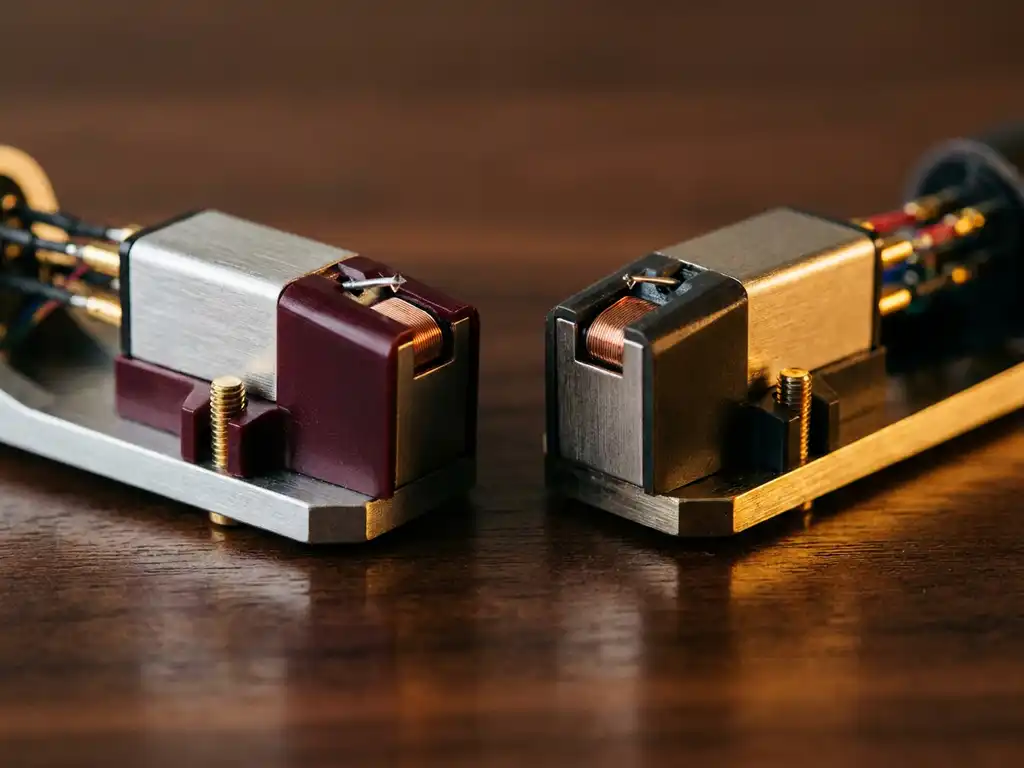
Vinyl playback is a beautifully tactile experience, and at the heart of it all sits a remarkably small but critically important component: the phono cartridge. Whether you are just stepping into the world of analog audio or refining a system that already sounds exceptional, understanding the difference between a moving coil cartridge and a moving magnet cartridge is one of the most meaningful decisions a vinyl enthusiast can make. The choice shapes not only how your records sound, but how your entire system needs to be configured.
Both MC and MM cartridges trace groove information from a record and convert it into an electrical signal, but they do so through fundamentally different mechanisms, each with its own sonic character, compatibility requirements, and ownership experience. Getting familiar with these differences helps make sense of why audiophiles feel so passionately about their preferred approach to vinyl playback.
How each cartridge type converts groove to signal
At its core, a phono cartridge is a miniature generator. A stylus traces the physical undulations pressed into a vinyl groove, and the cartridge translates that mechanical motion into a tiny electrical voltage that your system can amplify and reproduce as sound.
In a moving magnet cartridge, a small magnet is attached to the cantilever (the thin arm that holds the stylus). As the stylus moves, the magnet moves within a fixed coil of wire, generating a voltage. Because the coil is stationary and can be wound with many turns of wire, the output voltage is relatively high, typically between 2.5 and 5 millivolts. In a moving coil cartridge, the design is inverted: a tiny, lightweight coil is attached to the cantilever and moves within a fixed magnetic field. This approach allows the moving assembly to be far lighter, responding to groove modulations with greater speed and precision, but it produces a much lower output, often between 0.2 and 0.6 millivolts.
That difference in moving mass is the technical foundation for much of what separates the two cartridge types in practice. A lighter moving assembly tracks groove detail more faithfully and reacts faster to transient information, which is why MC designs are often favored in reference-level systems.
Sound character: MC vs. MM compared
Understanding the sonic differences between these two cartridge designs helps clarify why audiophiles develop such strong preferences, and why neither approach is universally superior.
Moving magnet cartridges are often described as warm, full-bodied, and musically engaging. Their slightly higher output and the physical characteristics of the moving magnet assembly tend to produce a sound that is forgiving, spacious, and easy to enjoy across a wide range of music. For listeners who value a relaxed, natural presentation, a quality MM cartridge can be deeply satisfying.
Moving coil cartridges, by contrast, are frequently praised for their resolution, speed, and three-dimensional soundstaging. The reduced moving mass allows them to track high-frequency groove information with greater accuracy, often revealing fine detail in recordings that MM designs smooth over. Midrange reproduction in particular benefits from the MC design’s agility, a quality that resonates strongly with listeners who want to feel genuinely connected to the music rather than simply hear it. That said, the finest MM cartridges from reputable manufacturers can hold their own against entry-level MC designs, so price and build quality matter as much as the underlying technology.
Phono stage compatibility and setup requirements
One of the most practical distinctions between MC and MM cartridges is the phono stage they require. Because a moving magnet cartridge produces a higher output, it works with any standard MM phono input, which applies a fixed 47-kilohm load impedance and the RIAA equalization curve needed for vinyl playback. This makes MM cartridges broadly compatible and straightforward to set up.
A moving coil cartridge’s lower output demands significantly more gain from the phono stage, and the loading requirements vary considerably between MC models. Some MC cartridges are described as “high-output MC,” producing enough voltage to work with a standard MM phono stage, but true low-output MC designs require either a dedicated MC phono stage or a step-up transformer (SUT) to boost the signal before it reaches the phono input. Matching the cartridge’s recommended load impedance to the phono stage is an important step that affects both tonal balance and dynamic performance.
For anyone building or upgrading a high-end audio system around vinyl, investing in a phono stage that handles both MM and MC inputs provides the flexibility to explore both cartridge families without replacing equipment. Many serious listeners find that the phono stage is as influential on the final sound as the cartridge itself, making it a component worth careful consideration. Exploring a range of high-end electronics designed with analog sources in mind can be a revealing exercise.
Stylus replacement, maintenance, and long-term ownership
Beyond sound quality and compatibility, the practical realities of ownership differ meaningfully between the two cartridge types, and these factors matter over the long term.
Moving magnet cartridges offer a clear advantage here: the stylus is user-replaceable. When the stylus wears out after several hundred hours of playback, the owner simply removes it and fits a new one, often at a fraction of the original cartridge cost. This makes MM designs more economical to maintain and less stressful to use daily.
Moving coil cartridges are built as a single integrated unit, and the stylus cannot be swapped at home. When the stylus wears, the entire cartridge must be returned to the manufacturer or a specialist for retipping or replacement. This is a more involved and typically more expensive process, though many audiophiles regard it as worthwhile given the sonic rewards. Some manufacturers offer retipping services that restore a beloved MC cartridge to its original performance, and building a relationship with a specialist is simply part of the MC ownership experience.
Regular stylus cleaning, correct tracking force, and proper tonearm alignment extend the life of any turntable cartridge significantly. These habits are good practice regardless of which technology sits at the end of the tonearm.
Choosing the right cartridge for your system
The best cartridge is the one that fits the system it lives in and the music it will be asked to play. Several factors are worth weighing before committing to either an MC or MM design.
- Phono stage capability: Confirm whether the existing phono stage supports MC loading and provides adequate gain. If not, factor the cost of an upgrade or step-up transformer into the decision.
- Tonearm compatibility: MC cartridges, being lighter and more compliant in some designs, pair best with tonearms of appropriate effective mass. Mismatched tonearm and cartridge compliance can cause resonance issues that undermine the investment.
- Budget across the whole chain: A high-quality MM cartridge in a well-matched system often outperforms a budget MC in a poorly configured one. Spending wisely across the signal chain matters more than chasing a specific technology.
- Listening priorities: Those drawn to resolution, air, and fine detail often gravitate toward MC designs. Those who prioritize warmth, body, and ease of ownership frequently find MM cartridges deeply satisfying.
- Practical lifestyle factors: If the turntable sees heavy daily use or is shared among family members, the easier maintenance of an MM design may be the more sensible long-term choice.
Neither technology is inherently superior. Both have produced legendary cartridges that have moved audiophiles to tears over decades of vinyl listening. The goal is alignment: a cartridge that works with the phono stage, suits the tonearm, and connects emotionally with the music being played.
How Accustic Arts supports your vinyl listening experience
We at Accustic Arts understand that a phono cartridge does not exist in isolation. Its performance is shaped by every component in the signal chain, and our electronics are designed with exactly that philosophy in mind. Matching a carefully chosen cartridge to a phono stage and amplification built for accuracy and emotional transparency is where the real magic happens.
Here is how we can help:
- Phono stage compatibility: Our electronics are engineered to extract the full potential of both MM and MC cartridges, with precise gain structures and loading options that honor the cartridge designer’s intentions.
- Signal path integrity: Every component in our lineup is built to preserve the delicate signal from a phono cartridge without coloration or compromise, reflecting our core philosophy of Absolute Sound Fidelity Through Reproduction.
- German engineering precision: Each product undergoes individual testing lasting up to two weeks before leaving our facility, ensuring that what reaches the listener performs exactly as intended.
- Expert guidance: Choosing between MC and MM, or matching a cartridge to a phono stage, involves nuanced decisions. Our team is available to help navigate those choices for any system configuration.
If you are ready to explore electronics that honor every detail a great cartridge can reveal, browse our full product range or get in touch with us directly. We are happy to help build a system that makes every record feel like a live performance.
Related Articles
- How does bass management impact the overall sound of a system?
- What is jitter in digital audio and how does it degrade sound?
- How do you balance sound accuracy with emotional engagement?
- How do audiophiles evaluate a component before buying in 2026?
- What is dynamic range and how does it shape the listening experience?