

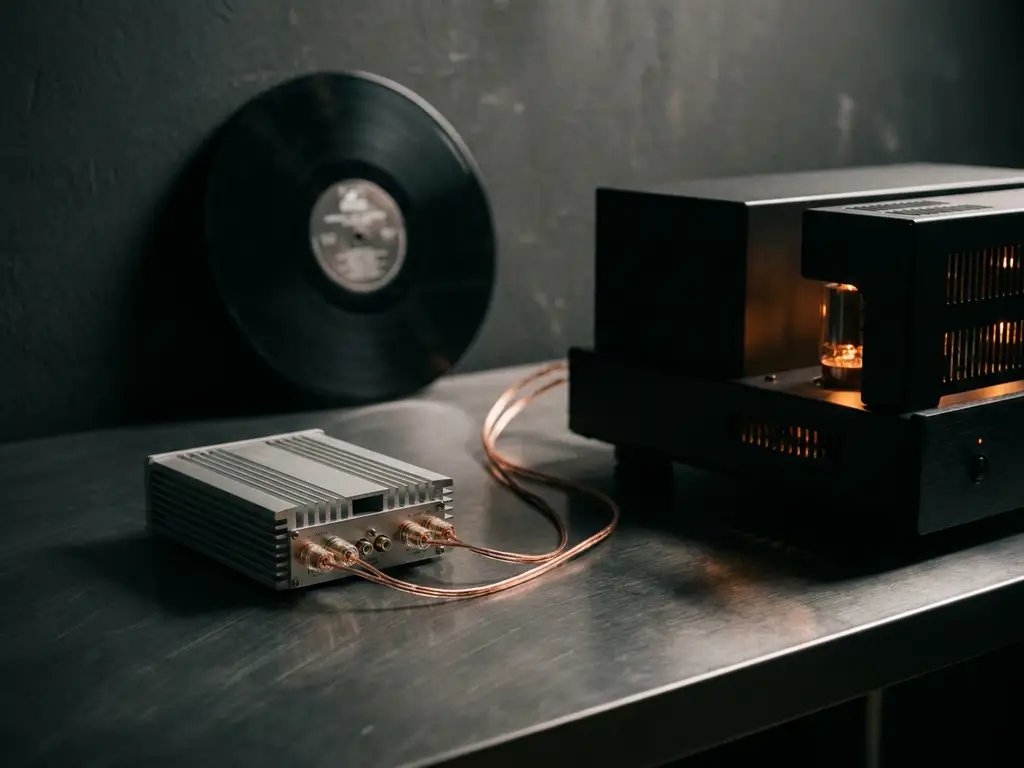
A Class D amplifier can sound as good as Class A or Class AB, and in 2026 the best Class D designs genuinely challenge traditional topologies at the highest levels of high-end audio. The gap has narrowed dramatically thanks to advances in switching technology, output filtering, and feedback design. Whether Class D is the right choice still depends on your priorities, and the sections below unpack exactly what separates these amplifier classes in practice.
How does a Class D amplifier actually work?
A Class D amplifier works by converting an audio signal into a rapid stream of on/off pulses, a technique called pulse-width modulation (PWM). The output transistors switch between fully on and fully off at very high frequencies, typically several hundred kilohertz. A low-pass filter at the output then reconstructs the original audio waveform from those pulses before it reaches the speakers.
Because the transistors spend almost no time in a partially conducting state, very little energy is wasted as heat. This is the fundamental efficiency advantage of Class D: conversion efficiency commonly exceeds 90%, compared to roughly 25% for Class A and 50 to 70% for Class AB. That efficiency allows Class D amplifiers to deliver high power output in compact, lightweight enclosures without large heatsinks or heavy power supplies.
The challenge has always been in that output filter and in the precision of the switching itself. Any timing errors in the switching process, or any resonance in the filter, can introduce distortion and high-frequency noise. Much of the engineering progress in Class D over the past decade has focused on solving exactly those problems through better feedback loops, improved gate drivers, and more refined filter topologies.
What makes Class A and Class AB amplifiers sound different?
Class A amplifiers keep their output transistors conducting continuously throughout the full audio cycle. This eliminates crossover distortion entirely, since the transistors never switch off, and produces an inherently smooth, linear signal path. Class AB amplifiers bias their transistors to conduct for slightly more than half the cycle each, reducing crossover distortion to very low levels while recovering much of the efficiency lost in pure Class A operation.
The sonic character often associated with Class A is a combination of factors. The signal path is simple, the transistors operate in their most linear region, and there is no switching noise by definition. Many experienced listeners describe Class A as having a natural, effortless quality, particularly in the midrange, where the human ear is most sensitive. Class AB, when well implemented, can approach that quality while running cooler and drawing less power at idle.
It is worth noting that the amplifier class is only one variable among many. Power supply quality, component selection, circuit topology, and output stage design all shape the final sound. A poorly designed Class A amplifier will not automatically outperform a well-engineered Class AB or modern Class D design.
Why did Class D have a bad reputation among audiophiles?
Early Class D amplifiers earned their poor reputation among audiophiles because the switching technology and output filters of the time introduced audible artifacts. High-frequency switching noise bled into the audio band, and the output filters added phase shift and frequency response anomalies that colored the sound. The result was often described as harsh, thin, or fatiguing compared to linear amplifiers.
The switching frequencies used in early designs were also relatively low, which made filtering more difficult without compromising audio bandwidth. Power supply rejection was another weakness: Class D amplifiers are more sensitive to noise on the supply rails than their linear counterparts, and early designs did not always address this adequately.
The reputation stuck partly because the audiophile community, reasonably, judges on listening experience rather than specifications. Even as the technology improved through the 2000s and 2010s, skepticism persisted. Some of that skepticism was warranted; many budget Class D products still cut corners on the output filter and power supply, confirming the bias. The high-end Class D designs that genuinely outperformed those early products did not always receive the same attention.
Has Class D technology improved enough to compete at the high end?
Yes, Class D technology has improved enough to compete at the high end of audio. Modern Class D designs using advanced feedback architectures, high switching frequencies above 500 kHz, and carefully engineered output filters now measure and, critically, sound very different from the early implementations that damaged the technology’s reputation.
Several developments have driven this progress. Self-oscillating feedback topologies, where the feedback loop wraps around the output filter rather than just the switching stage, have dramatically reduced distortion and improved load independence. GaN (gallium nitride) transistors, which switch faster and with lower losses than traditional silicon MOSFETs, have opened up new possibilities for switching frequency and linearity. Reference-grade power supply design has addressed the supply rejection weakness that plagued earlier Class D circuits.
The result is that a growing number of serious audiophiles and reviewers, including those writing for publications focused on high-end audio amplifiers, report that the best Class D amplifiers are genuinely competitive with Class A and Class AB designs at equivalent price points. This does not mean all Class D is equal, but the ceiling has risen considerably.
What are the real-world trade-offs between Class D and Class A/AB?
The real-world trade-offs between Class D and Class A/AB come down to efficiency and size on one side, and sonic character and simplicity on the other. Neither topology is universally superior; each involves genuine compromises that matter differently depending on your system and listening priorities.
Where Class D has a clear advantage
Class D runs cool, draws far less power at idle, and can deliver very high output power in a small chassis. For listeners who need high power to drive difficult speaker loads, or who want a compact system, Class D is genuinely practical in ways that a high-power Class A amplifier simply cannot match. A 300-watt Class A amplifier would generate enormous heat and require a very large, heavy enclosure.
Where Class A and Class AB still hold ground
Class A and Class AB amplifiers have a simpler signal path with no switching stage and no output filter to engineer around. At moderate power levels, a well-designed Class AB amplifier can be extraordinarily transparent and musical. Many audiophiles also find that Class A amplifiers, despite their inefficiency, reward them with a particular ease and naturalness in the midrange that remains the benchmark against which other topologies are measured. The emotional connection to music that experienced listeners describe is not a myth, even if it is difficult to quantify.
Should a serious audiophile consider a Class D amplifier?
A serious audiophile should absolutely consider a Class D amplifier, provided the specific design has been engineered without compromise. Amplifier class alone does not determine sound quality. What matters is the quality of execution: the feedback architecture, output filter design, power supply, and component selection. A reference-grade Class D amplifier from a manufacturer that prioritizes sonic performance deserves to be evaluated on its own terms, not dismissed on the basis of outdated assumptions.
The most useful approach is to listen critically. If a Class D amplifier allows you to hear deeper into your music, to feel the emotional weight of a performance, and to sustain listening sessions without fatigue, it is doing its job regardless of what topology is inside. Conversely, if a Class A amplifier delivers that experience more convincingly in your system with your speakers, that is the right answer for you.
The question of amplifier class is ultimately a starting point for evaluation, not a conclusion. In 2026, the best Class D amplifiers have earned a seat at the table in serious high-end audio systems, and any audiophile building or upgrading a reference system would benefit from keeping an open mind.
How Accustic Arts Approaches Amplifier Design
At Accustic Arts, we believe that the amplifier class is only meaningful when the execution behind it is uncompromising. Our amplifier range is built on that principle, with every design developed through direct experience in recording studios and professional live sound environments where accurate, emotionally engaging reproduction is not optional.
Here is what defines how we approach amplifier design:
- Uncompromising component selection: Only precision, high-grade components are used across every amplifier we build, regardless of the topology chosen.
- Rigorous testing: Every amplifier undergoes an individual product test that can last up to two weeks before it leaves our facility in Lauffen am Neckar, Germany.
- Optimized price-to-performance ratio: Our goal is not simply to build expensive equipment, but to deliver the highest possible sonic performance at each price point, informed by real-world studio and live performance experience.
- Emotionally engaging midrange reproduction: The characteristic that our listeners consistently describe is a natural, detailed midrange that allows the emotion in music to come through without artificial coloration.
If you are ready to explore our amplifier lineup or want to discuss which design fits your system and listening priorities, get in touch with us directly. We are happy to guide you toward the right choice.