

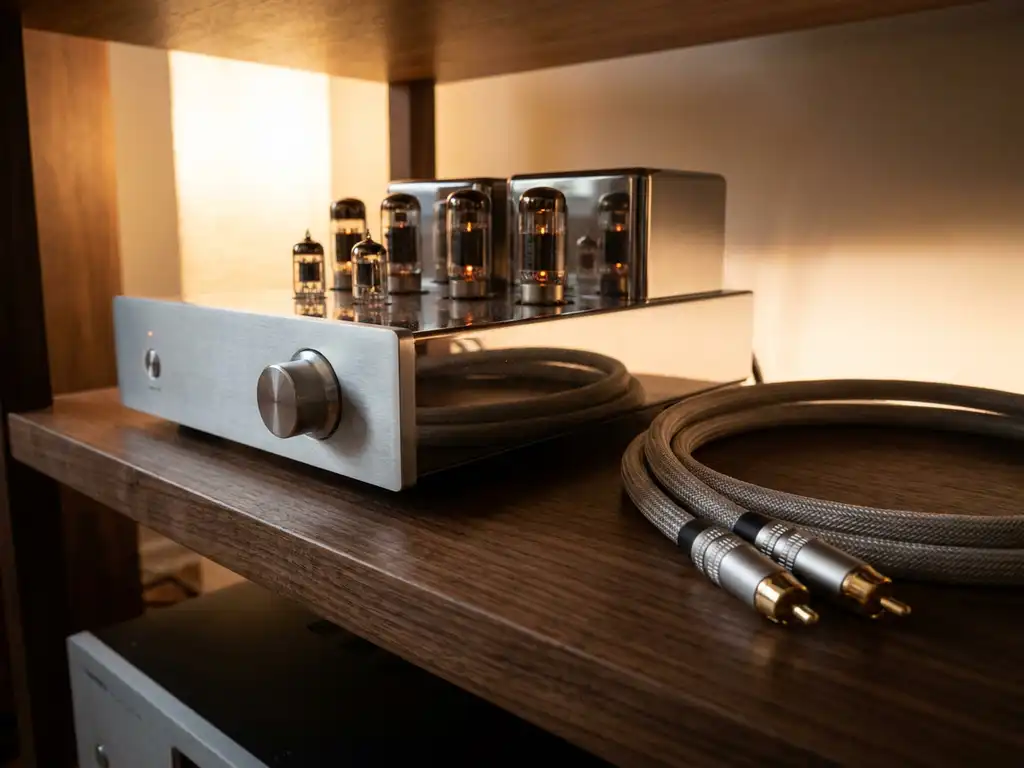
If you have ever wondered why two audio systems using the same speakers can sound so different, the preamplifier is often the answer. It sits at the heart of any serious audio chain, quietly shaping everything that reaches your ears. Understanding what a preamplifier does and why it matters is one of the most important steps toward building a system that truly moves you musically.
What is a preamplifier and what does it do?
A preamplifier is an electronic component that receives low-level audio signals from source components such as CD players, turntables, or digital-to-analog converters, amplifies those signals to a line level suitable for a power amplifier, and controls volume and source selection. It acts as the control center and signal conditioner of your audio system.
Without a preamplifier, the delicate signals coming from your sources would be too weak and too vulnerable to drive a power amplifier properly. The preamp does several jobs at once:
- Signal amplification: It raises weak source signals to a consistent, usable line level
- Source switching: It lets you select between multiple inputs, such as a CD player, streamer, or phono stage
- Volume control: It attenuates the amplified signal to your preferred listening level
- Impedance matching: It buffers the signal between source components and the power amplifier, ensuring an optimal electrical handoff
Think of the preamplifier as the conductor of an orchestra. It does not make the loudest sound, but it coordinates everything that follows.
How does a preamplifier affect sound quality?
A preamplifier directly affects sound quality because every audio signal in your system passes through it before reaching the power amplifier and speakers. The quality of its internal circuitry, components, and power supply determines how faithfully that signal is preserved or how much noise, coloration, and distortion are introduced.
Even small imperfections at the preamplifier stage are magnified downstream. A poorly designed preamp adds noise, compresses dynamics, and smears fine musical detail. A well-designed one preserves the full texture of the original recording, allowing you to hear the breath of a vocalist, the decay of a piano note, or the subtle interplay between instruments.
The key areas where a preamplifier shapes sound quality include:
- Noise floor: A lower noise floor means more silence between notes and greater perceived detail
- Dynamic range: A capable preamp handles sudden loud passages without compression or distortion
- Frequency response: High-quality preamps maintain neutrality across the full audible spectrum
- Midrange reproduction: This is often where an emotional connection to music lives, and it is the area most sensitive to circuit quality
In short, the preamplifier is not a passive link in the chain. It is an active shaper of everything your system ultimately delivers.
What’s the difference between a preamp and an integrated amplifier?
A preamplifier handles source selection, volume control, and signal conditioning, while a power amplifier drives the speakers. An integrated amplifier combines both functions in a single chassis. The core difference is that separating the two components allows each to be optimized independently, whereas an integrated amplifier makes a deliberate compromise in the name of simplicity and value.
Integrated amplifiers are an excellent choice for listeners who prioritize a clean setup and a streamlined signal path. They are also often more cost-effective, since you are buying one chassis, one power supply, and one set of controls instead of two.
Separate preamplifiers and power amplifiers, however, offer distinct advantages:
- Each component can be upgraded independently as your system and tastes evolve
- Sensitive preamplifier circuitry is physically isolated from the high-current demands of the power stage
- Dedicated power supplies for each component reduce interference and improve headroom
- Matching a specific preamp to a specific power amplifier can produce synergies that are difficult to achieve in a single box
For serious audiophiles building a reference-grade system, separate components typically offer a ceiling of performance that integrated designs find difficult to match.
Why does a high-end preamplifier sound better than a budget one?
A high-end preamplifier sounds better primarily because of the quality of its components, the precision of its engineering, and the care taken during construction and testing. Budget preamps use cost-optimized parts and simplified circuit topologies that introduce measurable and audible compromises. High-end designs eliminate those compromises at every stage of the signal path.
The differences are not abstract. They show up in how naturally instruments are rendered, how well the system separates complex musical passages, and how effortlessly it conveys the emotional content of a recording. Specific advantages of high-end preamplifier design include:
- Premium passive components: High-tolerance resistors and capacitors preserve signal accuracy rather than introducing subtle colorations
- Low-noise circuit design: Advanced topologies minimize the noise added to the signal during amplification
- Robust power supply: A well-regulated, generously specified power supply prevents voltage fluctuations from affecting the audio signal
- Rigorous quality control: Extended testing identifies and eliminates components that measure within specification but perform below the standard required
The result is not simply a louder or cleaner signal. It is a more complete, more emotionally communicative musical experience.
Should you use a tube or solid-state preamplifier?
The choice between a tube and a solid-state preamplifier depends on your musical priorities and system context. Tube preamplifiers are known for a warm, harmonically rich character that many listeners find more natural and engaging, particularly with acoustic music. Solid-state preamplifiers typically offer lower noise, greater precision, and a more neutral tonal balance that suits a wider range of genres.
Neither approach is universally superior. Each has genuine strengths:
Tube preamplifiers
- Often deliver a more organic, three-dimensional midrange
- Introduce even-order harmonic distortion that many ears find pleasing rather than fatiguing
- Can add a sense of warmth and air around instruments
- Require more maintenance, including periodic tube replacement
Solid-state preamplifiers
- Typically offer lower noise floors and wider dynamic range
- Provide consistent, reliable performance over time with minimal maintenance
- Suit systems where neutrality and precision are the primary goals
- Pair naturally with analytical or revealing speaker systems
Hybrid designs that combine a tube gain stage with solid-state output circuitry offer a compelling middle ground, capturing the tonal richness of tubes alongside the control and reliability of solid-state engineering.
How do you choose the right preamplifier for your system?
Choosing the right preamplifier means matching its electrical characteristics, input and output options, and sonic character to the rest of your system. Begin by identifying your sources, the power amplifier you plan to use, and the sound signature you are seeking. A preamplifier that works brilliantly in one system may not be the ideal choice in another.
Key factors to evaluate when selecting a preamp for your audio system include:
- Input and output compatibility: Confirm the preamp has the right number and type of inputs for your sources, and that its output impedance matches your power amplifier’s input impedance
- Gain structure: Ensure the preamp’s gain is appropriate for your sources and amplifier to avoid running the volume control at extreme positions
- Tonal balance: Consider whether your system needs warmth, neutrality, or added detail, and choose accordingly
- Build and component quality: Look for manufacturers who are transparent about their component choices and testing processes
- Listening audition: Whenever possible, listen to the preamplifier in a system similar to your own before committing
It is also worth considering the long-term picture. A preamplifier is typically the component you will keep the longest as you upgrade other parts of your system, so investing wisely at this stage pays dividends for years.
You can explore the full range of Accustic Arts audio products to find components designed to work together as a cohesive, high-performance system.
How Accustic Arts Elevates Preamplifier Performance
We design and build preamplifiers for listeners who refuse to accept compromise. At Accustic Arts, every preamplifier we produce reflects decades of engineering experience, deep roots in professional recording environments, and an uncompromising commitment to authentic musical reproduction. Our approach addresses every factor that determines preamplifier sound quality:
- Precision component selection: We use only high-grade passive and active components, chosen for their measured and audible contribution to signal integrity
- Rigorous testing: Each unit undergoes an individual testing process that can last up to two weeks before it leaves our facility in Lauffen am Neckar, Germany
- Emotionally engaging midrange: Our signature achievement is a midrange reproduction that communicates the full emotional content of music, not just its technical accuracy
- System synergy: Our preamplifiers are designed to work seamlessly with our power amplifiers, DACs, and CD players, allowing you to build a fully optimized signal chain
- Hybrid options available: For listeners drawn to the warmth of tubes combined with solid-state reliability, our tube hybrid components offer a refined solution
Whether you are building a system from scratch or upgrading a key component, we would love to help you find the right solution. Get in touch with us to discuss your system and discover which Accustic Arts preamplifier belongs at its heart.
—
Disclaimer: This article was created with the assistance of Artificial Intelligence and has been reviewed by our editorial team.
Ähnliche Artikel
- What Is the Best Way to Play Digital Music in a High-End System?
- What is the difference between soundproofing and acoustic treatment?
- Wie beeinflusst ein D/A-Wandler den Klang digitaler Musik?
- What is the audible impact of a high-quality power amplifier?
- Warum klingt dieselbe Musik auf verschiedenen Anlagen unterschiedlich?