

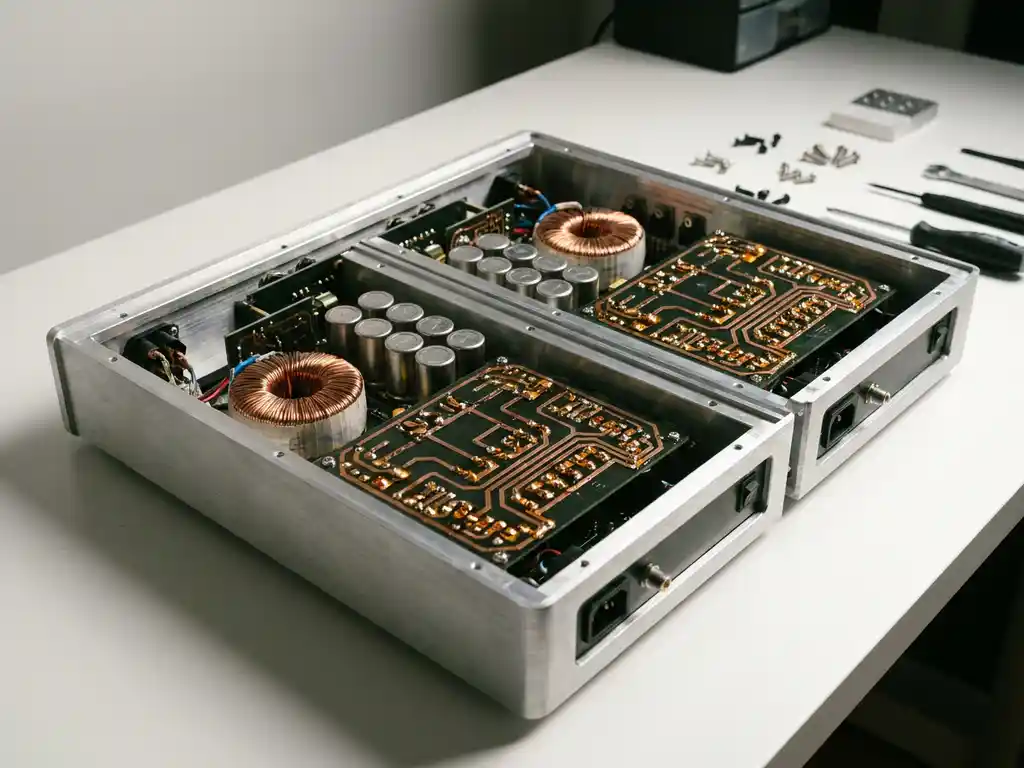
Crack open a mass-market receiver and a reference-grade audiophile amplifier, and the visual difference alone tells a story. One is packed tightly with off-the-shelf components, optimized for cost. The other looks almost architectural, deliberate, spacious, built around a clear hierarchy of parts. Understanding what lives inside a high-end amplifier is not just a technical exercise. It is the key to understanding why some audio electronics move you emotionally and others simply play music.
For those who take their listening seriously, the internals of an amplifier are every bit as important as its specifications on paper. The choices made at the circuit board level, the quality of individual components, and the discipline applied during assembly all shape the sound that eventually reaches your ears. This is a closer look at what actually goes into a reference-grade design, and why each decision matters.
The core components that shape your sound
Every amplifier, regardless of price, is built around the same fundamental building blocks: a power supply, an input stage, a gain stage, and an output stage. What separates an entry-level unit from a true audiophile amplifier is not the presence of these elements, but the quality, precision, and care applied to each one.
The input stage is where your signal first enters the amplifier. In a high-end design, this stage is kept as clean and noise-free as possible, using low-noise transistors or carefully selected tubes that preserve the delicate character of the incoming signal. The gain stage then amplifies that signal, and here, component matching becomes critical. Mismatched transistors or resistors introduce distortion that is audible, even if subtle. The output stage drives your loudspeakers directly, and its design determines how well the amplifier handles real-world speaker loads, which are rarely the simple resistive loads that specifications assume.
Taken together, these stages form a chain. Every weak link in that chain degrades the final result. Exceptional amplifier components at every stage are what allow a well-engineered design to reproduce music with the kind of accuracy and emotional presence that audiophiles seek.
How the power supply defines amplifier performance
The power supply is arguably the most important single element inside any amplifier, and it is often the component that receives the most significant investment in a high-end design.
A power supply amplifier section must deliver clean, stable voltage under dynamic conditions. Music is not a steady-state signal, it surges, drops, and changes character from moment to moment. A poorly designed power supply cannot keep up with those demands, and the result is compression, dynamic flattening, and a loss of the transient energy that makes music feel alive. High-end manufacturers use large, high-quality toroidal or R-core transformers, oversized filter capacitors, and often separate regulated supplies for different circuit stages to ensure that the amplification circuits always receive exactly what they need, regardless of the musical demand at that instant.
The physical placement of the power supply within the chassis also matters. Stray magnetic fields from transformers can induce hum and noise into sensitive signal circuits if they are positioned carelessly. In reference-grade designs, the layout is engineered with this in mind, keeping high-current components physically separated from low-level signal paths.
Signal path design and why every connection matters
In high-end amplifier circuit design, the guiding principle is simple: keep the signal path as short and direct as possible, and make every connection a deliberate, high-quality one.
Every solder joint, every connector, every length of internal wiring represents a potential source of degradation. High-end manufacturers often use point-to-point wiring for critical signal paths rather than routing signals through printed circuit board traces, which can introduce parasitic capacitance and inductance. Where PCBs are used, they are designed with wide, carefully routed traces, using high-quality substrate materials that remain stable across temperature ranges.
The choice of capacitors and resistors within the signal path carries enormous weight. Film capacitors are preferred over electrolytic types in signal-critical positions because they introduce far less distortion and age more gracefully. Metal-film resistors offer tighter tolerances and lower noise than their carbon-film counterparts. These are not abstract technical preferences, they translate directly into a cleaner, more transparent sound that allows the music’s natural character to come through without coloration.
What separates mass-market from reference-grade parts
The component choices made inside a high-end amplifier reflect a fundamentally different set of priorities compared to mass-market audio electronics.
Mass-market designs are optimized around cost and manufacturability. Components are selected to meet minimum specifications at the lowest possible price, and tolerances are broad enough to allow efficient production. This is not a criticism, it is simply a different engineering objective. Reference-grade design, by contrast, starts with the sonic and electrical ideal and works backward from there, selecting components that meet that standard regardless of cost.
This means using capacitors with extremely low equivalent series resistance, resistors matched to within fractions of a percent, and inductors wound with high-purity copper. It means choosing transistors or tubes that have been individually measured and selected for their characteristics, rather than simply pulled from a reel. The cumulative effect of these choices across dozens or hundreds of components is a circuit that behaves closer to the theoretical ideal, and sounds noticeably better as a result.
Testing and quality control inside a high-end factory
Even the finest components assembled carelessly will underperform. This is why the manufacturing process itself is a defining characteristic of genuine high-end audio production.
At Accustic Arts, we subject every completed component to an individual testing process that can last up to two weeks before it leaves our facility. This extended burn-in and evaluation period allows us to identify any instability, drift, or performance deviation that would never appear in a brief bench test. It reflects a commitment to the idea that a product should not simply measure correctly, it should perform consistently and reliably over years of real-world use.
This level of quality control is only possible at the scale at which true high-end manufacturers operate. It requires experienced engineers who listen as well as measure, and it requires the patience to hold a product back if it does not meet the standard. For the listener, this discipline translates into an amplifier that sounds exactly as it was designed to sound, from the first listening session through many years of ownership. That consistency, built from the inside out, is ultimately what a reference-grade amplifier delivers.