

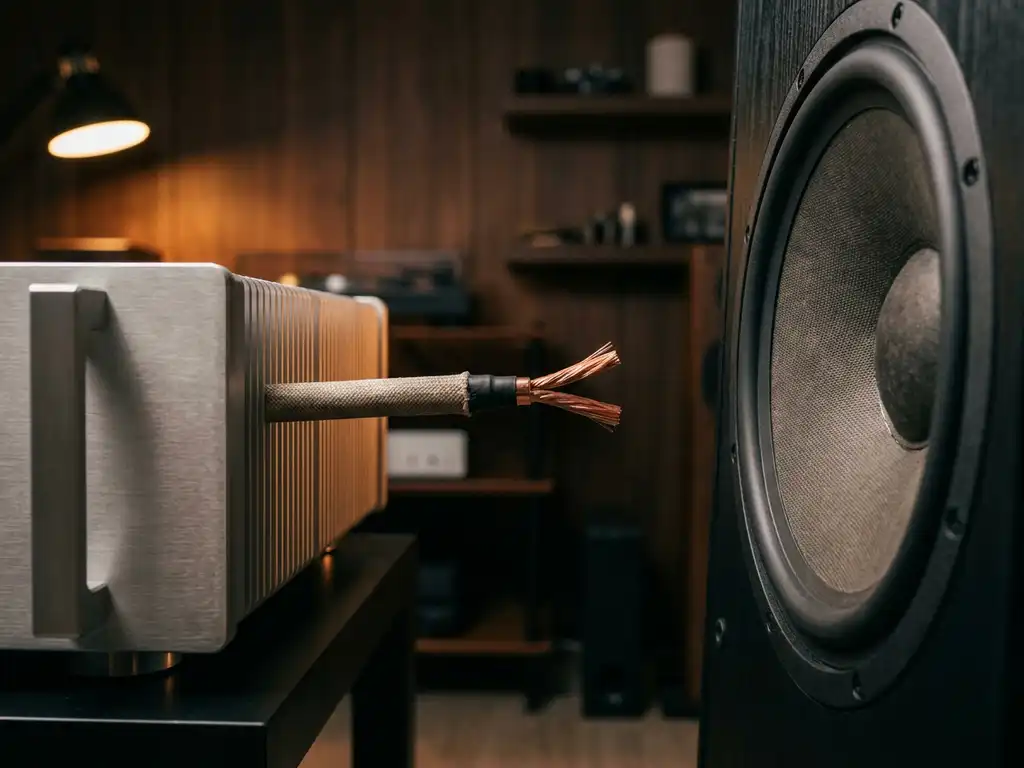
Most audiophiles spend considerable time comparing frequency response curves, distortion figures, and power ratings when evaluating amplifiers. Yet one specification that genuinely shapes how music feels in the room often gets overlooked: amplifier damping factor. Understanding what this number means and how it influences speaker control can make the difference between bass that sounds tight and articulate and bass that sounds loose and smeared. It is a deceptively simple concept with real audible consequences.
This guide breaks down damping factor explained in plain language, covering what it actually measures, how it affects cone behavior, and how to think about it when matching a high-end amplifier to your speaker system.
What damping factor actually measures in an amplifier
Damping factor is a ratio that describes the relationship between a speaker’s nominal impedance and the output impedance of the amplifier driving it. Specifically, it is calculated by dividing the speaker’s impedance (typically 8 ohms) by the amplifier’s output impedance. An amplifier with an output impedance of 0.08 ohms driving an 8-ohm speaker would have a damping factor of 100.
The practical significance of this ratio lies in what happens after a musical transient ends. When a woofer cone moves forward to reproduce a bass note, it needs to stop precisely when the signal dictates. A high damping factor means the amplifier presents a low-impedance „brake“ to the speaker, absorbing the back-EMF generated by the moving voice coil and halting cone motion quickly. A low damping factor means the amplifier offers less resistance to that residual cone movement, allowing it to continue vibrating slightly after the signal has ceased.
How damping factor shapes bass response and cone behavior
The connection between damping factor and speaker bass control is most audible in the low frequencies, where woofer cones have the greatest excursion and the most inertia to overcome. A well-damped amplifier keeps the cone tightly under electrical control, which translates to bass notes that start and stop cleanly, with defined pitch and texture rather than a warm, woolly bloom.
This matters enormously for musical realism. Upright bass, kick drum, and cello fundamentals each have a distinct character that depends on transient precision. When damping is insufficient, these instruments lose their individuality and blend into an undifferentiated low-frequency mass. Conversely, very high damping factor values can, in some speaker designs, make bass sound overly lean or analytical if the speaker was voiced to work with a degree of natural resonance. The relationship is not simply „higher is always better“ but rather about finding the right balance for a given system.
Real-world damping factor values and their audible differences
Solid-state amplifiers typically achieve damping factors ranging from around 50 to several hundred, with some designs exceeding 1000. Tube amplifiers, by contrast, often measure between 5 and 20, which is one reason they are described as having a warmer, more relaxed bass character. Neither approach is inherently superior; each interacts differently with speaker designs and listener preferences.
In practical listening terms, the audible difference between a damping factor of 200 and 500 is generally far less significant than the difference between 20 and 100. Once a threshold of adequate control is reached, further increases in damping factor yield diminishing perceptual returns. What matters more at that point is the overall quality of the amplifier’s output stage, power supply regulation, and circuit topology. Audio amplifier performance is always the sum of many interacting variables, not a single specification in isolation.
How speaker impedance and cable resistance reduce effective damping
Here is where the theoretical damping factor figure meets reality: the number measured at the amplifier’s output terminals is never the number experienced at the speaker’s voice coil. Every element in the signal path between amplifier and driver adds resistance, and that resistance reduces the effective damping factor the speaker actually receives.
Speaker cable is the most significant factor. A typical run of speaker cable introduces resistance that, depending on gauge and length, can easily cut effective damping in half or more. Crossover networks add further impedance, and the speaker’s own wiring contributes as well. This is why cable quality and gauge genuinely matter in a high-end audio system, particularly for speakers with complex crossovers or those designed to be driven with high-damping solid-state amplifiers. The practical takeaway is to keep cable runs reasonably short and to use appropriately gauged conductors, especially for low-impedance or demanding speaker loads.
Matching amplifier damping factor to your speaker system
Choosing an amplifier with an appropriate damping factor starts with understanding the speaker’s design intent and impedance characteristics. Speakers with large, heavy woofer cones and low resonant frequencies generally benefit from higher damping, as they require more electrical braking force to control cone overshoot. Smaller, lighter drivers in bookshelf designs are typically easier to control and less sensitive to damping factor variations.
It is also worth considering the type of music most often played. Genres with dense, fast bass lines, such as jazz, classical orchestral music, or electronica, expose poor damping control more readily than slower, less dynamically complex material. Listening in a large room with longer cable runs further emphasizes the importance of starting with a generous damping factor at the amplifier, since real-world losses will reduce it before the signal reaches the driver. When auditioning amplifiers, pay attention to how bass instruments decay. A well-damped pairing allows each note to bloom naturally and then release cleanly, rather than lingering or smearing into the next beat.
How Accustic Arts approaches amplifier damping and speaker control
At Accustic Arts, damping factor is not treated as a marketing figure to maximize on a specification sheet. Our amplifier designs are developed with a holistic understanding of how output impedance, power supply stiffness, and circuit topology interact to deliver genuine speaker control across real-world listening conditions. Several principles guide this approach:
- Precision component selection: We use only high-grade components throughout our output stages, ensuring that the measured damping factor is consistent and stable across the full audio bandwidth, not just at 1 kHz.
- Rigorous individual testing: Every amplifier undergoes up to two weeks of individual testing before dispatch, which includes evaluating real-world behavior under varying load conditions, not just bench measurements.
- Studio-informed voicing: Our development draws on direct experience in recording studios and professional live sound environments, where the difference between controlled and uncontrolled bass is immediately audible and consequential.
- Optimized price-to-performance: We engineer for meaningful audible improvements, not specification inflation. If a damping factor of 200 delivers the same real-world result as 800, we focus engineering resources on the variables that actually move the needle for listeners.
If you are ready to experience what genuinely controlled, emotionally engaging amplification sounds like in your own system, explore our full range of amplifiers or get in touch with us to discuss which Accustic Arts component is the right fit for your speakers and listening goals.