

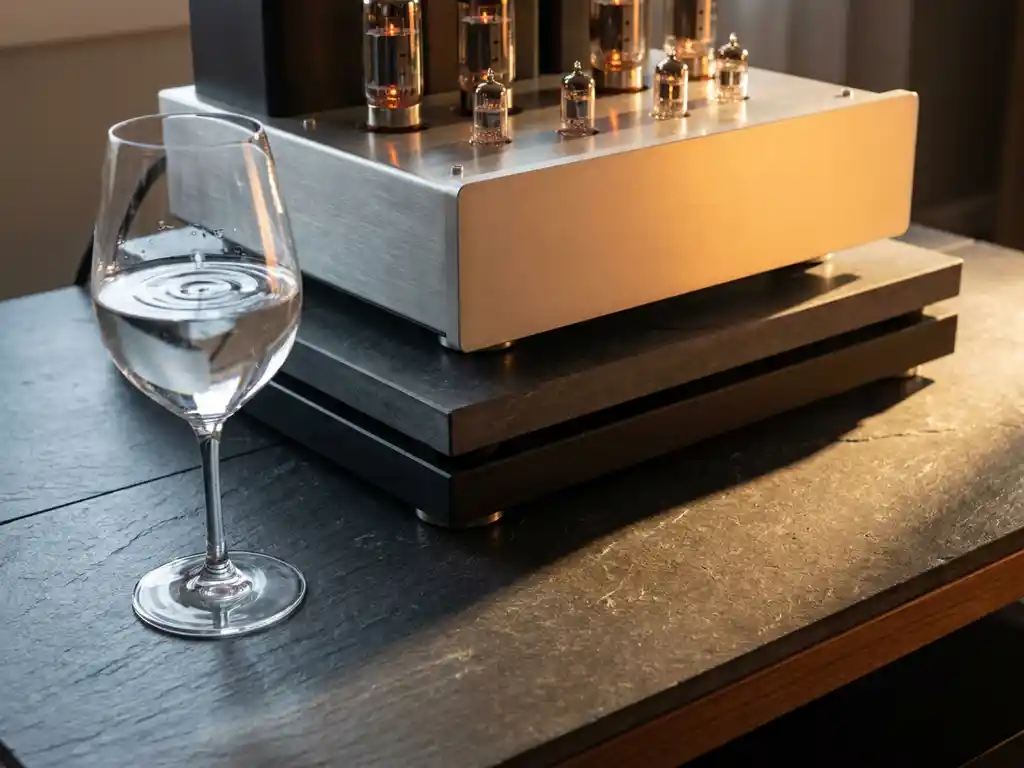
If you have ever noticed that your music sounds slightly off after placing a speaker near a subwoofer, or that a turntable skips when someone walks across the room, you have already experienced the real-world consequences of vibration in audio systems. Vibration is one of the most underestimated enemies of sound quality in high-fidelity audio, and understanding how it works is the first step toward building a truly resolving listening environment.
What types of vibration cause problems in audio components?
Vibration in audio equipment falls into two main categories: external mechanical vibration and internally generated resonance. External sources include foot traffic, HVAC systems, nearby speakers, and environmental noise transmitted through floors and surfaces. Internal sources arise from transformers, cooling fans, and the acoustic output of speakers themselves feeding back into sensitive components.
Both types are problematic, but they affect components in different ways. External vibration tends to introduce low-frequency disturbances that are broad and unpredictable. Internal resonance is often narrowband, meaning it occurs at specific frequencies tied to the physical dimensions and materials of a component’s chassis. When a chassis resonates at a particular frequency, it can amplify or color the audio signal at that same frequency, adding a subtle but audible smear to the sound.
- Acoustic feedback vibration: Sound waves from loudspeakers physically vibrate nearby components, including the amplifiers and sources driving them
- Structural vibration: Energy transmitted through floors, shelving, and equipment racks from footsteps or building movement
- Transformer hum: Power transformers inside amplifiers and DACs generate low-frequency mechanical vibration at mains frequency
- Airborne vibration: High sound pressure levels in the room can excite resonances in component casings and internal parts
Which audio components are most sensitive to vibration?
Turntables, CD players, and digital-to-analog converters are the most vibration-sensitive audio components. Turntables are especially vulnerable because the stylus reads microscopic groove variations, and any external movement contaminates the signal directly. CD and SACD transports rely on optical laser tracking that vibration can disrupt, while DACs contain precision crystal oscillators whose timing accuracy degrades under mechanical stress.
Tube amplifiers and tube hybrid components also rank among the most sensitive. Vacuum tubes are microphonic by nature, meaning their internal elements physically respond to sound waves and vibration, converting that movement back into an electrical signal that mixes with the audio path. This is why tube rolling and tube damping are common practices among enthusiasts. Preamplifiers, which handle the smallest signal levels in the chain, are similarly susceptible because even tiny amounts of vibration-induced noise become significant at low signal levels.
Solid-state amplifiers and power amplifiers are generally more robust, but their transformers still generate and transmit vibration into the chassis. Even a well-designed power amplifier benefits from good mechanical isolation, particularly when it shares a rack with source components.
How does vibration specifically damage audio signal quality?
Vibration degrades audio signal quality by introducing timing errors, added noise, and harmonic distortion into the signal path. In digital components, mechanical vibration causes jitter, which is a timing instability in the digital clock that results in a smeared, less focused soundstage and reduced transient clarity. In analog components, vibration induces microphonic noise that adds coloration and masks fine musical detail.
The subjective effects are often described by listeners as a loss of image stability, reduced low-level detail, and a slightly blurred or congested midrange. Instruments lose their precise placement in the stereo field, and the sense of air and space around voices and acoustic instruments diminishes. In severe cases, vibration causes audible distortion or, in the case of turntables, groove mistracking and skipping.
It is worth noting that the damage is cumulative and interactive. A component sitting on a resonant shelf, driven by a transformer that hums at 50 or 60 Hz, and exposed to the acoustic output of nearby speakers faces vibration from multiple directions simultaneously. Each source compounds the others, making the total effect on sound quality greater than any single source alone.
What are the best methods for isolating audio equipment from vibration?
The most effective methods for isolating audio equipment from vibration combine mass loading, decoupling, and absorption. No single solution addresses all vibration types, so a layered approach consistently delivers the best results. The goal is to interrupt the transmission path between the vibration source and the sensitive component.
- Equipment racks with mass-loaded shelves: Heavy, rigid shelving materials such as thick MDF, slate, or glass resist resonance by raising the frequency at which they vibrate beyond the audible range
- Isolation feet and platforms: Devices placed under components that use springs, elastomers, or air bladders to decouple the component from the shelf surface
- Spike and cone systems: Metal spikes or cones drain vibration energy away from the component and into the supporting surface, working on the opposite principle from soft isolators
- Dedicated equipment stands: Purpose-built stands with constrained-layer damping between shelf materials dissipate vibrational energy as heat rather than transmitting it
- Room placement: Positioning sensitive source components away from loudspeakers and subwoofers reduces the acoustic energy they are exposed to
For turntables specifically, a wall-mounted shelf attached directly to the building structure often outperforms floor-standing furniture because it bypasses floor-borne vibration entirely. For digital sources and DACs, isolation platforms with soft decoupling tend to be particularly effective at reducing jitter caused by high-frequency vibration.
How do high-end audio manufacturers design components to resist vibration?
High-end audio manufacturers address vibration resistance through chassis design, material selection, internal component mounting, and transformer isolation. The most sophisticated approach treats mechanical engineering as equal in importance to electronic circuit design, recognizing that the physical structure of a component is itself part of the signal path.
Key design strategies include:
- Thick, machined aluminum or steel chassis: Dense, rigid enclosures raise the resonant frequency of the cabinet and reduce the amplitude of vibration at audio frequencies
- Isolated transformer mounting: Suspending power transformers on rubber or elastomeric mounts prevents their mechanical vibration from coupling into the chassis and circuit boards
- Separate power supply enclosures: Housing the power supply in a dedicated chassis physically removes the largest source of internal vibration from sensitive analog and digital circuitry
- Board-level damping: Securing circuit boards with damping compounds or mounting hardware that absorbs vibration before it reaches sensitive components like crystal oscillators and op-amps
- Tube damping rings: In tube-based components, silicone or rubber rings fitted around tube bodies reduce microphonic pickup
The most revealing test of a manufacturer’s commitment to vibration control is how they treat their audio products at the component level, not just the chassis level. Precision-grade capacitors, resistors, and oscillators that are mechanically secured and thermally stable perform consistently better under real-world listening conditions than the same circuit built with loosely mounted parts.
How ACCUSTIC ARTS Approaches Vibration Control in High-End Audio
At ACCUSTIC ARTS, we treat vibration control as a fundamental engineering discipline, not an afterthought. Our philosophy of Absolute Sound Fidelity Through Reproduction demands that every component we design performs at its best under the conditions it will actually encounter in a real listening room. This means mechanical integrity is built into every product from the ground up.
Here is how we address vibration in our components:
- Precision-machined aluminum chassis: Our enclosures are engineered for rigidity and resonance control, minimizing the effects of airborne and structure-borne vibration on internal circuitry
- Isolated power supply design: Across our amplifier and DAC ranges, transformer isolation is a core design principle, keeping mechanical noise away from sensitive signal paths
- Elaborate pre-dispatch testing: Every component undergoes up to two weeks of individual testing before it leaves our facility in Lauffen am Neckar, ensuring that vibration-related issues are identified and resolved before the product reaches you
- Studio-informed engineering: Our experience in professional recording studios and live PA environments means we design for real-world acoustic conditions, not just laboratory measurements
- Tube hybrid components with microphonic management: Our tube hybrid designs incorporate mechanical damping strategies that preserve the warmth and texture of tube sound while minimizing microphonic coloration
If you want to experience what a genuinely vibration-resistant, reference-grade component sounds like in your own system, we invite you to explore our full range or get in touch with us directly. Visit our product range to find the component that fits your system, or contact us and let us help you take your listening experience to the next level.
—
Disclaimer: This article was created with the assistance of Artificial Intelligence and has been reviewed by our editorial team.