

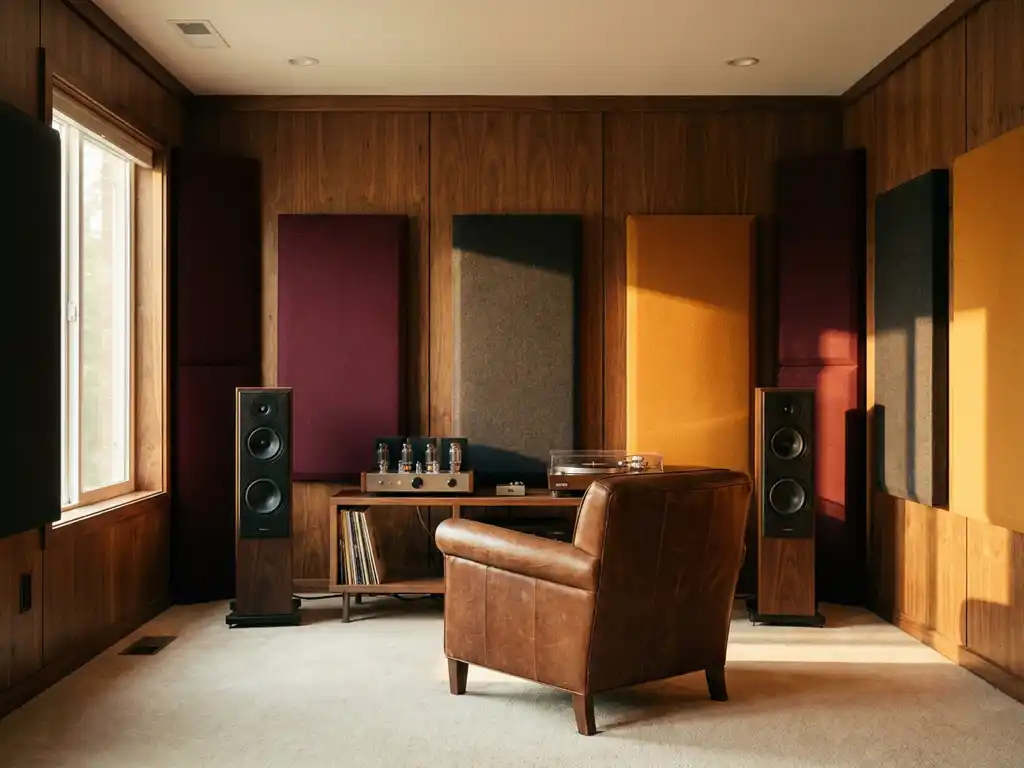
Creating an acoustically ideal listening room is one of the most rewarding investments an audiophile can make. Even the finest high-end electronics can only perform to their true potential when the room they operate in supports rather than fights the sound. Whether you are setting up a dedicated audio room from scratch or refining an existing space, understanding the principles of listening room acoustics will transform your musical experience from impressive to genuinely revelatory.
What makes a room acoustically ideal for listening?
An acoustically ideal listening room balances sound absorption, diffusion, and reflection to produce an accurate, natural sound field. It minimizes unwanted resonances and standing waves while preserving the liveliness and detail of the original recording. The goal is a space where the room itself adds as little coloration as possible, letting the music speak for itself.
Achieving this balance involves several interconnected factors. Room dimensions, surface materials, furniture placement, and dedicated acoustic treatment all play a role. A well-designed hi-fi listening room does not need to look like a recording studio to sound like one. Many audiophiles achieve excellent results in domestic settings by making thoughtful, targeted adjustments. The key is understanding that every surface in the room interacts with sound waves, and those interactions either support or undermine what your equipment is trying to reproduce.
The most important qualities of an acoustically ideal room include controlled low-frequency behavior, a smooth mid-range response, and a natural high-frequency decay that neither sounds dead nor overly reverberant. When these elements align, music gains clarity, imaging improves dramatically, and listening fatigue drops significantly.
How does room shape affect sound quality?
Room shape directly determines how sound waves travel, reflect, and interact with one another. Rectangular rooms are the most common and can work well, but they are also prone to parallel wall reflections that create standing waves. Non-rectangular rooms or rooms with angled walls naturally scatter sound, reducing problematic resonances.
In a rectangular room, sound waves bounce between parallel surfaces and reinforce certain frequencies while canceling others. These reinforced frequencies are called room modes or standing waves, and they cause some bass notes to sound booming while others seem to disappear entirely. The ratio of a room’s length, width, and height determines which frequencies are affected most severely.
Rooms with proportions that follow established acoustic guidelines, such as those derived from the work of acoustic researchers, tend to distribute room modes more evenly across the frequency spectrum. This does not eliminate modes entirely, but it prevents them from clustering at the same frequencies, which would create severe peaks and dips. If you have a choice in room dimensions, avoiding ratios where the length, width, or height are simple multiples of one another is a practical starting point for better room acoustics for audiophiles.
What are the most common acoustic problems in listening rooms?
The most common acoustic problems in listening rooms are bass buildup in corners, flutter echo between parallel walls, early reflections from side walls and the ceiling, and excessive reverberation in lively, hard-surfaced rooms. Each of these issues degrades sound quality in distinct and identifiable ways.
- Bass buildup: Low frequencies accumulate in corners and along walls, creating an uneven, muddy bass response that obscures detail and timing.
- Flutter echo: Rapid, repetitive echoes between two parallel hard surfaces smear transients and add an unpleasant coloration to voices and instruments.
- Early reflections: Sound arriving at the listening position milliseconds after the direct signal from the speakers blurs stereo imaging and reduces perceived clarity.
- Excessive reverberation: Rooms with too many hard, reflective surfaces create a wash of sound that masks fine detail and makes music sound congested.
- Room resonances: Specific frequencies that the room naturally amplifies can make certain notes sound unnaturally loud or sustained compared to others.
Identifying which problems are present in your space is the first step toward effective audio room treatment. Listening to familiar recordings and paying attention to bass consistency, vocal clarity, and stereo image stability will reveal the most pressing issues.
What’s the difference between acoustic absorption and diffusion?
Acoustic absorption reduces sound energy by converting it to heat through porous or dense materials, lowering reverberation and controlling reflections. Acoustic diffusion scatters sound in multiple directions without significantly reducing its energy, maintaining a sense of liveliness and space while breaking up problematic reflections. Both are essential tools in a well-treated room, and neither should be used exclusively.
Absorption is most effective at controlling mid and high frequencies. Materials such as thick foam panels, mineral wool, heavy curtains, and upholstered furniture absorb sound energy before it can bounce around the room. Bass traps are a specialized form of absorption designed to address low-frequency buildup, typically placed in corners where bass energy concentrates most heavily.
Diffusion, by contrast, uses irregular or mathematically calculated surface geometries to scatter reflected sound in many directions simultaneously. This prevents strong, coherent reflections that would blur imaging, while keeping the room from sounding unnaturally dead. A room treated exclusively with absorption can feel acoustically suffocating, stripping away the sense of space and air that makes music feel alive. Combining both approaches produces a high-end audio room that is controlled without being lifeless.
Where should acoustic treatment be placed in a listening room?
Acoustic treatment should be placed at the first reflection points on the side walls and ceiling, in room corners for bass control, and on the rear wall behind the listening position. These locations address the most damaging reflections and resonances before they degrade the listening experience.
- Side wall first reflection points: Use a mirror to find where you can see the speaker from the listening seat. That point is where sound reflects most strongly toward your ears. Placing an absorptive or diffusive panel here significantly improves stereo imaging.
- Ceiling reflection point: The same principle applies above the listening position. A panel at the ceiling reflection point reduces comb filtering and improves clarity.
- Room corners: Floor-to-ceiling bass traps in corners are the single most effective way to address low-frequency buildup. Even partial treatment in corners yields audible improvements.
- Rear wall: A combination of diffusion and absorption behind the listening position helps control rear reflections without making the room feel closed in.
- Front wall behind speakers: Treatment here reduces early reflections from the wall closest to the speakers, tightening the bass and improving depth of image.
Effective room acoustic treatment does not require covering every surface. Targeted placement at these key positions delivers most of the benefit with a fraction of the material.
How do you find the ideal listening position in a room?
The ideal listening position in a room is typically located between one third and two thirds of the room’s length from the front wall, centered between the side walls, and positioned so that the listener’s ears are at tweeter height. This placement minimizes the influence of the strongest room modes while maximizing the coherence of the stereo image.
A common starting guideline is to place the listening seat at approximately 38% of the room’s total length from the front wall. This position tends to avoid the worst bass mode peaks and nulls, producing a more balanced low-frequency response. However, every room is different, and the best position in your specific space requires some experimentation.
To refine your sound room setup, try playing a familiar recording with sustained bass notes and slowly moving your listening chair forward and backward in small increments. Notice where the bass sounds most even and full rather than booming or thin. Once you find that point, check that the stereo image is stable and centered. The speakers themselves should form an equilateral triangle with the listening seat, with each speaker toed in to point directly at your ears.
Avoid placing the listening seat directly against the rear wall. This position creates strong bass buildup from rear wall reflections and collapses the sense of depth in the soundstage. A gap of at least half a meter between the rear wall and the listening seat makes a meaningful difference to both bass clarity and spatial presentation.
How Acoustic Arts Supports Your Listening Room Journey
Getting your room acoustics right is only half of the equation. The other half is ensuring that the electronics reproducing your music are worthy of the space you have worked so hard to optimize. At Accustic Arts, we design every component with the conviction that acoustically ideal listening rooms deserve equally uncompromising electronics. Here is what sets our approach apart:
- Precision engineering for accurate reproduction: Our components are built to reproduce music as it was recorded, without coloration or artificial enhancement, so that every acoustic improvement you make in your room is fully audible.
- Two-week individual testing: Every product we manufacture undergoes up to two weeks of rigorous testing before dispatch, ensuring that what arrives in your listening room performs exactly as intended.
- A full ecosystem of high-end components: From preamplifiers and power amplifiers to CD players, D/A converters, and tube hybrid components, we offer everything needed to build a reference-grade system around your optimized room.
- Rooted in real-world audio experience: Our development philosophy draws on decades of work in recording studios and professional live sound environments, giving our products a musicality that resonates in any well-treated listening space.
If you are ready to experience what a truly optimized listening environment combined with reference-grade electronics can achieve, we invite you to explore our full range of high-end audio components or get in touch with us directly to discuss which products are the right fit for your room and your musical taste.
—
Disclaimer: This article was created with the assistance of Artificial Intelligence and has been reviewed by our editorial team.
Ähnliche Artikel
- Why do amplifier power ratings vary so much between brands?
- Warum verwenden High-End-Audiokomponenten hochwertige Innenbauteile?
- Wie beeinflusst elektromagnetische Störung die Audioqualität?
- What is the difference between accuracy and musicality in hi-fi?
- How does power supply quality affect audio component performance?