

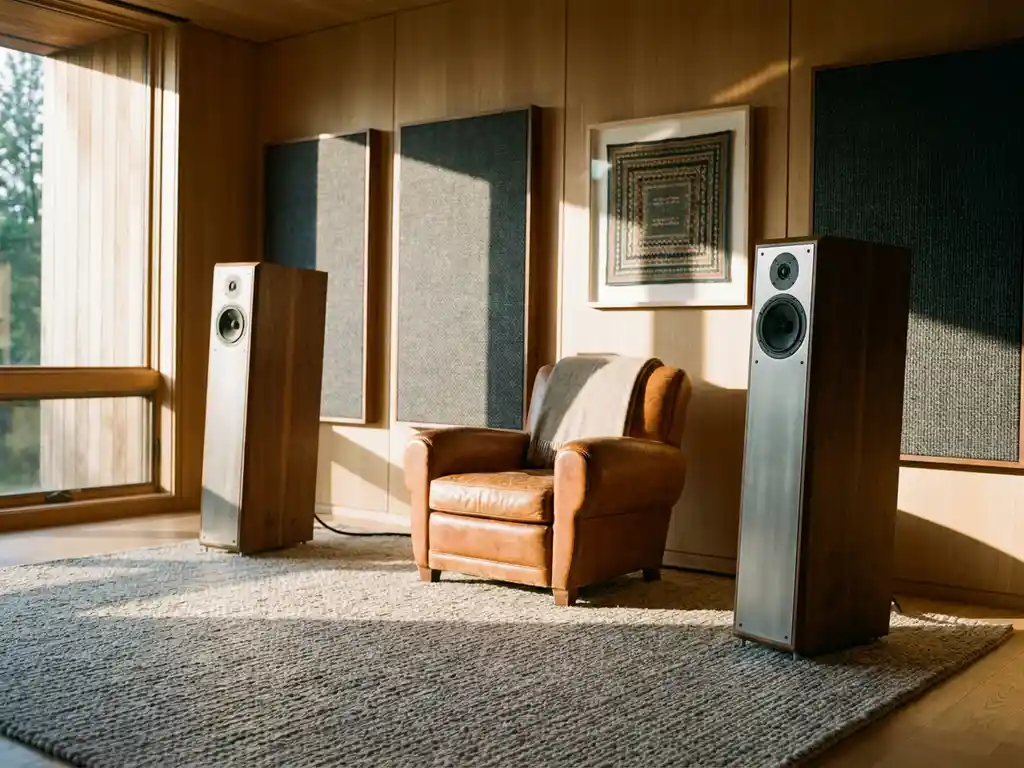
Getting the most out of your hi-fi speakers has less to do with the price tag and more to do with where you put them. Even the finest high-end audio components can sound flat, congested, or lifeless if placed incorrectly in a room. Speaker placement is one of the most powerful and cost-free tools available to any audiophile, and understanding the principles behind it can transform your listening experience entirely.
Why does speaker placement affect sound quality?
Speaker placement affects sound quality because the position of a speaker determines how its sound waves interact with the room’s surfaces, dimensions, and furnishings. These interactions shape everything from bass response and stereo imaging to clarity and tonal balance. Moving a speaker even a few centimetres can produce audible and significant differences in the sound you hear at the listening position.
Sound travels in all directions from a speaker driver. While some of that sound reaches your ears directly, a large portion bounces off walls, floors, and ceilings before arriving at the listening position. These reflected waves combine with the direct sound, sometimes reinforcing certain frequencies and cancelling others. The result can be bloated bass, a collapsed stereo image, or a lack of detail in the midrange. Correct speaker positioning minimises these negative interactions and allows the speaker to perform as its designer intended.
How does room acoustics influence speaker placement?
Room acoustics influence speaker placement by determining where problematic reflections, standing waves, and bass buildup occur. The size, shape, and surface materials of a room create acoustic behaviour that must be accounted for when positioning speakers. Parallel walls create standing waves that exaggerate or cancel bass frequencies at predictable points in the room.
Hard surfaces such as bare floors, glass windows, and plaster walls reflect high frequencies aggressively, which can create a harsh or bright character. Soft furnishings, rugs, and bookshelves help absorb and diffuse these reflections. Rooms with irregular shapes or asymmetric furniture layouts introduce their own complications, often causing the left and right channels to sound different even when the speakers themselves are positioned symmetrically. Understanding your room’s acoustic character is an essential first step before making any speaker positioning decisions.
- Rectangular rooms are common but prone to strong standing waves along their length and width
- Open-plan spaces often lack sufficient bass reinforcement and can sound thin
- Rooms with mixed surfaces typically offer the most balanced acoustic starting point
What is the ideal distance between speakers and the listening position?
The ideal distance between speakers and the listening position follows the equilateral triangle rule: the two speakers and the listener should each be the same distance apart, forming an equilateral triangle. This geometry creates accurate stereo imaging and a stable, focused soundstage. For most home listening rooms, this places the listening seat roughly two to three metres from each speaker.
The equilateral triangle is a widely accepted starting point, but it is not absolute. Some listeners prefer a slightly wider triangle, pulling the listening seat further back to create a more expansive, enveloping soundstage. Others prefer a narrower arrangement for a more intimate, focused presentation. The key is symmetry: both speakers must be the same distance from the listening position, and the listener must sit on the central axis between them. Deviating from this symmetry is one of the most common causes of a weak or wandering stereo image in an audio setup.
How far should speakers be placed from the wall?
Speakers should generally be placed at least 30 to 60 centimetres from the rear wall, and ideally further if the room allows. Proximity to the rear wall reinforces bass frequencies, which can sound warm and full in small quantities but quickly become muddy and overwhelming. The further a speaker sits from the wall, the more controlled and defined the bass reproduction tends to be.
Side walls also matter. A speaker placed too close to a side wall will produce early reflections that smear the stereo image and reduce the sense of space in the recording. As a general principle, speakers should have more distance from the side wall than from the rear wall. Corner placement should be avoided entirely in most cases, as corners are the points in a room where bass energy accumulates most severely, resulting in a boomy and uncontrolled low end that obscures musical detail.
Floorstanding speakers and bookshelf speakers behave differently near boundaries. Bookshelf speakers used without stands and placed directly against a wall will almost always suffer more noticeably than a well-designed floorstander with a rear port that has been positioned thoughtfully.
What is speaker toe-in and how does it affect sound?
Speaker toe-in refers to the angle at which speakers are rotated inward toward the listening position rather than firing straight ahead. Toe-in affects the directness of high-frequency energy reaching the listener, the width of the stereo image, and the perceived sharpness of instrument placement within that image. More toe-in typically produces a more focused, forward-sounding presentation; less toe-in creates a wider, more diffuse soundstage.
The optimal toe-in angle depends on the speaker’s design, particularly the dispersion characteristics of its tweeter. Some speakers are voiced to be listened to on-axis, meaning they sound best when pointed directly at the listener. Others perform better with minimal toe-in, relying on room reflections to fill out the sound. A practical starting point is to angle each speaker so that it points toward the listener’s ear position, then experiment from there in small increments.
- More toe-in: sharper imaging, stronger centre image, reduced soundstage width
- Less toe-in: wider soundstage, more relaxed presentation, potentially less precise imaging
- Asymmetric toe-in: can compensate for an acoustically uneven room, but should be a last resort
How do you fine-tune speaker placement for the best sound?
Fine-tuning speaker placement involves a methodical process of small adjustments, careful listening, and patience. Start with the equilateral triangle as your baseline, then make incremental changes to distance from the rear wall, side wall clearance, and toe-in angle. Listen to familiar recordings you know well, focusing on bass definition, stereo imaging, and the naturalness of voices and instruments.
Use the following process to refine your audio setup systematically:
- Set up the equilateral triangle with equal distance from each speaker to the listening seat
- Ensure both speakers are the same distance from the rear wall and side walls
- Apply equal toe-in to both speakers, beginning with the tweeter aimed at the listening position
- Play a familiar track with a clear centre image, such as a vocal recording, and check that the voice appears centred and stable
- Adjust rear wall distance in 5 to 10 centimetre increments to find the point where bass sounds defined rather than bloated
- Experiment with toe-in in small steps, listening for changes in image focus and soundstage width
- Once satisfied, mark the speaker positions and listen across a variety of music to confirm the result holds
The process takes time, but the rewards are significant. Many audiophiles find that careful speaker positioning unlocks performance they did not know their existing components were capable of delivering. It is also worth revisiting placement if you change any component in your system, as different amplifiers and sources can alter the tonal balance in ways that call for repositioning.
How ACCUSTIC ARTS Helps You Achieve the Best Sound From Your Speakers
Correct speaker placement unlocks the potential of your audio system, but that potential must first exist in the components themselves. At ACCUSTIC ARTS, we design electronics that reward careful setup with a level of musical authenticity that is immediately recognisable. When your speakers are positioned well and driven by components built to our exacting standards, the result is sound that is not just accurate but emotionally engaging.
Here is what we bring to your high-end audio system:
- Uncompromising component quality: Every product we manufacture uses only precision, high-grade components selected for their contribution to accurate, natural sound reproduction
- Rigorous testing: Each component undergoes an individual testing process that can last up to two weeks before it leaves our facility in Lauffen am Neckar, Germany
- Emotionally engaging midrange: Our signature achievement is a midrange reproduction that brings warmth and detail to music without artificial colouration, making the most of a well-positioned speaker setup
- A complete system approach: From preamplifiers and integrated amplifiers to D/A converters and CD players, our full range of high-end audio products is designed to work together and with the finest speakers on the market
If you are ready to take your listening experience to the next level, we invite you to explore what ACCUSTIC ARTS can offer. Contact us directly to speak with our team about finding the right components for your system and your room.
—
Disclaimer: This article was created with the assistance of Artificial Intelligence and has been reviewed by our editorial team.