

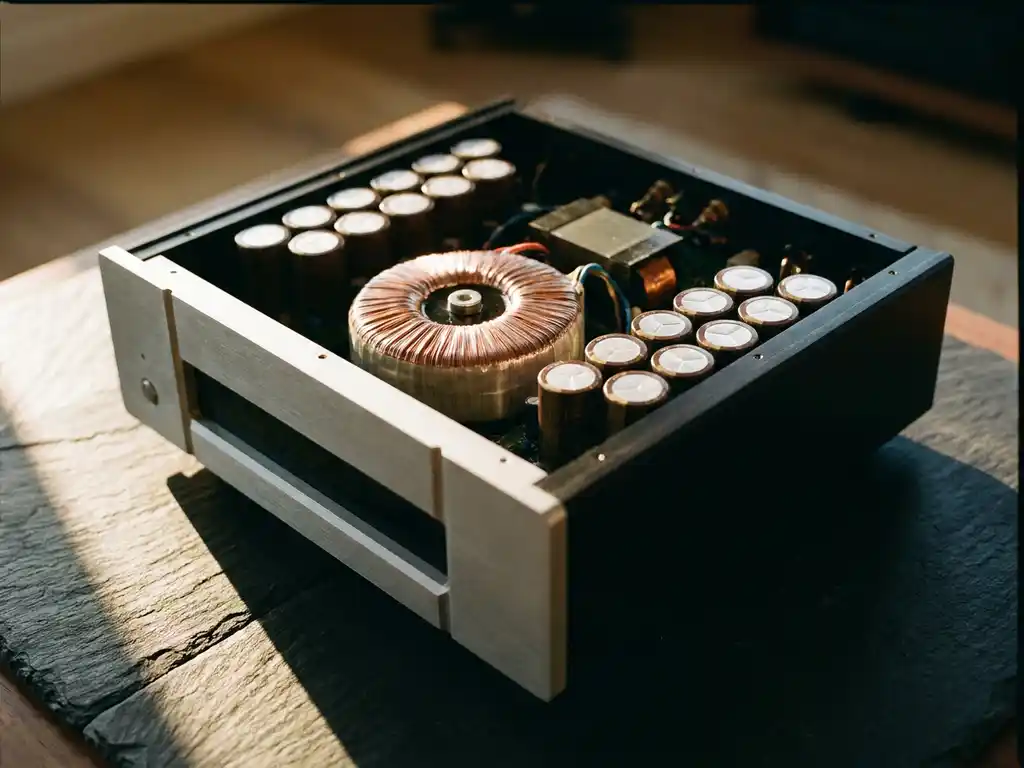
The power supply is one of the most consequential components inside any piece of audio electronics, yet it rarely receives the attention it deserves. While audiophiles debate amplifier topology, DAC chip choices, and cable geometry, the humble power supply quietly determines whether all those carefully chosen components can actually perform to their potential. Understanding how power supply quality shapes the sound you hear is essential for anyone serious about high-fidelity audio reproduction.
Why does power supply quality matter in audio components?
Power supply quality matters in audio components because every circuit inside an amplifier, DAC, or preamplifier depends on a stable, clean voltage rail to operate correctly. When the supply voltage fluctuates or carries electrical noise, those variations feed directly into the signal path, degrading the accuracy of musical reproduction. A well-designed power supply is the foundation on which every other performance characteristic is built.
Think of the power supply as the circulatory system of an audio component. The heart of the device, whether it is an amplifier stage or a digital-to-analogue converter, can only perform as well as the quality of the energy it receives. Ripple, noise, and instability in the supply rail translate into distortion, reduced dynamic range, and a loss of the fine detail that separates high-end audio from ordinary hi-fi. This is why experienced audio engineers often say that investing in the power supply is investing in every other part of the circuit simultaneously.
How does a poor power supply affect sound quality?
A poor power supply affects sound quality by introducing noise and instability into the audio signal chain. This manifests as a raised noise floor, reduced clarity in the midrange, smeared transient response, and a compressed sense of dynamic contrast. In severe cases, audible hum or hiss becomes apparent, but even subtle power supply deficiencies can rob music of its emotional impact and fine detail.
The effects are not always dramatic or immediately obvious. Power supply noise often operates at frequencies that sit beneath the threshold of conscious awareness but still colour the overall presentation. Listeners frequently describe the results of poor power supply design as a sound that feels congested, flat, or fatiguing over long listening sessions. The soundstage may narrow, instrument separation can blur, and the sense of three-dimensional space that well-recorded music contains simply fails to emerge. For audiophiles seeking genuine emotional engagement with their music, these are meaningful losses.
- Elevated noise floor: Background hiss or hum that masks low-level musical detail
- Reduced dynamic range: Peaks and quiet passages lose their contrast
- Smeared transients: The attack of percussion and plucked strings loses precision
- Compressed soundstage: Spatial information in recordings fails to resolve clearly
- Listening fatigue: The brain works harder to interpret a noisier, less coherent signal
What are the main types of power supplies used in audio electronics?
The main types of power supplies used in audio electronics are linear power supplies and switch-mode power supplies. Linear designs use a mains transformer, rectifier, and filter capacitors to convert AC mains power into stable DC. Switch-mode designs convert power using high-frequency switching transistors and are more compact and efficient, but require careful engineering to avoid introducing noise into sensitive audio circuits.
Beyond these two primary categories, some audio components use regulated linear supplies, which add active voltage regulation stages to further stabilise the output. Battery-based power supplies represent a third approach, eliminating mains-derived noise entirely, though they introduce their own practical limitations. Hybrid designs that combine elements of both linear and switch-mode approaches also exist, particularly in components where size and heat management are important considerations.
What is the difference between a linear and a switch-mode power supply?
The key difference between a linear and a switch-mode power supply is how each converts mains AC voltage into the stable DC voltage that audio circuits require. A linear supply uses a large transformer operating at mains frequency, followed by rectification and capacitor filtering, producing a quiet, stable output with minimal high-frequency noise. A switch-mode supply converts power using transistors switching at tens or hundreds of kilohertz, making it smaller and more efficient but potentially introducing high-frequency interference into the audio circuit.
For audiophile applications, linear power supplies have long been the preferred approach. Their operating principle is inherently low-noise because the transformer and capacitors work at low frequencies that are easy to filter. The trade-off is size and weight: a quality linear supply requires a substantial transformer and large filter capacitors, which is why high-end audio components are often significantly heavier than their specifications might suggest.
Switch-mode supplies, when designed with sufficient care and filtering, can perform well in audio applications and have become increasingly capable. However, the engineering challenge is considerable. The high-frequency switching energy must be prevented from coupling into sensitive analogue stages, which demands sophisticated filtering and layout discipline. In the most demanding reference-grade components, linear supplies remain the benchmark.
How do audio manufacturers design power supplies for high-end components?
High-end audio manufacturers design power supplies with a no-compromise approach that prioritises noise rejection, voltage stability, and isolation from the signal path. This typically involves oversized transformers with separate windings for different circuit sections, multiple stages of rectification and filtering, and dedicated regulation for the most sensitive stages such as analogue output and digital clock circuits.
Separation is a recurring principle in high-quality power supply design. Digital circuits generate noise by nature, and that noise must be prevented from reaching analogue stages. Accomplished designers use physically separate transformer windings, individual rectifier and filter banks, and sometimes entirely separate power supply boards for different sections of the component. The goal is to give each circuit section its own clean, stable source of energy that is isolated from the demands and noise of every other section.
Component selection within the power supply itself is equally important. High-grade filter capacitors with low equivalent series resistance, carefully chosen rectifier diodes with controlled switching behaviour, and precision voltage regulators all contribute to the quality of the final output. The layout of the power supply on the circuit board, and its physical positioning within the chassis relative to sensitive signal-carrying components, also plays a significant role in the final result.
Does mains power quality in the home affect audio performance?
Yes, mains power quality in the home does affect audio performance, particularly in systems with less robust power supply designs. Household mains power carries noise from appliances, lighting, and other electronics on the same circuit. This noise can enter an audio component through its power supply and degrade sound quality, though a well-engineered audiophile power supply will reject much of this interference before it reaches the signal path.
The degree of impact depends heavily on the quality of the component’s internal power supply. A high-end component with a well-regulated, heavily filtered linear supply will be far less susceptible to mains noise than a budget product with a minimal power supply. That said, even the best internal designs benefit from reasonably clean incoming power.
Audiophiles who notice that their system sounds better late at night, when fewer appliances are active and the mains is quieter, are often experiencing the real effect of mains power quality on their listening. Practical steps to improve the mains environment include dedicated audio circuits, high-quality power conditioning units, and careful attention to which devices share a circuit with the audio system. Avoiding circuits shared with motors, air conditioning units, and fluorescent lighting can make a meaningful difference in sensitive systems.
How Accustic Arts approaches power supply design
At Accustic Arts, we treat the power supply as one of the most critical engineering decisions in every product we develop. Our philosophy of Absolute Sound Fidelity Through Reproduction demands that every component in the signal chain, including the power supply, operates at the highest possible standard. Here is how we put that into practice:
- Oversized, custom-wound transformers with separate windings for analogue and digital sections, minimising cross-contamination between circuit domains
- Multiple independent regulation stages that give each sensitive circuit section its own clean, stable voltage rail
- Rigorous component selection throughout the power supply, using only high-grade capacitors, precision regulators, and carefully chosen rectifier components
- Extensive testing before dispatch, with individual product testing lasting up to two weeks to confirm that power supply performance meets our exacting standards under real-world conditions
- Experience drawn from professional environments, including recording studios and live PA systems, informing our understanding of how power quality translates into sonic performance
Every Accustic Arts component is designed so that the power supply never becomes the limiting factor in your listening experience. If you would like to explore our audio electronics products or learn more about the engineering principles behind our designs, we invite you to get in touch with us directly. Our team is ready to help you find the right component for your system and your musical journey.
—
Disclaimer: This article was created with the assistance of Artificial Intelligence and has been reviewed by our editorial team.