

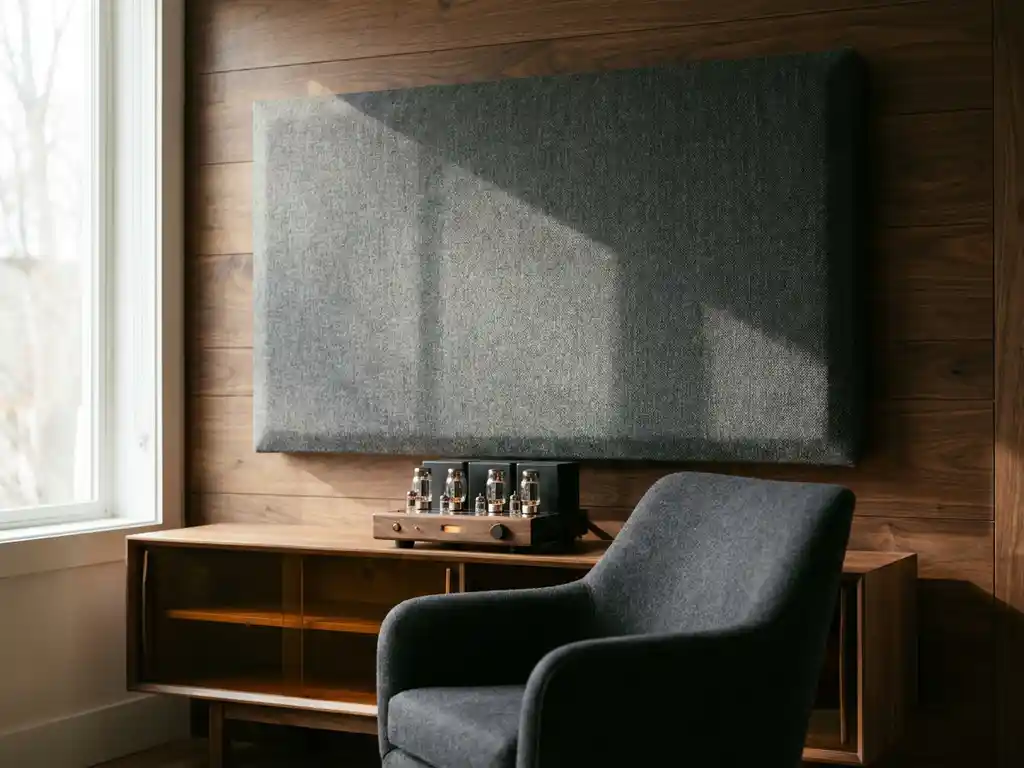
If you have ever set up a high-end audio system and felt that something was still missing despite the quality of your components, the room itself is likely the culprit. Acoustic panels are one of the most effective tools audiophiles use to take control of their listening environment and unlock the true potential of their equipment. This guide answers the most common questions about acoustic panels, room acoustics, and why treatment matters so much in a dedicated listening room.
What are acoustic panels and what do they actually do?
Acoustic panels are purpose-built surfaces designed to absorb, diffuse, or redirect sound energy within a room. Rather than allowing sound waves to bounce freely off hard walls, ceilings, and floors, acoustic panels intercept those reflections and convert the energy into small amounts of heat, reducing unwanted reverberation and improving the clarity of what you hear.
At their core, most absorptive panels consist of a dense, porous material such as mineral wool, rigid fiberglass, or open-cell foam wrapped in acoustically transparent fabric. When a sound wave enters this material, friction between the wave and the fibrous structure dissipates its energy. The result is a room that responds more predictably to the sound your system produces, rather than adding its own coloration on top of it.
Diffuser panels work differently. Instead of absorbing energy, they scatter reflections in multiple directions, breaking up standing waves and flutter echo while preserving a sense of liveliness and space. Many well-designed listening rooms use a combination of both approaches to achieve a balanced acoustic environment.
Why does a listening room need acoustic treatment?
A listening room needs acoustic treatment because untreated rooms introduce their own acoustic signature on top of the music. Hard, parallel surfaces create standing waves, flutter echo, and early reflections that smear transients, blur imaging, and distort the frequency balance you hear, regardless of how accurate your audio components are.
Even in a room filled with expensive furniture and soft furnishings, the acoustics are rarely optimized for critical listening. Low-frequency energy tends to build up in corners, creating bass modes that make certain notes sound louder or longer than they should. Mid and high-frequency reflections arrive at your ears a few milliseconds after the direct sound, effectively adding a second, slightly delayed version of the music that reduces stereo imaging precision and makes the soundstage feel vague or congested.
The practical consequence is that what you hear is a blend of your system’s output and the room’s acoustic response. No amount of component upgrades will fully resolve problems that originate in the room itself. Acoustic treatment addresses those problems at their source, giving your system the best possible conditions to perform as its designers intended.
What types of acoustic panels are used in listening rooms?
The main types of acoustic panels used in listening rooms are broadband absorbers, bass traps, diffusers, and combination panels. Each serves a distinct acoustic function, and most well-treated rooms incorporate more than one type.
- Broadband absorbers: Thick panels, typically 100mm or more, made from dense fibrous material. They absorb a wide range of frequencies from the upper bass through the high frequencies and are the workhorses of most acoustic treatment setups.
- Bass traps: Designed specifically to address low-frequency buildup. They are usually placed in corners, where bass energy concentrates most intensely. Corner-mounted bass traps can make a significant difference to the evenness of bass reproduction across the room.
- Diffusers: Panels with an irregular surface profile, often based on mathematical sequences, that scatter reflections rather than absorbing them. They are commonly used on rear walls and ceilings to maintain a sense of acoustic space without adding harsh reflections.
- Combination panels: Products that integrate both absorptive and diffusive elements, offering flexibility for rooms where space is limited or where a single panel needs to address multiple acoustic issues.
The right combination depends on the dimensions of the room, the materials of its surfaces, and the specific acoustic problems you are trying to solve.
Where should acoustic panels be placed in a listening room?
Acoustic panels should be placed at the primary reflection points in the room: the side walls at the first reflection points beside each speaker, the front wall behind the speakers, the rear wall behind the listening position, and the corners where bass energy accumulates. This placement addresses the most damaging reflections first.
A practical starting point is the mirror technique for side wall placement. Sit in your listening position and have someone slide a mirror along the side wall. Wherever you can see a speaker in the mirror is a first reflection point and a priority location for an absorber or diffuser. Repeating this process for the ceiling and rear wall gives you a clear map of where treatment will have the greatest impact.
Corner bass traps should run floor to ceiling if possible, as bass energy accumulates across the full height of a corner, not just at one point. Treating all four vertical corners of a room, and ideally the ceiling corners as well, produces a noticeably tighter and more even bass response.
The rear wall behind the listening position benefits from diffusion more than absorption in most rooms, as heavy absorption behind the listener can create an unnaturally dead acoustic environment. A mix of diffusion and light absorption on the rear wall tends to preserve a natural sense of space while still controlling flutter echo.
What’s the difference between acoustic panels and soundproofing?
Acoustic panels and soundproofing are fundamentally different solutions that address different problems. Acoustic panels control how sound behaves inside a room by managing reflections and absorption. Soundproofing prevents sound from passing through walls, floors, and ceilings from one space to another. The two are not interchangeable.
This distinction matters enormously for audiophiles. Hanging acoustic panels on your walls will not stop your neighbors from hearing your system, nor will it prevent external noise from entering your room. Effective soundproofing requires mass, decoupling, and airtight construction, typically involving additional layers of dense material, resilient channels, and sealed gaps.
Conversely, soundproofing a room does nothing to improve the acoustic quality inside it. A heavily soundproofed room with bare concrete walls and no acoustic treatment will still have severe flutter echo, standing waves, and poor imaging. Both elements serve a purpose, but they operate on entirely different physical principles and must be addressed separately.
For most home listening rooms, acoustic treatment delivers the greater audible improvement because it directly affects what you hear during playback. Soundproofing becomes a priority when external noise intrudes on listening sessions or when the listening room shares walls with occupied spaces that require quiet.
How do acoustic panels improve the performance of high-end audio equipment?
Acoustic panels improve the performance of high-end audio equipment by removing the room’s acoustic distortions from the listening experience, allowing the equipment to be heard as it was designed to sound. Without treatment, even the most accurate components are judged through the filter of an uncontrolled room, which can mask detail, distort tonal balance, and collapse the stereo image.
The improvements are often most noticeable in three areas. First, stereo imaging becomes sharper and more stable. When early reflections are controlled, the brain receives a cleaner direct signal and is better able to locate instruments and voices within the soundstage. Second, tonal balance becomes more accurate. Bass modes that previously made certain frequencies sound bloated or thin are reduced, revealing the true character of the recording. Third, low-level detail becomes more audible. Acoustic treatment lowers the noise floor of the room, so subtle musical cues that were previously masked by reflected energy become clearly perceptible.
For anyone who has invested in reference-grade electronics, acoustic treatment is not an optional extra. It is the final step that allows the full resolution and emotional expressiveness of high-quality components to be heard without interference. The investment in high-end audio products only reaches its full potential when the listening environment supports rather than undermines performance.
How ACCUSTIC ARTS Supports Your Listening Room Journey
At ACCUSTIC ARTS, we understand that a great listening room is the foundation on which every component performs. Our electronics are engineered to the highest standards of accuracy and emotional fidelity, and we know from decades of experience that room acoustics determine how much of that performance you actually hear. That is why we take a holistic view of the listening experience.
Here is how we can support you:
- Reference-grade components designed for real rooms: Our amplifiers, preamplifiers, DACs, and CD players are voiced and tested in real listening environments, not just in anechoic chambers, so they perform beautifully in treated home listening rooms.
- Expert guidance on system and room synergy: Our team has deep roots in professional recording studios and live venues, giving us practical insight into how rooms interact with electronics. We are happy to discuss your listening environment when helping you choose the right components.
- A product range that rewards acoustic investment: The resolution and midrange expressiveness our components deliver become fully audible only in a well-treated room. Pairing our electronics with proper acoustic treatment is one of the most rewarding upgrades any audiophile can make.
If you are ready to experience what your listening room is truly capable of, get in touch with us and let us help you find the right path forward.
—
Disclaimer: This article was created with the assistance of Artificial Intelligence and has been reviewed by our editorial team.