

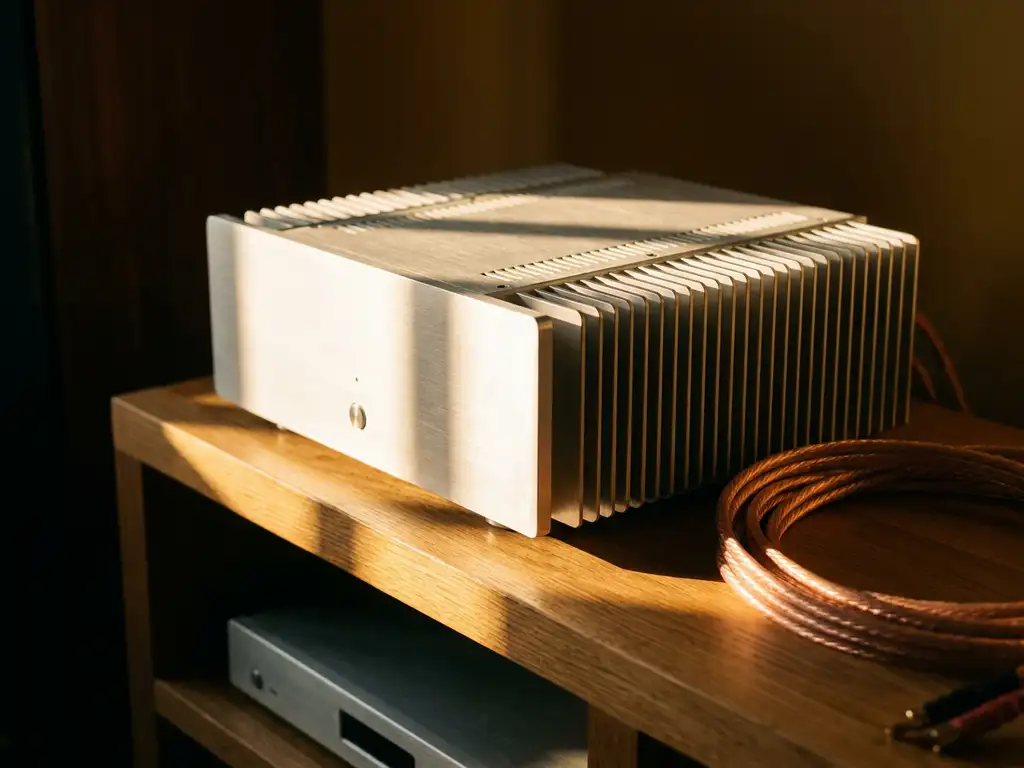
Ask two audiophiles why one amplifier sounds more alive than another, and you will likely get two very different answers. Some point to wattage, others to circuit topology, and a few will simply say the faster amplifier „just gets out of the way of the music.“ That intuition is not wrong, but the engineering behind amplifier speed and audio dynamics runs deeper than most listening sessions reveal. Understanding what actually makes a dynamic amplifier sound the way it does helps explain why two components with identical power ratings can deliver completely different emotional experiences.
The terms „fast“ and „dynamic“ are often used interchangeably in audiophile circles, but they describe related yet distinct qualities. Speed refers to how quickly an amplifier responds to rapid changes in the audio signal, while dynamics describe the range between the softest and loudest passages an amplifier can reproduce faithfully. Both qualities are shaped by engineering decisions made long before a component ever reaches a listening room, and together they determine whether music feels alive or merely accurate.
The engineering behind perceived speed and dynamics
Perceived speed in an amplifier is rooted in a measurable property called slew rate, which describes how fast the output voltage can change in response to an input signal. A higher slew rate means the amplifier can track rapid transients, such as a snare hit or a plucked string, without smearing the leading edge of the sound. When an amplifier cannot keep pace with the signal, those transients arrive slightly rounded and softened, and the music loses its sense of immediacy.
Bandwidth is equally important. An amplifier with a wide, flat frequency response well beyond the audible range tends to handle phase relationships within the audio band more cleanly, which contributes to the perception of tightness and precision. This is why engineering decisions about feedback topology, compensation networks, and gain structure all feed directly into how „fast“ a high-end amplifier ultimately sounds, even if none of those parameters appear on a standard specification sheet.
How power supply design shapes dynamic headroom
Dynamic headroom is the reserve capacity an amplifier draws on when music demands sudden bursts of power. The power supply is the foundation of that reserve, and its design determines whether an amplifier can respond to those demands instantly or stumble under the load.
A robust power supply uses high-capacity capacitors and a generously rated transformer to store energy close to the output stage. When a loud transient arrives, that stored energy discharges immediately, allowing the amplifier to deliver peak current without sagging. An undersized power supply, by contrast, creates a bottleneck. The voltage rail droops under load, and the amplifier compresses the dynamic peaks that make orchestral crescendos or jazz drum solos feel physically present. This is one reason why the best audiophile amplifiers are often significantly heavier than their rated output would suggest: the weight is largely transformer and capacitance, both of which serve dynamic performance directly.
Output stage topology and its impact on transient accuracy
The output stage is where the amplifier’s design philosophy meets the loudspeaker, and its topology has a direct bearing on transient accuracy. Class A operation keeps the output devices conducting continuously, eliminating the crossover distortion that can smear fine detail at low signal levels. The tradeoff is heat and inefficiency, but the sonic reward is a smoothness and coherence through transients that many listeners find uniquely satisfying.
Class AB designs switch between Class A and Class B operation depending on signal level, offering a practical balance between efficiency and performance. When implemented with care, particularly with well-matched output devices and tight bias control, Class AB amplifiers can track transients with impressive accuracy. Class D amplifiers, which switch output devices at very high frequencies, have matured considerably and can achieve excellent measured performance, though their perceived sonic character remains a subject of genuine debate among experienced listeners. Each topology involves engineering compromises, and the quality of execution within any given class matters far more than the class itself.
Why component quality determines real-world dynamic performance
Specifications describe an amplifier under ideal, steady-state conditions. Real music is anything but steady-state, and the components inside the circuit determine how well the design holds together when conditions become demanding.
Capacitors with low equivalent series resistance charge and discharge more quickly, supporting faster transient response. Resistors with tight tolerances keep gain stages balanced and predictable. Transistors and output devices selected for consistent operating parameters reduce the small timing errors that accumulate into a sense of vagueness or sluggishness. The wiring, the solder joints, the quality of the printed circuit board, and even the mechanical rigidity of the chassis all contribute to or subtract from the amplifier’s ability to perform as its designer intended.
At Accustic Arts, we approach component selection as a non-negotiable part of the design process. Every component in our amplifiers is chosen for its measured performance under dynamic conditions, not just its nominal value, and each finished unit undergoes individual testing for up to two weeks before it leaves our facility. That process exists precisely because real-world dynamic performance cannot be assumed from a parts list alone.
What to listen for when evaluating amplifier dynamics
Evaluating amplifier performance in a listening session requires knowing where to focus attention. The most revealing moments in music are not the loud passages but the transitions, the instant a quiet passage gives way to something powerful, or the moment a single instrument emerges from a complex ensemble.
Listen for how the amplifier handles the leading edge of percussive sounds. A fast amplifier renders the attack of a drum or a piano note with a clean, defined onset rather than a softened blur. Pay attention to the lowest dynamic levels as well. An amplifier with genuine dynamic range preserves detail and texture in quiet passages rather than collapsing them into a flat, undifferentiated background. Finally, notice whether the soundstage holds its shape when the music becomes complex and loud. An amplifier that loses composure under load tends to compress the sense of space and separation between instruments, a subtle but telling sign that its dynamic reserves are being stretched.
Bringing familiar recordings to a listening session is the most reliable way to hear these qualities clearly. Music you know intimately will reveal differences between components that a piece heard for the first time simply cannot, because you already carry a reference for how it should feel.
Ähnliche Artikel
- What is the difference between a tube amplifier and a solid-state amplifier?
- How do you know if your listening room is hurting your sound?
- Was ist der Sweetspot im Hörraum und wie findet man ihn?
- What is the sweet spot in a listening room and how do you find it?
- Warum brauchen Audiogeräte eine Einspielzeit?