

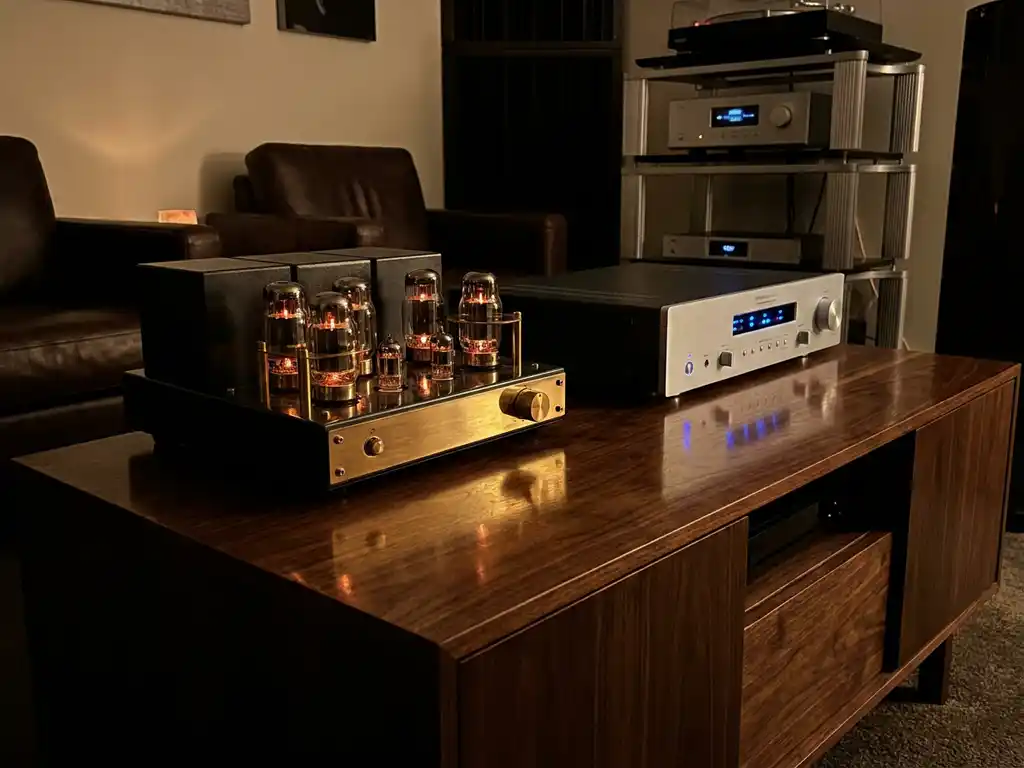
Choosing between a tube amplifier and a solid-state amplifier is one of the most debated topics in high-end audio. Both technologies have passionate supporters, and for good reason — each offers a genuinely different listening experience. Understanding how they work, how they sound, and what it means to live with each type will help you make a confident, informed choice for your system.
What is a tube amplifier and how does it work?
A tube amplifier (also called a valve amplifier) is an amplifier that uses vacuum tubes — glass-enclosed electronic components that control electrical current through a heated filament and a vacuum — to amplify an audio signal. Tubes regulate current flow by modulating electron streams between internal electrodes, producing an amplified output signal with a characteristic warmth and harmonic richness.
Vacuum tubes were the dominant amplification technology from the early twentieth century through the 1960s. Each tube contains a cathode that emits electrons when heated, a control grid that modulates the electron flow, and an anode (plate) that collects the current. This process introduces a small amount of even-order harmonic distortion — predominantly second-order — which many listeners perceive as pleasing rather than harsh. The output transformers used in most tube amplifier designs also play a significant role in shaping the final sound, acting as an interface between the high-impedance tube circuitry and the speaker load.
Tube amplifiers typically run at high voltages and relatively low power output compared to solid-state designs. This means they generally pair best with efficient loudspeakers that do not demand enormous current delivery.
What is a solid-state amplifier and how does it differ internally?
A solid-state amplifier uses transistors — semiconductor devices made from materials such as silicon — to amplify audio signals. Unlike vacuum tubes, transistors operate at low voltages, require no warm-up time, and generate less heat. They are more compact, more reliable over time, and capable of delivering very high power output with low measured distortion.
Inside a solid-state amplifier, bipolar junction transistors (BJTs) or field-effect transistors (FETs) perform the same fundamental task as tubes: controlling a larger current with a smaller one. Because transistors do not introduce the same even-order harmonic character as tubes, solid-state amplifiers tend to measure with lower total harmonic distortion (THD). However, when solid-state circuits do distort, the distortion tends to be of a higher odd-order character, which some listeners find less musically natural.
Modern solid-state amplifier design has advanced enormously. High-end transistor amplifiers can offer exceptional bandwidth, iron-fisted control over bass frequencies, and the ability to drive virtually any loudspeaker load with authority — qualities that make them a strong foundation for reference-grade listening systems.
What does a tube amplifier sound like compared to a solid-state amplifier?
A tube amplifier typically sounds warm, open, and three-dimensional, with a naturally rounded midrange that many listeners describe as musical or emotionally involving. A solid-state amplifier generally sounds more neutral, detailed, and controlled, with tighter bass and a more analytical presentation. The difference is real, though the gap narrows significantly at the highest quality levels.
The sonic signature of tube amplification comes largely from its harmonic distortion profile and the behaviour of output transformers. The even-order harmonics tubes generate tend to blend with the musical signal in a way that feels organic rather than irritating. This quality is especially noticeable in the midrange, where voices and acoustic instruments live — the frequency range that matters most for emotional connection to music.
Solid-state amplifiers, by contrast, tend to excel in areas like bass definition, dynamic headroom, and low-level detail retrieval. At high quality levels, a well-designed transistor amplifier can sound remarkably transparent and natural, without the coloration sometimes associated with lower-tier solid-state designs.
It is worth noting that the difference between a mediocre tube amplifier and a mediocre solid-state amplifier is often more pronounced than the difference between two well-engineered examples of each type. At the reference level, both technologies are capable of deeply satisfying musical reproduction.
Which amplifier type is better for high-end audio listening?
Neither tube nor solid-state amplifiers are universally better for high-end audio listening — the right choice depends on your loudspeakers, your musical preferences, and what qualities you prioritise in a listening experience. For emotionally engaging midrange and acoustic music, tubes are often preferred. For bass-heavy genres, high-volume listening, or difficult speaker loads, solid-state amplifiers typically hold the advantage.
The audiophile community has long recognised that the best amplifier is the one that works in harmony with the rest of your system. Speaker sensitivity and impedance characteristics play a major role: tube amplifiers, particularly single-ended designs, thrive with high-sensitivity speakers, while solid-state amplifiers can control low-impedance, power-hungry designs with far greater ease.
Some manufacturers address this by developing hybrid designs that combine tube input or driver stages with solid-state output stages, capturing some of the harmonic warmth of valves alongside the power and control of transistors. These hybrid amplifiers represent a compelling middle ground for listeners who do not want to choose between the two worlds.
What are the practical differences in owning a tube vs. solid-state amplifier?
Owning a tube amplifier requires more active maintenance than a solid-state design. Tubes are consumable components that wear out over time and need periodic replacement, typically every few years depending on usage. Tube amplifiers also need a warm-up period before reaching optimal performance, run hotter, and are generally more sensitive to vibration. Solid-state amplifiers are more set-and-forget by comparison.
Here is a practical summary of the key ownership differences:
- Maintenance: Tube amplifiers require tube replacement every few years; solid-state amplifiers have no consumable components under normal use
- Warm-up time: Tubes benefit from a 20 to 30 minute warm-up period; solid-state amplifiers perform well almost immediately
- Heat output: Tube amplifiers run significantly hotter and require adequate ventilation around the unit
- Reliability: Solid-state amplifiers generally have a longer service life with fewer failure points
- Power output: Solid-state amplifiers can deliver far higher power levels at lower cost per watt
- Speaker compatibility: Solid-state amplifiers are compatible with a wider range of loudspeaker designs
- Aesthetic appeal: Many audiophiles find the glowing tubes of a valve amplifier visually and emotionally appealing in a listening room
Neither set of trade-offs is a dealbreaker for a committed audiophile. They simply reflect different priorities and different ways of engaging with the listening experience.
Should I choose a tube or solid-state amplifier for my system?
Choose a tube amplifier if you value a warm, harmonically rich midrange, listen primarily to acoustic music, vocals, or jazz, and own efficient loudspeakers. Choose a solid-state amplifier if you prioritise neutrality, bass control, high power output, and compatibility with a wide range of speakers. If you want elements of both, a hybrid amplifier is worth serious consideration.
Beyond the technology itself, the quality of the implementation matters far more than the topology. A thoughtfully engineered solid-state amplifier will outperform a poorly designed tube design every time, and vice versa. When evaluating any amplifier, listen critically, consider the full system context, and trust your own ears over specifications alone.
Visiting a dedicated high-end audio dealer where you can audition amplifiers in a controlled environment is the most reliable way to make this decision. Reading reviews from trusted publications and engaging with the audiophile community can also help you narrow your shortlist before you listen.
How Accustic Arts Approaches Tube and Solid-State Amplification
At Accustic Arts, we do not believe in choosing sides in the tube versus solid-state debate. Instead, we engineer each product to deliver the qualities that matter most to serious music lovers: natural, emotionally engaging sound that stays faithful to the original recording. Our approach draws on decades of experience in both recording studios and high-end audio manufacturing, which means every design decision is grounded in how music actually sounds in real acoustic spaces.
Here is what sets our amplifier range apart:
- Tube hybrid components that combine the harmonic richness of valve technology with the control and reliability of solid-state output stages
- Pure solid-state designs engineered for exceptional neutrality, dynamic authority, and compatibility with demanding loudspeaker loads
- Rigorous two-week individual testing for every component before it leaves our facility in Lauffen am Neckar, Germany
- Precision component selection using only high-grade parts and the latest construction principles to ensure long-term performance and reliability
- A philosophy rooted in Absolute Sound Fidelity Through Reproduction — meaning our goal is always the music, never the technology for its own sake
Whether you are drawn to the warmth of valve amplification or the precision of a high-end transistor design, we have an amplifier built to elevate your listening experience. Explore our full amplifier range to find the right match for your system, or get in touch with us to discuss which Accustic Arts amplifier is the right fit for your loudspeakers and musical tastes.
—
Disclaimer: This article was created with the assistance of Artificial Intelligence and has been reviewed by our editorial team.
Ähnliche Artikel
- Do amplifiers wear out or degrade over time?
- What is acoustic sound quality and why does it matter?
- Was sind die Vorzüge von hochwertigen CD-Spielern gegenüber Streaming?
- How does a D/A converter affect the sound of digital music?
- Was ist Abbildungsgenauigkeit in der Audiowiedergabe und wie verbessert man sie?