

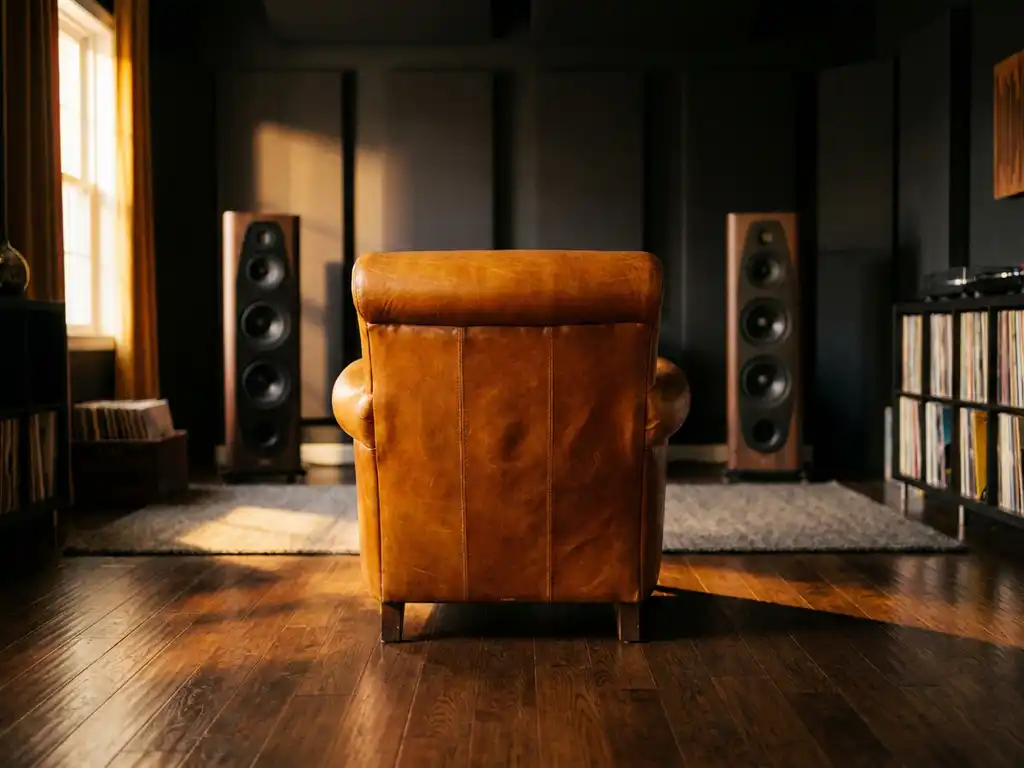
If you have ever sat down in front of your speakers and felt like something was missing, only to shift a few inches and suddenly hear the music come alive, you have already experienced the sweet spot firsthand. It is one of those phenomena that every serious listener encounters, yet few fully understand. Whether you are building your first dedicated listening room or refining a system you have lived with for years, knowing how to locate and optimize your audio sweet spot can transform the way you experience music.
What is the sweet spot in a listening room?
The sweet spot in a listening room is the specific listening position where sound from both speakers combines most accurately, creating the most balanced, detailed, and three-dimensional stereo image. At this point, the listener hears the music as the recording engineer intended, with precise imaging, correct tonal balance, and a convincing sense of depth and width.
The concept originates from stereo reproduction theory. When two speakers play back a stereo recording, each carries slightly different information for the left and right channels. The sweet spot is where those two channels blend seamlessly, producing a coherent soundstage with a stable phantom center image. Move too far to one side, and the stereo image collapses toward the nearer speaker. Sit too close or too far, and the balance between direct sound and room reflections shifts, softening detail and blurring instrument placement. The stereo sweet spot is, in essence, the seat with the best view of the sonic stage.
Why does the sweet spot matter for sound quality?
The sweet spot matters because it is the only position in the room where all the acoustic variables align correctly. Outside of the optimal listening position, frequency response becomes uneven, stereo imaging loses precision, and the emotional connection to the music weakens. Even a world-class hi-fi system cannot compensate for a poorly chosen listening position.
Room acoustics play a constant role in what you hear. Sound waves reflect off walls, floors, and ceilings before reaching your ears. At the sweet spot, these reflections arrive at the right time and at the right level relative to the direct sound from the speakers, supporting rather than obscuring the music. Away from this position, early reflections can arrive too soon or too prominently, smearing transients and dulling the sense of air and space around instruments. For audiophiles who invest in high-end audio setups, ignoring the listening position means leaving a significant portion of that investment unrealized.
How do speaker placement and room dimensions affect the sweet spot?
Speaker placement and room dimensions directly determine where the sweet spot falls and how large it is. The geometry of the equilateral triangle formed by the two speakers and the listening position, combined with the room’s length, width, and height, sets the acoustic foundation for everything else.
A widely used starting principle is the equilateral triangle rule: place your speakers so that the distance between them equals the distance from each speaker to your listening position. This creates a symmetrical arrangement where both speakers are equally weighted at the sweet spot. Toe-in, meaning the degree to which speakers angle toward the listener, also shifts where the stereo image locks in most convincingly.
Room dimensions introduce additional complexity through standing waves, also called room modes. These are frequencies that build up or cancel out at specific points in the room depending on its dimensions. A listening position that sits at a bass node, for example, will hear an exaggerated low end that does not reflect what is actually in the recording. Avoiding these nodes, typically by positioning the listening seat somewhere between one third and two thirds of the room’s length, helps produce a more accurate tonal balance at your hi-fi listening room’s sweet spot.
How do you find the sweet spot in your listening room?
To find the sweet spot, start by positioning your speakers symmetrically along the shorter wall of the room and apply the equilateral triangle rule. Then use a familiar, well-recorded piece of music to listen for a stable, centered vocal or lead instrument image while moving your listening chair forward and backward until the stereo image snaps into focus.
Here is a practical step-by-step approach:
- Set up symmetrically. Both speakers should be the same distance from the side walls and angled equally toward the listening position.
- Apply the equilateral triangle rule. The distance between your speakers should roughly match the distance from each speaker to your ears.
- Play a mono reference track. A mono signal collapses to a single phantom center image. If it sounds centered and focused, your position is well-aligned.
- Check bass balance. Move your seat forward or back in small increments while listening to bass-heavy passages. Find the position where bass sounds even and controlled rather than boomy or thin.
- Mark the position. Once you find the optimal listening position, note the exact distance from the front wall and side walls so you can return to it reliably.
Some listeners use a real-time analyzer app on a phone or tablet to measure frequency response at different seat positions, which adds an objective layer to what your ears are telling you. That said, your ears remain the most important instrument in this process.
What room treatments help expand the sweet spot?
Acoustic room treatments expand the sweet spot by reducing the intensity of early reflections and controlling standing waves, which makes accurate stereo imaging available across a wider listening area rather than a single narrow point.
The most effective treatments to consider include:
- Absorption panels at first reflection points. These are the wall positions where sound from each speaker bounces directly toward the listening seat. Treating these spots with broadband absorbers reduces comb filtering and widens the sweet zone.
- Bass traps in corners. Low frequencies accumulate in room corners. Bass traps absorb this energy, evening out the low-frequency response across the room and making the listening position less sensitive to small movements.
- Diffusers on the rear wall. Rather than absorbing all sound behind the listener, diffusers scatter it, preserving a sense of spaciousness while preventing strong reflections from muddying the soundstage.
- Rugs and soft furnishings. A thick rug between the speakers and the listening seat reduces floor reflections, which can otherwise smear high-frequency detail.
A well-treated room does not eliminate the sweet spot, it deepens it and makes it more forgiving. You can move a foot in either direction and still hear a convincing, well-defined stereo image, which makes the listening experience more relaxed and natural.
How does audio equipment quality influence the sweet spot experience?
High-quality audio equipment does not change where the sweet spot is located, but it dramatically improves what you hear when you sit in it. Precise components with low distortion and accurate imaging capabilities allow the stereo sweet spot to reveal more of the recording, delivering finer detail, more convincing depth, and a stronger emotional connection to the music.
Lower-quality components tend to compress the dynamic and spatial information in a recording. The result is that even from the perfect listening position, the soundstage feels flat and the music lacks presence. By contrast, well-engineered electronics, from a transparent preamplifier to a musically accurate DAC or CD player, reproduce the spatial cues embedded in recordings with far greater precision. Instruments occupy distinct positions in the soundstage, voices carry texture and breath, and the sense of a real acoustic space becomes palpable.
This is why experienced audiophiles treat room optimization and equipment quality as equally important. Finding your audio sweet spot gives your system the best possible acoustic conditions. Investing in genuinely high-performance electronics ensures there is something worth hearing when you sit down in it. The two pursuits reinforce each other, and neither is complete without the other.
How Acoustic Arts Helps You Get the Most from Your Listening Room
We design every Accustic Arts component with one goal in mind: to place you as close as possible to the music, regardless of how challenging your room may be. When your electronics are accurate and musically truthful, the sweet spot becomes not just a technical position but a genuinely moving place to sit. Here is how we support that experience:
- Precise stereo imaging. Our amplifiers and source components are engineered to preserve the spatial information in recordings, making it easier to lock in a convincing soundstage from your listening position.
- Natural tonal balance. With low coloration across the frequency range, our components reveal what the recording actually contains rather than imposing a character of their own, which means your room treatments and speaker placement choices have a real effect.
- Emotionally engaging midrange reproduction. Our signature midrange performance ensures that even in imperfect acoustic conditions, voices and instruments carry the expressiveness that makes music feel live.
- Uncompromising build quality. Every component undergoes individual testing for up to two weeks before it leaves our facility, so what arrives in your listening room performs exactly as intended.
If you are ready to experience what a truly high-end audio setup can do in your listening room, explore our full range of high-end audio components or get in touch with us to discuss which components are the right fit for your space and your musical priorities.
—
Disclaimer: This article was created with the assistance of Artificial Intelligence and has been reviewed by our editorial team.