

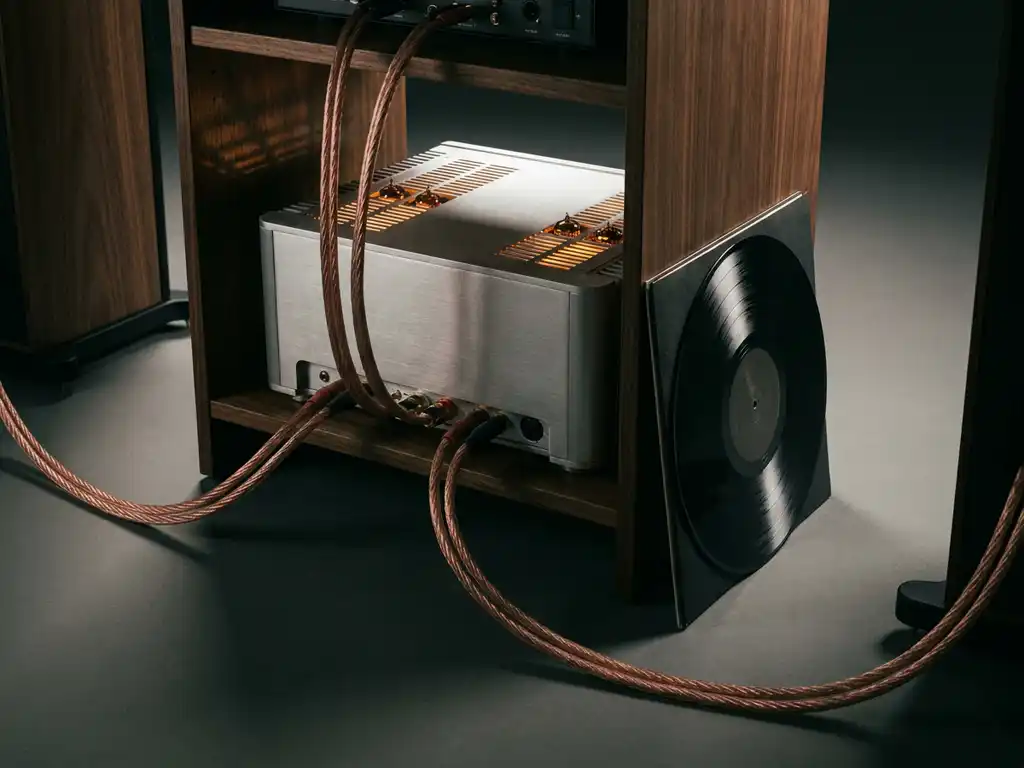
Every hi-fi system has a moment where everything clicks, where the music stops sounding like audio playback and starts feeling like a live performance. More often than not, the amplifier is the component making that possible. Yet for many listeners stepping into the world of high-fidelity audio, the amplifier remains one of the least understood pieces of the puzzle. Understanding what an amplifier hi-fi system relationship actually looks like, and why it matters so much, is the first step toward building a system that genuinely moves you.
At its core, the job of a hi-fi amplifier is deceptively simple: take a small electrical signal and make it large enough to drive a loudspeaker. But that description barely scratches the surface. The way an amplifier performs that task, the precision, the speed, the control, determines whether music sounds flat and mechanical or rich and alive. Let’s walk through exactly how it works.
From weak signal to full sound
The signal that leaves a source component, a CD player, a streaming device, or a turntable, is tiny. We’re talking millivolts of electrical energy, nowhere near powerful enough to move a speaker cone. The audio amplifier function is to take that fragile signal and multiply its power, sometimes by a factor of hundreds, while preserving every detail encoded within it.
This process is not simply a matter of turning up the volume. A well-designed amplifier must amplify the signal linearly, meaning the output should be a faithful, scaled-up version of the input with no added distortion, no smearing of transients, and no loss of fine detail. Any deviation from that ideal is something the listener will eventually hear, even if they struggle to name exactly what feels off. The difference between an amplifier that does this well and one that does it poorly is the difference between music that engages you and music that merely plays in the background.
Preamplifier vs. power amplifier: what each stage handles
Most amplification systems divide the work into two distinct stages, each with a specific role to play. Understanding the distinction between a preamplifier and a power amplifier helps explain why serious audiophiles often treat them as separate components rather than a single box.
The preamplifier handles source selection, volume control, and the initial amplification of the signal to what is called line level. It acts as the control centre of the system, managing inputs from multiple sources and sending a clean, consistent signal downstream. The power amplifier then takes that line-level signal and delivers the high-current output needed to drive loudspeakers with authority. It does not need to make decisions about sources or volume, its only job is to amplify with maximum fidelity and power delivery. Separating these two functions allows each stage to be optimised independently, which is one reason why high-end separates so often outperform all-in-one solutions.
How amplifier quality shapes the listening experience
The technical specifications of an amplifier, output power, signal-to-noise ratio, total harmonic distortion, matter, but they do not tell the whole story. What truly separates a great high-end amplifier from an average one is the character of its performance across the entire audible frequency range, particularly in the midrange where the human voice and most musical instruments live.
A high-quality amplifier preserves the texture of a vocalist’s breath, the decay of a piano note, and the subtle spatial cues that place instruments in a three-dimensional soundstage. It controls the loudspeaker with precision, ensuring that bass notes are tight rather than bloated and that high frequencies are extended without becoming harsh. At Accustic Arts, we have always placed particular emphasis on midrange reproduction, the emotional core of music, because that is where the difference between technically correct sound and genuinely moving sound is most profoundly felt. Components are tested for up to two weeks before leaving our facility, precisely because we know how much these fine distinctions matter to serious listeners.
Matching an amplifier to the rest of your system
Even the finest amplifier will underperform if it is poorly matched to the other components around it. System synergy is not a vague audiophile concept, it has real, measurable implications for sound quality.
The most important practical consideration is the relationship between amplifier output power and loudspeaker sensitivity. A speaker with low sensitivity requires significantly more power to reach the same volume as a more efficient design. Equally important is impedance compatibility: an amplifier should be comfortable driving the impedance load presented by the speaker across the full frequency range, not just at a nominal rating. Beyond these electrical considerations, the source components feeding the amplifier also matter. A high-quality amplifier signal chain is only as strong as its weakest link, which is why building a balanced system, where no single component dramatically outclasses or underserves the others, leads to the most satisfying results.
Integrated vs. separate amplifier components
The choice between an integrated amplifier and a separate preamplifier and power amplifier combination is one of the most common decisions audiophiles face, and there is no single right answer, it depends on priorities, space, and budget.
An integrated amplifier combines both amplification stages into a single chassis. Modern integrated designs have reached extraordinary performance levels, and for many listeners they represent an ideal balance of convenience, value, and sonic quality. Separates, on the other hand, offer greater flexibility and the potential for higher performance ceilings, since each component can be engineered without compromise and upgraded independently over time. For those building a long-term reference system, separates often make more sense. For listeners who want exceptional sound in a more streamlined setup, a well-designed integrated can be the smarter choice. The key is to evaluate each option on its own merits rather than assuming that more boxes automatically means better sound.
Whichever path makes sense for a given listener, the amplifier remains the beating heart of any hi-fi system. Getting it right, understanding what it does, how it interacts with other components, and what qualities to prioritise, opens the door to a listening experience that rewards every hour spent with music.
Ähnliche Artikel
- Why do high-end audio components use premium internal parts?
- Wie vergleicht sich ein Vollverstärker mit einer Vor-Endstufen-Kombination?
- How do you improve acoustics in a dedicated listening room?
- What is soundstage and how is it created in a hi-fi system?
- Was ist Klirrfaktor und wie beeinflusst er den Klang?