

Even the most carefully chosen audio components can underperform when the conditions around them are not right. Poor sound quality in a home audio setup is rarely the result of a single problem. More often, it is a combination of factors working against each other. Understanding what those factors are is the first step toward genuinely better sound, and fortunately, many of the most common issues are fixable without spending a fortune.
How does room acoustics affect your sound quality?
Room acoustics are one of the most significant and most overlooked causes of poor sound quality. The physical characteristics of your listening room, including its size, shape, surface materials, and furnishings, directly shape how sound waves travel, reflect, and reach your ears. A technically excellent system can sound muddy, harsh, or lifeless purely because of the room it sits in.
Sound waves bounce off hard surfaces like walls, floors, and ceilings. When those reflections arrive at your ears a fraction of a second after the direct sound, they cause comb filtering, smearing of transients, and a loss of stereo imaging. Low frequencies behave differently, building up in corners and along walls to create boomy, one-note bass that masks detail across the entire frequency range.
Practical improvements include:
- Adding rugs, curtains, or upholstered furniture to absorb high-frequency reflections
- Placing acoustic panels or bookshelves at first-reflection points on side walls
- Using bass traps in corners to reduce low-frequency buildup
- Avoiding perfectly symmetrical, parallel wall arrangements where standing waves are most severe
Even modest acoustic treatment can reveal layers of detail that were previously buried, making this one of the highest-value upgrades available to any hi-fi enthusiast.
What’s the difference between a weak and a poor-quality audio component?
A weak audio component lacks sufficient power or resolution to perform at its best in a given system or room, while a poor-quality component introduces its own distortions, colorations, or noise regardless of the conditions. The distinction matters because the solution is different in each case. A weak component may simply need to be matched more carefully; a poor-quality one needs to be replaced.
Weakness typically shows up as a lack of dynamic range, thin bass, or an inability to drive demanding speakers to satisfying volume levels. These are symptoms of insufficient amplifier power, a low-output source, or an impedance mismatch between components. The system may sound fine at low volumes but compress and harden as levels rise.
Poor quality, by contrast, manifests as persistent harshness, grain, or a flat and lifeless presentation at any volume. Budget components often use inferior capacitors, resistors, and circuit topologies that introduce measurable and audible distortion. The result is a sound that fatigues the listener, lacks natural timbre, and fails to convey the emotional content of music.
When evaluating your own system, ask whether the problem changes with volume. If it does, you are likely dealing with a matching or power issue. If the character of the problem stays consistent, the component itself is the source.
How does speaker placement affect sound in a home setup?
Speaker placement has a profound effect on sound quality because it determines how the speaker interacts with both the listener and the room. Even high-quality speakers will produce poor imaging, uneven bass, and a collapsed soundstage if they are positioned incorrectly. Placement is one of the most powerful and cost-free tuning tools available.
The most common placement mistakes include:
- Placing speakers too close to walls: This reinforces bass frequencies artificially, creating a bloated and indistinct low end
- Unequal distances from side walls: Asymmetrical placement disrupts stereo imaging and shifts the soundstage off-center
- Incorrect toe-in angle: Speakers aimed too far inward or outward narrow or widen the sweet spot and affect high-frequency balance
- Listening position too close to the rear wall: This introduces bass reinforcement at the listening seat and degrades clarity
A good starting point is to form an equilateral triangle between the two speakers and the listening position, with each speaker pulled at least 60 to 90 centimeters away from the rear wall. From there, small adjustments to toe-in and distance can yield surprising improvements in focus, depth, and tonal balance.
Can cables and connections cause poor audio quality?
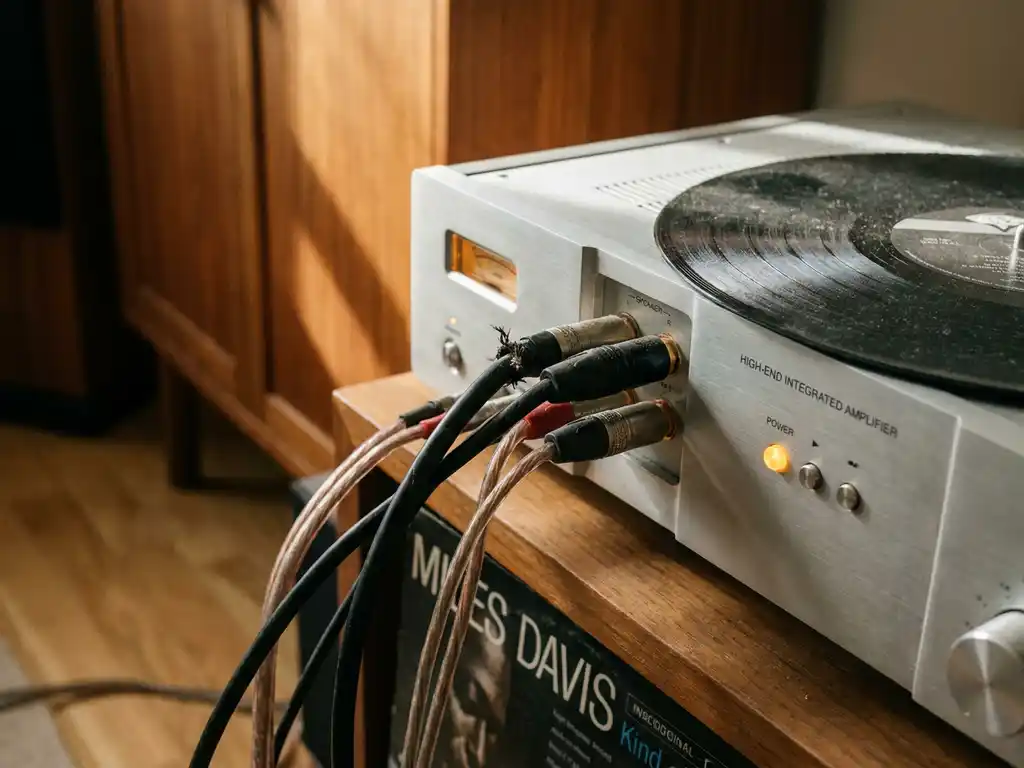
Yes, cables and connections can cause measurable and audible degradation in audio quality, though the degree of impact depends on the type of connection, the length of the cable run, and the quality of the terminations. Corroded connectors, loose contacts, and poorly shielded cables are genuine sources of audio quality issues in a home setup.
Oxidation on RCA or XLR connectors increases contact resistance and introduces noise. A loose connection at any point in the signal chain can cause intermittent dropouts, channel imbalance, or a subtle haze that reduces clarity. Ground loops, often introduced through unshielded interconnects or shared power circuits, add a persistent hum that undermines the listening experience.
That said, the relationship between cable cost and audible improvement is not linear. The most meaningful gains come from ensuring connections are clean, tight, and properly shielded, rather than from spending disproportionate amounts on exotic cables. Balanced XLR connections, where your components support them, offer a practical advantage in longer runs by rejecting common-mode noise.
Regularly cleaning connectors with a contact cleaner and checking that all terminations are secure is a simple maintenance habit that preserves the integrity of your signal path.
How can you improve sound quality without replacing your whole system?
Improving sound quality without replacing your entire system is very achievable. The most effective approach focuses on the areas with the highest impact first: room acoustics, speaker placement, and signal path integrity. These changes cost little or nothing and often reveal that your existing components are more capable than they appeared.
Work through these steps in order:
- Optimize speaker placement using the equilateral triangle method and experiment with distance from walls and toe-in angle
- Address room acoustics with soft furnishings, rugs, and targeted absorption at first-reflection points
- Inspect and clean all connections, replacing any cables with damaged shielding or corroded terminations
- Evaluate component matching to ensure your amplifier has sufficient power for your speakers and that source components are not the limiting factor
- Isolate components from vibration using dedicated shelving or isolation platforms, which can reduce microphonic interference in sensitive electronics
If these steps reveal a genuine ceiling in your system’s performance, the most strategic upgrade is usually the component that is the weakest link. In many systems, that is the source or the amplifier rather than the speakers. Upgrading a single well-chosen component can transform the character of an entire system. You can explore high-end audio components designed to serve as exactly that kind of transformative upgrade.
How ACCUSTIC ARTS Helps You Achieve the Sound Your System Is Capable Of
At Accustic Arts, we design electronics specifically to eliminate the most common causes of poor sound quality at the component level. Every product we build is engineered to stay true to the music, with no artificial coloration, no compromises in parts quality, and no shortcuts in the testing process. Here is how we address the issues discussed in this article:
- Uncompromising component quality: We use only precision, high-grade parts across every product line, ensuring that distortion and noise introduced by the electronics themselves are reduced to the absolute minimum
- Rigorous testing: Each component undergoes an individual test process that can last up to two weeks before it leaves our facility, so you receive a product that performs exactly as designed
- Optimized signal path design: Our preamplifiers, CD players, D/A converters, integrated amplifiers, and power amplifiers are engineered to work together, reducing the matching problems that cause so many home audio setups to underperform
- Real-world development context: Our experience in recording studios and professional live venues informs how we voice our products, meaning they are designed to reproduce music as it actually sounds, not as a flattering approximation of it
If you are ready to address the root causes of poor sound quality in your home audio setup and want to hear what your music is truly capable of, we would love to help. Get in touch with us to discuss your system and find the right path forward.
—
Disclaimer: This article was created with the assistance of Artificial Intelligence and has been reviewed by our editorial team.
Ähnliche Artikel
- What is input sensitivity on an amplifier?
- Wie verbessert man die Akustik in einem dedizierten Hörraum?
- Wie vergleicht sich ein Vollverstärker mit einer Vor-Endstufen-Kombination?
- Why does the same music sound different on different systems?
- Warum klingt dieselbe Musik auf verschiedenen Anlagen unterschiedlich?