

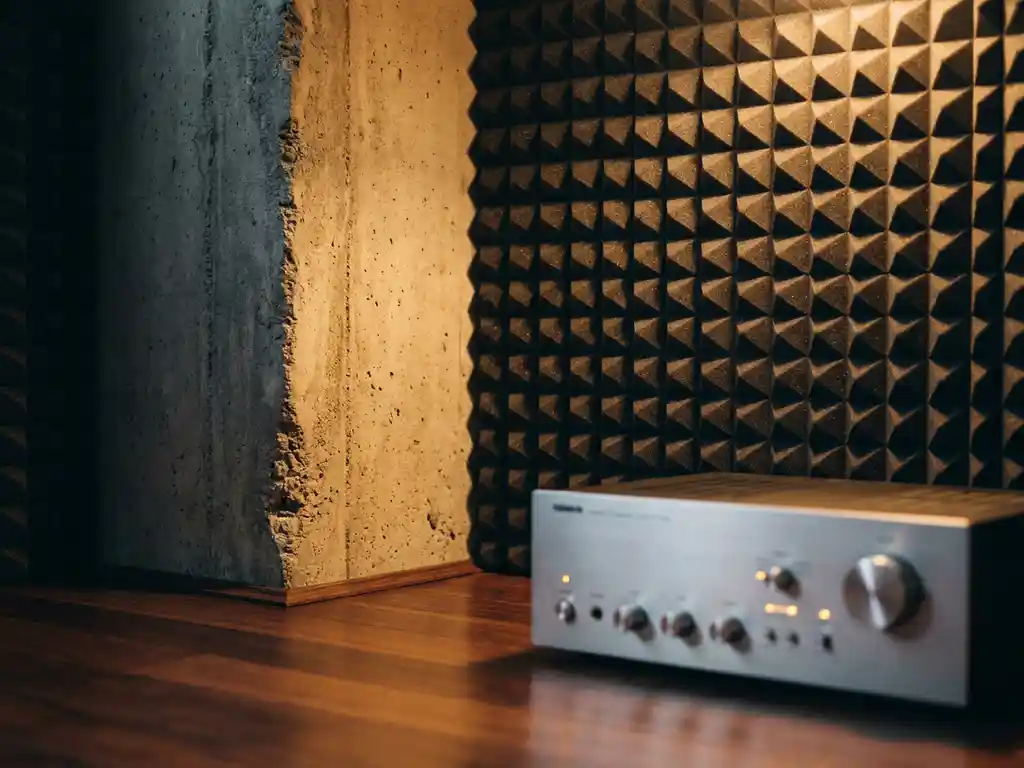
If you’ve ever stood in a room and noticed that music sounds dull, echoey, or somehow disconnected from the emotion it should carry, you’ve already experienced the impact of acoustics firsthand. Two terms come up constantly in this space: soundproofing and acoustic treatment. They sound similar, and many people use them interchangeably, but they address completely different problems. Understanding the distinction is essential whether you’re setting up a home listening room, a recording space, or a dedicated high-end audio environment.
What is soundproofing and what does it actually do?
Soundproofing is the practice of blocking sound from passing through walls, floors, ceilings, doors, and windows. It is about sound isolation — preventing noise from entering or leaving a space. Soundproofing does not improve how sound behaves inside a room; it controls the transmission of sound between rooms or between a room and the outside world.
Effective soundproofing relies on mass, decoupling, and sealing. Heavy materials like concrete, dense drywall, and mass-loaded vinyl add the physical weight needed to stop sound waves from vibrating through a structure. Decoupling involves separating building elements — walls from frames, floors from joists — so vibrations cannot travel through solid connections. Sealing addresses gaps around doors, windows, and penetrations, because even a small gap can allow a significant amount of sound to pass through.
Common soundproofing applications include recording studios that need to keep external traffic noise out, home theaters designed to contain high-volume playback, and apartment walls built to reduce noise from neighbors. It is worth noting that true soundproofing is almost always a construction-level intervention. Acoustic foam panels, rugs, and curtains do not soundproof a room in any meaningful way, despite what many product listings suggest.
What is acoustic treatment and how does it work?
Acoustic treatment is the practice of controlling how sound behaves within a room. It uses absorbers, diffusers, and bass traps to manage reflections, reverberation, and frequency buildup, resulting in a more accurate and balanced listening environment. Acoustic treatment does not block sound from leaving or entering a space.
When sound waves travel through a room, they bounce off hard surfaces and interact with each other. These reflections can cause problems, including:
- Flutter echo — rapid, repeating echoes between parallel walls
- Comb filtering — phase interference where reflected sound combines with direct sound and causes frequency peaks and dips
- Bass buildup — low frequencies accumulate in room corners and along walls, creating an uneven bass response
- Excessive reverberation — long decay times that blur detail and reduce clarity
Absorbers, typically made from open-cell foam or mineral wool, reduce mid and high-frequency reflections. Diffusers scatter sound energy in multiple directions rather than absorbing it, preserving a sense of liveliness and space. Bass traps, placed in corners where low-frequency energy concentrates, help even out the bass response across the room. Together, these tools shape the acoustic character of a space so that what you hear reflects the recording more accurately.
What’s the difference between soundproofing and acoustic treatment?
The key difference between soundproofing and acoustic treatment is this: soundproofing controls the movement of sound between spaces, while acoustic treatment controls the behavior of sound within a space. Soundproofing is about isolation; acoustic treatment is about sound quality inside the room.
Think of it this way. Soundproofing is the wall between you and the outside world. Acoustic treatment is what happens once sound is already inside the room with you. A perfectly soundproofed room with no acoustic treatment can still sound terrible — boomy, echoey, and inaccurate. Conversely, a beautifully treated room with no soundproofing will still be disturbed by external noise and will leak sound to neighboring spaces.
The two disciplines use entirely different materials and methods:
- Soundproofing materials: Mass-loaded vinyl, dense drywall, resilient channels, acoustic sealant, solid-core doors
- Acoustic treatment materials: Acoustic foam, mineral wool panels, diffuser panels, bass traps, broadband absorbers
Understanding this distinction saves time, money, and frustration. Many people buy foam panels expecting to soundproof their room and are disappointed when neighbors can still hear everything. Foam absorbs reflections inside the room — it does not stop sound from traveling through walls.
Why does room acoustics matter for high-end audio listening?
Room acoustics matter for high-end audio because the room itself is part of the playback chain. Even the finest electronics and speakers are compromised if the listening environment introduces coloration, frequency imbalances, or excessive reflections that distort what you actually hear. In a poorly treated room, you are not hearing the recording — you are hearing the recording plus the room’s problems.
For audiophiles investing in reference-grade components, this is a critical consideration. The emotional nuance, the spatial depth, and the tonal accuracy that high-end audio is capable of delivering — all of it can be masked or degraded by untreated room acoustics. A well-treated room allows every detail of a performance to come through as the artist and engineer intended.
Key acoustic factors that affect high-end listening include:
- First reflection points — where sound bounces off side walls, ceiling, and floor before reaching your ears, smearing the stereo image
- Bass response — room modes create peaks and nulls that make bass sound uneven depending on where you sit
- Reverberation time — too long and the room sounds muddy; too short and it sounds unnatural and fatiguing
- Symmetry — acoustic asymmetry in the room disrupts the stereo image and soundstage
Many audiophiles focus exclusively on equipment upgrades while overlooking the room. In reality, addressing room acoustics can often yield a more noticeable improvement to the listening experience than swapping components.
Do you need soundproofing, acoustic treatment, or both?
Whether you need soundproofing, acoustic treatment, or both depends on two questions: Are you disturbed by noise coming in or going out? And does your room sound accurate and balanced? If the answer to the first question is yes, you need soundproofing. If the answer to the second is no, you need acoustic treatment. Many serious listening rooms benefit from addressing both.
A practical way to assess your situation:
- Listen during quiet hours — if you can hear traffic, HVAC, or neighbors clearly, external noise isolation is a priority
- Clap your hands sharply in the room — if you hear a clear flutter or ringing decay, the room needs acoustic treatment
- Walk around while music plays — if bass changes dramatically depending on where you stand, room modes are affecting your listening position
- Check your stereo image — if instruments feel vague or poorly positioned in the soundstage, first reflections may be the culprit
For dedicated high-end audio listening rooms, the ideal approach combines a reasonable level of sound isolation with thoughtful acoustic treatment. If you are working within an existing space without the option of structural changes, prioritizing acoustic treatment will deliver the most immediate improvement to sound quality.
What are the most common acoustic treatment mistakes to avoid?
The most common acoustic treatment mistakes include over-absorbing the room, treating only high frequencies while ignoring bass, and placing panels in the wrong positions. These errors can make a room sound worse rather than better, leading to a dull, lifeless sound or a bass response that remains uneven despite significant investment.
Avoid these frequent missteps:
- Using only thin foam panels — thin foam absorbs high frequencies but does almost nothing for the mid-bass and bass range, where most room problems originate
- Covering every surface with absorption — an over-damped room sounds unnatural and fatiguing; a balance of absorption and diffusion is essential
- Ignoring corners — bass energy concentrates in corners, and bass traps placed there address the most problematic frequency buildup in most rooms
- Skipping the listening position — treatment should be designed around where you actually sit, not placed randomly around the room
- Confusing decoration with treatment — bookshelves, curtains, and rugs help slightly but are not substitutes for purpose-built acoustic panels
- Treating only one wall — acoustic treatment works best when it addresses all reflection paths symmetrically
A thoughtful, measured approach to room acoustics — starting with bass traps in corners, broadband absorbers at first reflection points, and diffusion on the rear wall — will consistently outperform a room filled with thin foam tiles applied without a plan.
How Accustic Arts Supports Your Listening Environment
We understand that a high-end audio system only reaches its full potential in an environment where every element of the chain is optimized — from the electronics to the room itself. At Accustic Arts, our products are engineered to reveal every layer of a recording with emotional accuracy and tonal precision. When paired with a thoughtfully treated listening space, the results speak for themselves.
Here is what we bring to your listening experience:
- Reference-grade electronics — our preamplifiers, power amplifiers, integrated amplifiers, D/A converters, and CD players are built to reproduce sound with absolute fidelity, letting the music breathe in any well-prepared room
- Uncompromising quality standards — every component undergoes individual testing for up to two weeks before leaving our facility in Lauffen am Neckar, Germany
- Emotionally engaging midrange reproduction — our signature sound characteristic ensures that once your room is treated correctly, the music connects on a deeper level
- Experience rooted in professional audio — our development background in recording studios and live venues informs how we design products that perform in real-world acoustic environments
If you are ready to experience what your music truly sounds like through electronics built without compromise, get in touch with us to learn more about our product range and find the right components for your listening room.
—
Disclaimer: This article was created with the assistance of Artificial Intelligence and has been reviewed by our editorial team.
Ähnliche Artikel
- Why do amplifier power ratings vary so much between brands?
- How does bass management impact the overall sound of a system?
- Was ist der Unterschied zwischen einem Röhrenverstärker und einem Transistorverstärker?
- What is the difference between high-end and mid-fi audio components?
- Was ist Abbildungsgenauigkeit in der Audiowiedergabe und wie verbessert man sie?