

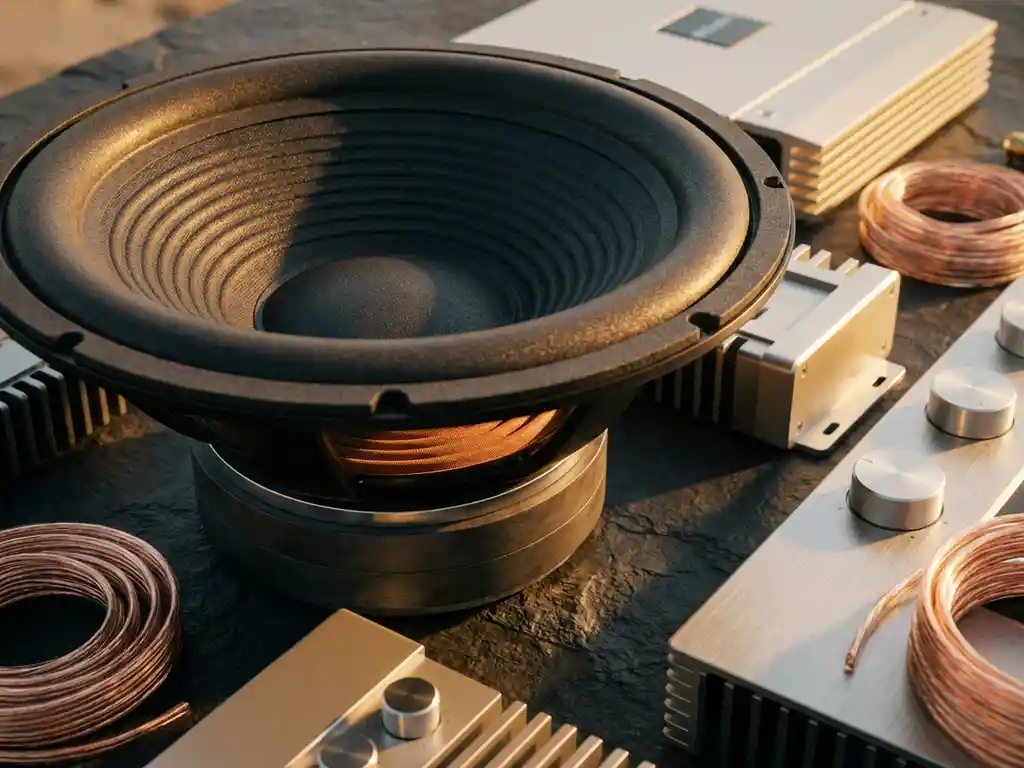
Getting the most out of your sound system often comes down to one often-overlooked factor: how well your bass frequencies are managed. Whether you are building a dedicated listening room or fine-tuning an existing setup, bass management plays a central role in how your system sounds as a whole. Understanding it properly can mean the difference between a muddy, unfocused presentation and a truly immersive, emotionally engaging listening experience.
What is bass management in a hi-fi system?
Bass management is the process of directing low-frequency audio signals to the components in your system best suited to reproduce them. In practice, this means deciding which speakers handle bass frequencies, at what point those frequencies are redirected, and whether a subwoofer takes over below a certain threshold. It is a foundational element of any well-configured audio setup.
At its core, bass management involves a crossover point, sometimes called a crossover frequency, that acts as a dividing line. Frequencies above this point are sent to your main speakers, while those below are routed to a subwoofer or handled differently depending on your system’s design. In a stereo hi-fi system, bass management may be handled passively by the speakers themselves or actively through a preamplifier or dedicated processor. In more complex speaker systems, dedicated bass management hardware or DSP-based tools take on this role with greater precision.
The goal is always the same: ensure every frequency range is reproduced by the component best equipped to handle it, without overlap, gaps, or phase inconsistencies that would compromise the listening experience.
How does bass management affect overall sound quality?
Bass management directly shapes how coherent, balanced, and natural your system sounds. When it is set up correctly, the bass integrates seamlessly with the midrange and treble, producing a full-range presentation that feels unified rather than assembled from separate parts. When it is poorly configured, the result is audible problems across the entire frequency spectrum.
The most immediate impact of poor bass management is a loss of clarity in the midrange. When main speakers are pushed to reproduce bass frequencies they were not designed to handle, they distort under the strain, and that distortion bleeds upward into the frequencies where vocals, instruments, and harmonic detail live. Conversely, when bass is under-managed and a subwoofer is not properly integrated, the low end feels disconnected, and the soundstage loses its sense of depth and weight.
Proper bass management also has a significant effect on dynamics. A speaker system freed from the burden of reproducing very low frequencies can operate more efficiently, delivering cleaner transients and more headroom at higher listening levels. This is why even audiophiles who prefer a purely two-channel setup benefit from understanding how their speakers naturally roll off at the low end and how that shapes their overall sonic character.
What’s the difference between bass management in home theatre and hi-fi stereo?
The key distinction is intent and complexity. Home theatre bass management is standardised and primarily handled by an AV receiver using the LFE (Low Frequency Effects) channel and configurable speaker size settings. Hi-fi stereo bass management is more nuanced, often passive, and demands greater attention to speaker matching, room acoustics, and system synergy.
In a home theatre environment, the goal is to distribute bass across multiple channels while managing a dedicated subwoofer for cinematic impact. The crossover settings are typically set using a receiver’s built-in menu, and the LFE channel carries dedicated low-frequency content mixed specifically for that purpose. The emphasis is on envelopment and dramatic effect.
In a high-end stereo system, there is no LFE channel and no multichannel routing. Bass management becomes a question of how well your main speakers extend into the lower registers, whether a subwoofer is integrated and how transparently it blends, and how the room itself interacts with bass frequencies. The standard for success in hi-fi stereo is not impact but accuracy: the bass should feel natural, tuneful, and tightly controlled, never boomy or exaggerated. This is a considerably more demanding target, and it is one that rewards careful setup and quality electronics.
How do you set the correct crossover frequency for your speakers?
The correct crossover frequency is determined primarily by your main speakers‘ low-frequency extension. As a starting point, set the crossover at or slightly above the frequency where your speakers begin to roll off, typically around 80 Hz for bookshelf speakers, though this varies widely depending on the design and driver size.
Here is a practical approach to finding the right setting:
- Consult your speaker’s specifications. Look for the stated frequency response and note where the lower limit sits. A speaker rated down to 60 Hz might benefit from a crossover set at 80 Hz to ensure smooth overlap.
- Start with 80 Hz as a baseline. This is a widely recommended starting point that works well for most bookshelf and smaller floorstanding speakers.
- Listen critically before adjusting. Play music with well-defined bass lines and listen for where the bass feels disconnected or the transition between subwoofer and main speakers becomes audible.
- Adjust in small increments. Move the crossover up or down by 10 Hz at a time and reassess. The ideal setting produces a seamless, coherent low end where no single driver calls attention to itself.
- Account for room acoustics. Room modes and standing waves can make certain bass frequencies sound louder or quieter than they actually are. Measurement tools or room correction software can help identify these issues.
Large floorstanding speakers with genuine bass extension to 30 or 40 Hz may not need a subwoofer at all, or may benefit from a very low crossover point of 40 to 60 Hz. The key is matching the crossover to the actual capabilities of your speakers, not to a default setting.
Why does bass management sound different on high-end electronics?
High-end electronics handle bass management with greater precision, lower noise floors, and superior component quality, which means the crossover and signal routing process introduces far less coloration or distortion into the signal. The result is bass that feels more natural, more controlled, and more integrated with the rest of the frequency range.
On entry-level or mid-fi electronics, crossover circuits and bass routing are often implemented with cost-effective components that introduce phase errors, noise, or slight tonal shifts. These imperfections are subtle individually but cumulative in their effect, particularly in the critical transition zone between the subwoofer and main speakers. A slight phase mismatch at 80 Hz, for instance, can cause a noticeable dip in perceived bass weight even when all settings appear correct on paper.
High-end audio electronics address this through several means: precision crossover components, careful circuit layout to minimise interference, and in many cases, analogue signal paths that preserve the integrity of the original recording. The difference is most apparent in acoustic music, where the natural decay of a double bass or the fundamental frequencies of a piano require not just power but genuine resolution to reproduce convincingly. This is where high-end audio electronics reveal their advantage most clearly.
What are the most common bass management mistakes to avoid?
The most common bass management mistakes are setting the crossover frequency too high, ignoring phase alignment between the subwoofer and main speakers, and placing the subwoofer in a position chosen for convenience rather than acoustic performance. Each of these errors undermines the coherence of the entire sound system.
Here are the mistakes that appear most frequently in real-world audio setups:
- Setting the crossover too high. A crossover at 120 Hz or above for capable floorstanding speakers forces the subwoofer to reproduce frequencies that are directionally localised, making it audible as a separate source rather than a seamless extension of the main speakers.
- Ignoring phase alignment. A subwoofer that is out of phase with the main speakers causes bass cancellation at the crossover point, resulting in a thin, hollow sound even when all other settings seem correct. Most subwoofers include a phase control for exactly this reason.
- Poor subwoofer placement. Corners amplify bass but also create uneven frequency response. Experimenting with placement before finalising the position is essential, as even small changes can significantly affect the character of the low end.
- Neglecting room acoustics. Bass frequencies are more affected by room dimensions and surface materials than any other part of the frequency spectrum. Bass traps and acoustic treatment in the corners of a listening room can resolve problems that no amount of electronic adjustment will fix.
- Skipping the listening test. Relying solely on measurements or default settings without critical listening is a common shortcut that rarely produces the best result. Your ears remain the most important tool in any audio setup process.
How Accustic Arts Supports Your Bass Management Setup
We understand that bass management is not just a technical checkbox but a critical part of achieving the kind of emotionally engaging, accurate sound reproduction that defines a truly great listening experience. Our components are designed from the ground up to support precise, natural bass integration across a wide range of system configurations.
Here is what we bring to your audio setup:
- Precision-engineered preamplifiers and integrated amplifiers with exceptionally low noise floors that preserve the integrity of bass frequencies through the signal chain
- High-grade D/A converters that resolve low-frequency detail with the accuracy required to reveal the full character of bass instruments in a recording
- Component-level quality control including individual product testing of up to two weeks, ensuring every unit performs exactly as intended before it reaches your system
- A design philosophy rooted in studio and live sound experience, meaning our electronics are calibrated against real musical reference points rather than theoretical benchmarks alone
Whether you are building a new reference system or upgrading an existing setup, we are here to help you find the right components for your goals. Explore our full range of high-end audio electronics or get in touch with us directly to discuss your system and how we can help you achieve the sound you are looking for.
—
Disclaimer: This article was created with the assistance of Artificial Intelligence and has been reviewed by our editorial team.