

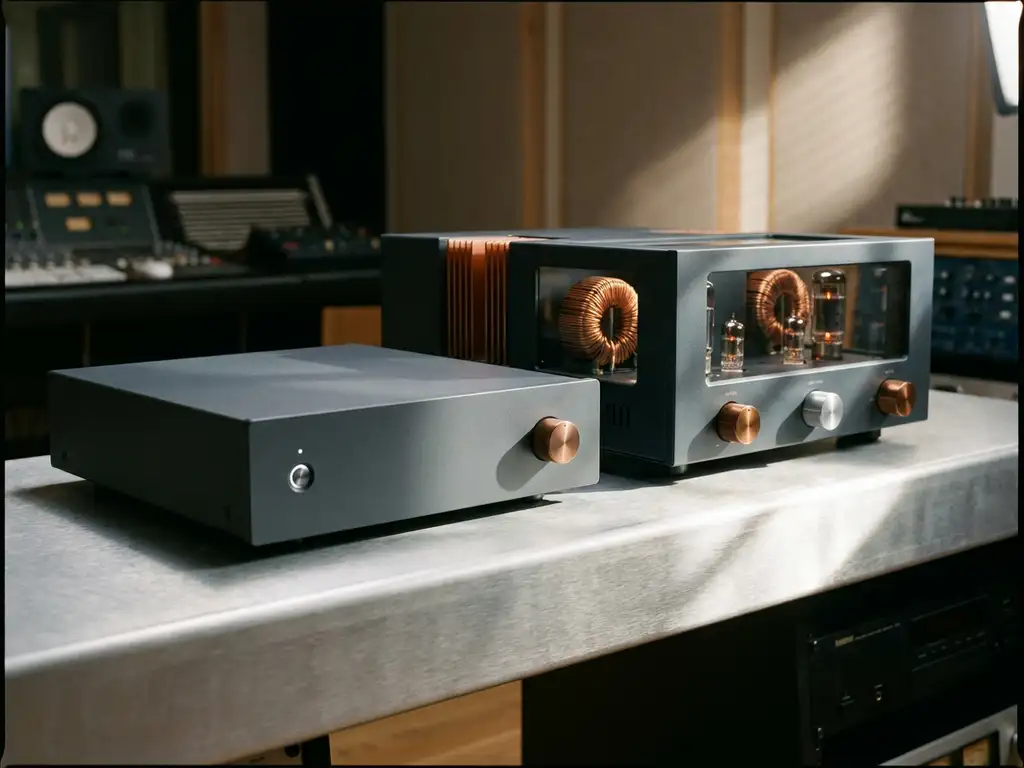
Amplifier power ratings vary so much between brands because there is no single universal standard that manufacturers must follow. Some brands measure power under strict, real-world conditions, while others use more flattering test methods that produce higher numbers. The result is a market where a 50-watt amplifier from one brand can outperform a 200-watt model from another in actual listening conditions. The sections below unpack exactly how these differences arise and what to look for instead.
How do manufacturers actually measure amplifier power?
Manufacturers measure amplifier power by driving a test load, typically a resistor that simulates a speaker, with a signal and recording how much power the amplifier delivers before distortion becomes unacceptable. The critical variable is which conditions they choose: the test frequency, the duration of the test, the distortion threshold, and whether both channels are driven simultaneously all affect the result significantly.
A manufacturer using a single 1 kHz tone, one channel driven, with a generous distortion ceiling will report a much higher number than a manufacturer who drives both channels simultaneously across the full 20 Hz to 20 kHz audio band at a strict distortion limit. Neither approach is necessarily dishonest, but the numbers are not directly comparable. This is why two amplifiers with identical wattage figures on paper can behave very differently in a listening room.
High-end manufacturers tend to apply the more demanding measurement conditions because their products are designed to perform consistently under real-world use. Budget and mass-market products are more likely to use optimistic test conditions to make specifications look competitive on a retail shelf.
What’s the difference between RMS, peak, and dynamic power ratings?
RMS power, also called continuous power, is the most meaningful amplifier power rating because it represents the steady, sustained output an amplifier can deliver over time without distortion. Peak power is the maximum output achievable for a brief instant, and dynamic power describes short bursts of output beyond the RMS figure that occur during musical transients. RMS is the standard you should use for comparisons.
RMS power: the reliable baseline
RMS stands for Root Mean Square, a mathematical method for calculating the equivalent continuous power of an alternating signal. When an amplifier is rated at 100 watts RMS, it can deliver that output continuously without exceeding its distortion specification. This is the figure that determines whether an amplifier can drive your speakers to satisfying volume levels in everyday use.
Peak and dynamic power: the marketing numbers
Peak power is typically double the RMS figure because it represents the maximum instantaneous output before the amplifier clips. Dynamic power ratings sit somewhere between the two and reflect how the amplifier responds to sudden loud passages in music. These figures are not useless, but they are frequently used in marketing materials to make an amplifier appear more powerful than its sustained output would suggest. A well-designed amplifier with a strong power supply will handle musical peaks naturally without needing inflated peak power claims to prove it.
Why do different load impedances change an amplifier’s power output?
An amplifier’s power output changes with load impedance because lower impedance draws more current from the amplifier. Most amplifiers are rated at 8 ohms, but speakers often dip to 4 ohms or lower at certain frequencies. A well-designed amplifier will roughly double its power output as impedance halves, while a weaker design may struggle or even clip under low-impedance loads.
This is one of the most revealing tests of an amplifier’s true capability. If a manufacturer only publishes an 8-ohm power figure and avoids stating the 4-ohm output, that is often a signal that the power supply and output stage are not robust enough to handle demanding speakers. Real-world loudspeakers are reactive loads, meaning their impedance fluctuates across the frequency range, so an amplifier that maintains stable, clean output across varying impedances is far more capable than raw wattage alone suggests.
When evaluating high-end amplifier products, always look for power ratings at multiple impedance levels. This single data point reveals more about an amplifier’s engineering quality than almost any other specification.
Do higher wattage numbers mean better sound quality?
Higher wattage does not mean better sound quality. Beyond the power needed to drive your specific speakers to satisfying levels in your room, additional wattage contributes nothing to sonic performance. Sound quality is determined by circuit design, component quality, power supply stability, and distortion characteristics, none of which are captured by a wattage figure.
The relationship between watts and perceived loudness is also frequently misunderstood. Doubling the amplifier power produces only a modest increase in perceived volume, roughly 3 dB, which is just barely noticeable to most listeners. Going from 50 watts to 100 watts is a much smaller real-world difference than the numbers suggest. Meanwhile, a 50-watt amplifier with low distortion and a stable power supply will consistently outperform a 200-watt amplifier with mediocre circuit design in terms of musical engagement and clarity.
Speaker sensitivity plays an equally important role. A speaker rated at 90 dB sensitivity requires far less power to reach a given volume than one rated at 84 dB. Matching amplifier output to speaker sensitivity is a more meaningful exercise than chasing the highest wattage specification.
What specs should you look at beyond wattage when choosing an amplifier?
Beyond wattage, the most important amplifier specifications are total harmonic distortion (THD), signal-to-noise ratio (SNR), damping factor, frequency response, and power supply quality. These figures collectively describe how accurately and cleanly an amplifier reproduces a signal, which is what actually determines how music sounds in your room.
- Total Harmonic Distortion (THD): Expressed as a percentage, this measures how much the amplifier alters the original signal. Lower is better, and a figure below 0.1% at rated power is a meaningful benchmark for quality audio amplifier measurements.
- Signal-to-Noise Ratio (SNR): This describes how far the musical signal sits above the amplifier’s background noise floor. A higher SNR, typically above 100 dB for quality designs, means a blacker background and greater low-level detail retrieval.
- Damping Factor: This indicates how well the amplifier controls speaker cone movement. A higher damping factor generally means tighter, more controlled bass reproduction, though circuit topology also plays a role.
- Frequency Response: A flat, wide frequency response, ideally 20 Hz to 20 kHz within a fraction of a dB, confirms the amplifier treats all frequencies equally rather than emphasizing or rolling off certain ranges.
- Power Supply Design: A generously specified, well-regulated power supply is the foundation of consistent performance. It determines how the amplifier behaves during demanding musical passages and under varying speaker loads.
These specifications, read together rather than in isolation, give a far more complete picture of an amplifier’s real-world performance than wattage alone. When a manufacturer publishes all of these figures openly, that transparency is itself a quality signal.
How Accustic Arts approaches amplifier power and transparency
At Accustic Arts, we believe that honest specifications and uncompromising engineering are inseparable. Every amplifier we build is measured under demanding, real-world conditions, and our published figures reflect what our components actually deliver, not what looks best on a spec sheet. Here is what sets our approach apart:
- Rigorous testing: Every individual component undergoes testing that can last up to two weeks before it leaves our facility in Lauffen am Neckar, Germany. This process catches performance inconsistencies that standard production-line testing would miss.
- Stable output across loads: Our power amplifiers and monoblock designs are engineered to maintain clean, stable output across the full range of real-world speaker impedances, not just the 8-ohm reference point.
- Honest specifications: We publish THD, SNR, and frequency response alongside power figures because we want our customers to compare our products on the basis of complete information.
- Emotionally engaging performance: Our guiding philosophy, Absolute Sound Fidelity Through Reproduction, means we optimize for what music actually sounds like, not for impressive numbers in a brochure.
If you would like to explore our range of power amplifiers, monoblock amplifiers, integrated amplifiers, and preamplifiers, visit our full product range. If you have questions about matching an Accustic Arts component to your system or speakers, we welcome you to get in touch with us directly. We are happy to help you find the right solution for your listening environment.