

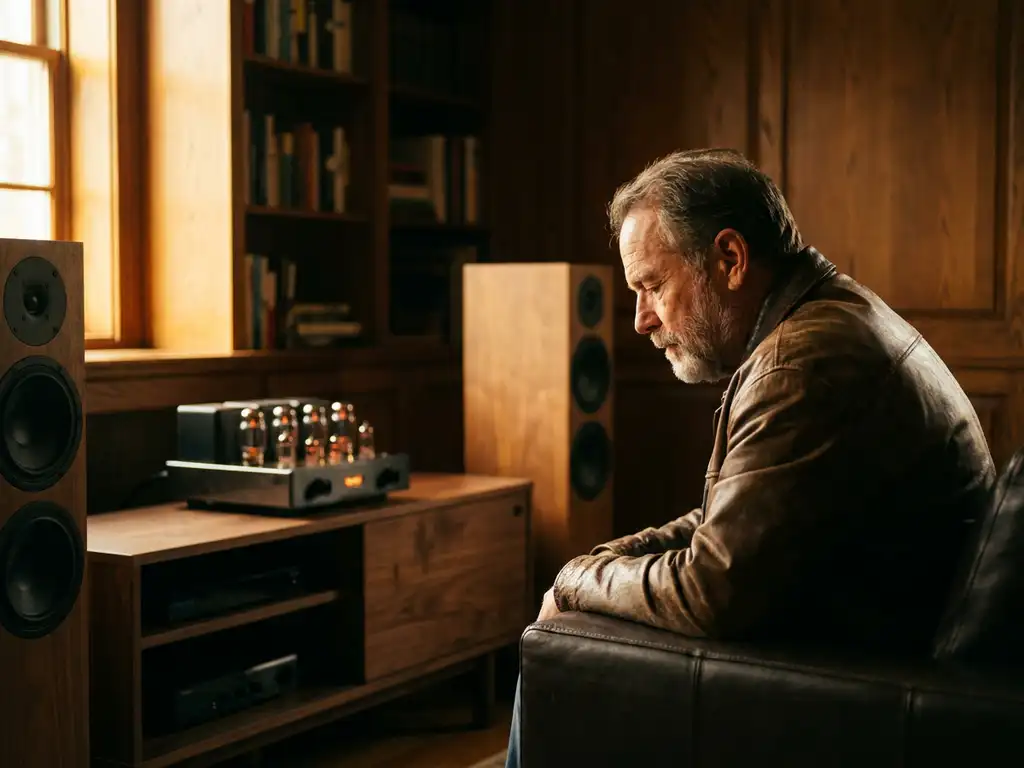
When auditioning an amplifier, listen for clarity across the full frequency range, dynamic control, midrange naturalness, and how well the amplifier handles both quiet passages and loud peaks without strain. These qualities reveal whether an amplifier is technically competent or genuinely musical. The questions below walk through each critical dimension of a thorough amplifier listening test.
What sonic qualities reveal an amplifier’s true character?
An amplifier’s true character reveals itself through tonal balance, background silence, and the sense of ease it brings to music at all volume levels. A high-quality amplifier sounds composed rather than strained, presents instruments with natural weight and texture, and keeps the noise floor low enough that soft details emerge without effort. These qualities matter more than raw power ratings.
Start by listening to whether the bass is controlled and defined or loose and bloated. Move your attention to the treble and check whether it sounds extended and smooth or bright and fatiguing. Then ask yourself whether the overall presentation feels coherent, as if the music is being reproduced as a whole rather than assembled from separate frequency bands. A great amplifier integrates everything so naturally that you stop thinking about the electronics and start thinking about the music.
Pay particular attention to the silence between notes. A genuinely quiet background, free from hiss or hum, is a strong indicator of thoughtful engineering and high-grade component selection. When the music pauses, nothing should fill that space.
How does an amplifier handle dynamic contrasts in music?
A well-designed amplifier handles dynamic contrasts by delivering sudden loud passages with authority while preserving the delicacy of quiet moments without compression or distortion. Dynamics are one of the most telling tests in any amplifier evaluation, because compressing or softening peaks robs music of its emotional impact and sense of realism.
Choose a recording with a wide dynamic range, such as a live orchestral performance or an acoustic jazz session, and listen for what happens when the music suddenly surges. Does the amplifier stay composed and powerful, or does it harden and lose its sense of space? Equally important is the recovery after a loud peak. A strong amplifier returns to a quiet, composed presentation immediately, without overhang or blur.
Micro-dynamics matter just as much as macro-dynamics. The subtle swell of a vocalist’s breath, the gentle decay of a piano note, the brush on a snare drum: these small variations carry enormous emotional weight. An amplifier that flattens them makes music feel mechanical rather than alive.
What does good midrange reproduction actually sound like?
Good midrange reproduction sounds natural, present, and emotionally engaging. Voices and instruments occupy a believable space in the room, with realistic body and texture rather than sounding thin, nasal, or artificially forward. Because the human voice and most melodic instruments live primarily in the midrange, this frequency region is where an amplifier’s character becomes most audible.
A well-reproduced midrange lets you feel the resonance of a cello, the breath behind a saxophone, and the grain in a singer’s voice. It does not smooth everything into a pleasant but characterless blend, nor does it exaggerate presence to create a false sense of detail. The result is music that sounds lived-in and emotionally direct.
If you find yourself leaning forward, drawn into the performance, the midrange is doing its job. If you feel slightly disconnected from the music, or if voices sound slightly hollow or nasal, the amplifier may be struggling in this critical region. This is why the midrange is often the first thing experienced listeners evaluate during an amplifier listening test.
Should you audition an amplifier with familiar music or test tracks?
You should audition an amplifier primarily with music you know intimately, supplemented by a small selection of well-recorded test tracks. Familiar music is your most reliable reference because you already know how it should sound. If something feels off, you will notice it immediately rather than wondering whether the recording is to blame.
Choose recordings that span different genres and recording styles. A close-miked vocal, a large orchestral work, a small jazz ensemble, and a well-produced acoustic guitar track each stress different aspects of amplifier performance. Variety matters because an amplifier that flatters one genre may struggle with another.
Test tracks can be useful for specific checks, such as confirming bass extension or evaluating stereo imaging, but they should not replace music you love. The ultimate measure of any amplifier is whether it makes your own record collection sound more compelling and emotionally true. Evaluate amplifier sound quality through music that means something to you.
How long should an amplifier audition last before making a judgment?
An amplifier audition should last at least 30 to 60 minutes of focused listening before forming a serious judgment, with a follow-up session on a separate day if possible. First impressions can be misleading because initial brightness or warmth may fade as your ears adjust, revealing a different underlying character.
Many audiophiles fall into the trap of making decisions based on the first few minutes, when novelty and excitement color perception. Listening fatigue is also a real factor. An amplifier that sounds exciting for ten minutes but becomes tiring over an hour is telling you something important about its long-term livability.
If the opportunity allows, listen at different times of day and with different source material. Pay attention to how you feel at the end of a long session. A genuinely musical amplifier leaves you wanting to hear more music, not relieved that the listening test is over. That sustained engagement is one of the most honest signals in any high-end amplifier evaluation.
What role does the rest of the system play in an amplifier audition?
The rest of the system plays a decisive role in an amplifier audition because an amplifier never operates in isolation. Speakers, source components, cables, and room acoustics all interact with the amplifier’s output, meaning a component that sounds excellent in one system may sound quite different in another. Ideally, audition the amplifier in a system as close as possible to your own.
Speaker matching is particularly important. Some amplifiers are voiced to suit high-sensitivity speakers with simple crossovers, while others are designed to drive demanding, low-impedance loads with ease. An amplifier that struggles with your speakers will never reveal its true potential, no matter how good it is on paper.
The source component also shapes what the amplifier has to work with. A high-quality DAC or CD player feeds the amplifier a cleaner, more resolved signal, making it easier to evaluate the amplifier’s own contribution rather than the limitations of upstream components. Whenever possible, keep as many variables constant as you can, changing only the amplifier, so that what you hear reflects the amplifier’s actual character.
How Accustic Arts Amplifiers Are Built for the Audition That Matters
Everything described in this article, the dynamic authority, the natural midrange, the composed silence, and the long-term listenability, reflects exactly what we design for at Accustic Arts. Our amplifiers are engineered to pass the most demanding listening tests because we believe that the audition never truly ends. Every unit goes through an individual testing process that can last up to two weeks before it leaves our facility in Lauffen am Neckar, Germany.
- Emotionally engaging midrange: Our signature midrange reproduction is the quality most often cited by audiophiles and music professionals who choose our components. It is warm without being artificial, detailed without being clinical.
- Dynamic composure: Our amplifiers are designed to handle the full dynamic range of real music, from the softest pianissimo to sudden orchestral peaks, without compression or hardening.
- High-grade components throughout: We use only precise, carefully selected parts across every product line, because component quality is audible and irreplaceable.
- Studio-informed development: Our engineering draws on real-world experience in recording studios and live venues, which means our amplifiers are optimized for music as it actually sounds, not as test signals suggest it should.
If you are ready to experience what a genuinely musical amplifier sounds like in your own system, explore our full range of amplifiers and components or get in touch with us to find the right match for your listening setup.