

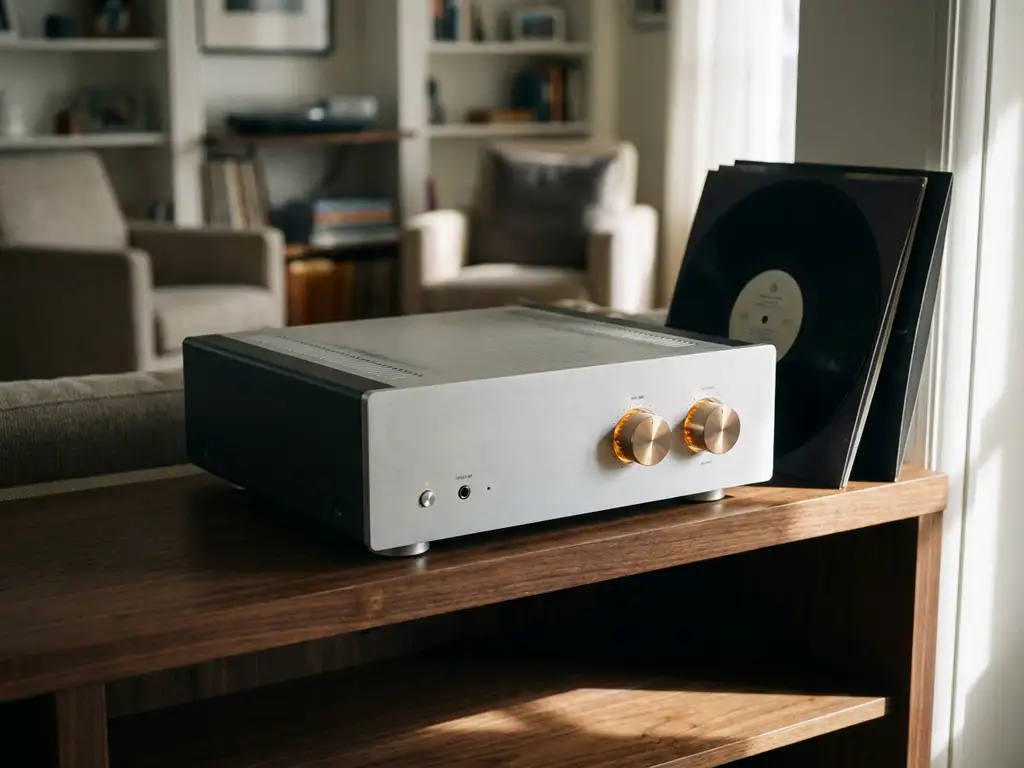
Most audiophiles should budget between $3,000 and $15,000 for a high-end amplifier, though true reference-grade components can reach well beyond that. The right number depends on your speakers, your source components, and how much of your system’s potential you want to unlock. The questions below walk through every factor that shapes a smart amplifier budget.
What price range counts as high-end for an amplifier?
A high-end amplifier generally starts around $3,000 to $5,000 for an integrated amplifier and rises steeply from there. Separates, a dedicated preamplifier paired with a power amplifier, typically enter high-end territory at a combined $5,000 to $8,000, with flagship systems regularly exceeding $20,000 or more per component.
The boundary between „good hi-fi“ and genuine high-end audio is not purely about price. It reflects a shift in design philosophy: hand-selected components, custom-wound transformers, point-to-point wiring, and listening sessions that influence engineering decisions. At this level, manufacturers stop cutting corners and start making choices that serve sound quality above all else. You begin to hear the difference not just in clarity, but in the emotional weight of music, the way a piano note decays, or the way a vocalist’s breath shapes a phrase.
What factors drive up the cost of a high-end amplifier?
Several engineering and manufacturing choices directly raise the cost of a high-end amplifier. The most significant are component quality, output topology, chassis construction, and the labor intensity of assembly and testing.
- Component selection: High-grade capacitors, precision resistors, and premium output transistors or tubes cost significantly more than off-the-shelf alternatives. Matched component pairs add further cost.
- Power supply design: A robust, low-noise power supply is one of the most expensive parts of any serious amplifier. Oversized transformers, separate regulated rails, and extensive filtering all add to the bill.
- Output topology: Class A operation, tube circuits, and hybrid designs are more expensive to engineer and run than standard Class AB solid-state designs, but they often reward listeners with a more natural, organic sound.
- Chassis and build quality: Thick aluminum or steel enclosures, precision-machined faceplate work, and vibration-damping construction add cost while reducing interference and resonance.
- Testing and quality control: Serious manufacturers run extended burn-in and measurement cycles before a unit ships. Some individual component tests run for days or even weeks.
When you pay more for a high-end amplifier, you are not paying for a brand name alone. You are paying for the cumulative result of every one of these decisions made without compromise.
Should you budget more for a preamplifier or a power amplifier?
In most high-end systems, the power amplifier benefits most from the larger share of the budget, since it does the heaviest lifting, driving current into your speakers and directly shaping dynamics and control. However, a weak preamplifier will limit everything downstream, so neither component should be severely underfunded relative to the other.
A common starting point is a roughly 40/60 or 50/50 split between preamp and power amp. If your speakers are particularly demanding, low impedance, low sensitivity, or large floor-standers, shifting more budget toward the power amplifier makes sense. If you are building a system around a high-quality DAC or phono stage that handles much of the signal processing, a simpler but well-built passive or active preamp may allow you to redirect funds to the power stage.
The cleanest approach is to audition both components together before committing. Synergy between a preamplifier and power amplifier matters enormously, and a well-matched pair at a given price point will consistently outperform mismatched components where one is significantly more capable than the other.
How does your speaker choice affect your amplifier budget?
Your speakers are the single most important factor in determining how much amplifier you need. Inefficient, low-impedance speakers demand far more current and voltage than efficient, high-impedance designs, meaning the amplifier must work harder and needs to be built to a higher standard to perform well under load.
Speakers with sensitivity ratings below 87 dB and impedance dips below 4 ohms will expose the weaknesses of underpowered or poorly designed amplifiers, thin bass, compressed dynamics, and a loss of control at higher volumes. These speakers require amplifiers with generous power reserves and stable current delivery, which pushes you toward higher-priced designs.
Conversely, high-sensitivity speakers, particularly horn-loaded designs or those rated above 95 dB, can sound extraordinary with low-powered tube amplifiers that would struggle with more demanding loads. In these systems, a modest-wattage but exceptionally well-built amplifier can outperform a brute-force solid-state design costing three times as much. Always research your speaker’s impedance curve and sensitivity before setting your amplifier budget.
What’s the difference between buying new and buying used high-end amplifiers?
Buying used high-end amplifiers can offer genuine value, but it introduces risks that new purchases do not carry. New amplifiers come with full manufacturer warranties, factory-fresh components, and the assurance that no prior owner has modified or stressed the unit. Used amplifiers can represent significant savings, often 30 to 60 percent below retail, but require careful vetting.
Advantages of buying new
- Full warranty coverage and manufacturer support
- Confirmed component condition and original calibration
- Access to current models with the latest design refinements
- Peace of mind, particularly for complex tube or hybrid designs
Advantages of buying used
- Substantially lower entry cost into reference-grade performance
- Access to discontinued models with strong reputations
- Well-burned-in components that may have already settled into optimal performance
- Opportunity to step up to a higher tier than your new budget would allow
If you buy used, prioritize units sold by original owners with documented service history, and avoid anything that has been modified unless you understand exactly what was changed and why. Reputable dealers who inspect and recondition used high-end equipment offer a middle ground worth considering.
How do you know when your amplifier budget is right for your system?
Your amplifier budget is right when it is proportional to the rest of your system and matched to your speakers‘ demands. A useful rule of thumb is that no single component should cost more than roughly twice the combined value of the rest of your system, an expensive amplifier driving budget speakers, or vice versa, will always leave performance on the table.
The clearest signal that your amplifier budget is well-placed is what you hear during an audition. A correctly budgeted amplifier in your system should make music feel more complete, not just louder or more detailed, but more emotionally present. If you are straining to hear a difference between amplifiers at different price points, your speakers or source components may be the limiting factor, and your money is better spent there first.
It also helps to think about longevity. High-end amplifiers, when well-built, can serve a system for decades. An amplifier that stretches your budget slightly but is built without compromise will almost always outlast and outperform a cheaper unit bought to save money in the short term. Invest in the component you will not feel the need to replace.
Finally, audition in your own listening environment whenever possible. Room acoustics, cabling, and the rest of your signal chain all influence what you hear. A budget that feels right in a dealer’s showroom should be confirmed at home before you commit.
How Accustic Arts Fits Into Your Amplifier Budget
We design every amplifier at Accustic Arts to deliver reference-grade performance at a price point that reflects genuine engineering value rather than marketing premium. Our philosophy, Absolute Sound Fidelity Through Reproduction, shapes every decision, from component selection to the individual testing process that can run up to two weeks per unit before it leaves our facility in Lauffen am Neckar, Germany.
Here is what that means in practice for your budget:
- Transparent pricing: Our amplifiers are priced to reflect their build quality and performance tier honestly. You are not paying for inflated brand positioning.
- Broad range: From integrated amplifiers to monoblock power amplifiers, our full product range covers multiple price points within the high-end category, making it easier to find the right fit for your system and budget.
- Synergy by design: Because we manufacture preamplifiers, power amplifiers, integrated amplifiers, and source components, you can build a fully matched system where every component is engineered to work together, eliminating the guesswork of mixing brands.
- Long-term value: Our build quality and testing standards are designed to produce components that perform at their best for decades, making the investment genuinely durable.
If you are ready to find the right amplifier for your system and budget, get in touch with us and we will help you identify the best match for your speakers, listening preferences, and price range.