

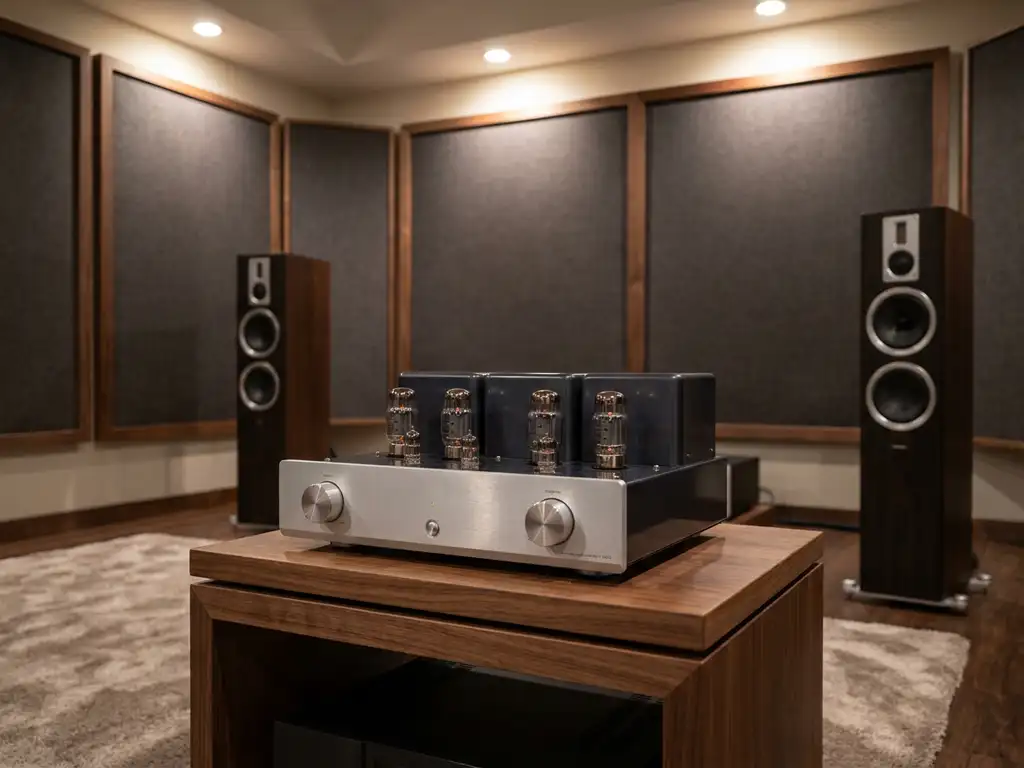
A dedicated listening room is one of the most rewarding investments an audiophile can make. But four walls and a good audio system are rarely enough on their own. The acoustic behavior of a room shapes what you actually hear just as much as the electronics producing the sound. Understanding how to improve dedicated listening room acoustics means understanding the relationship between your space, your treatment choices, and your equipment — and getting that relationship right transforms a good system into a transcendent one.
What makes a dedicated listening room acoustically challenging?
A dedicated listening room presents acoustic challenges primarily because sound waves reflect off hard surfaces, creating interference patterns that distort what you hear. Parallel walls generate standing waves and flutter echo. Room modes cause certain bass frequencies to build up or cancel out at specific positions. Even a beautifully designed room can produce a listening experience that feels congested, uneven, or fatiguing without proper acoustic treatment.
The most common problems in untreated rooms include:
- Standing waves (room modes): Low-frequency buildup between parallel surfaces that makes bass sound boomy or uneven depending on where you sit
- Flutter echo: A rapid, metallic echo caused by sound bouncing repeatedly between hard, reflective walls
- Early reflections: Sound arriving at your ears milliseconds after the direct signal, smearing imaging and reducing clarity
- Reverberation: Prolonged decay of sound that muddies detail and makes the soundstage feel diffuse
These issues affect every frequency range differently, which is why a complete acoustic treatment approach addresses the full spectrum rather than targeting one problem in isolation.
What are the most effective acoustic treatment types for a listening room?
The most effective acoustic treatments for a listening room are bass traps, broadband absorbers, acoustic panels, and diffusers. Each serves a distinct purpose: bass traps control low-frequency buildup, broadband absorbers reduce mid and high-frequency reflections, and diffusers scatter sound to create a more natural, spacious feel without deadening the room.
Here is a practical breakdown of the core treatment types:
- Bass traps: Thick, dense foam or rockwool panels placed in corners where low-frequency energy concentrates. Corner placement is critical because that is where standing waves are most intense.
- Broadband absorbers: Medium-density panels that absorb a wide range of frequencies. These are the workhorses of listening room acoustic treatment and handle the majority of reflection control.
- Acoustic panels: Thinner absorbers designed to target mid and high frequencies. Placed at reflection points, they reduce flutter echo and tighten imaging significantly.
- Diffusers: Irregular-surface panels that scatter sound rather than absorbing it. They preserve a sense of space and liveliness while eliminating harsh reflections.
A well-treated room typically combines all of these, with heavier treatment in corners and at primary reflection points, and diffusion toward the rear of the room.
Where should you place acoustic panels in a listening room?
Acoustic panels in a listening room should be placed at the first reflection points on the side walls, on the ceiling above the listening position, and on the front wall behind the speakers. These are the locations where sound bounces directly from your speakers to your ears, causing the greatest interference with imaging and tonal accuracy.
To find your side-wall first reflection points, use the mirror trick: have someone slide a mirror along the side wall while you sit in your listening position. Wherever you can see a speaker in the mirror is where a panel belongs. Repeat this process for the ceiling.
Beyond first reflections, consider these placement priorities:
- Corners (floor-to-ceiling): Place bass traps here first. All four vertical corners benefit, with front corners being the highest priority.
- Side walls at ear level: Cover first reflection points with broadband absorbers or acoustic panels.
- Ceiling above the listening position: A ceiling cloud significantly improves clarity and focus.
- Front wall: Treatment between and behind the speakers reduces boundary reflections and tightens the soundstage.
- Rear wall: A combination of absorption and diffusion here prevents the room from sounding overly dead while controlling late reflections.
What’s the difference between acoustic absorption and diffusion?
Acoustic absorption converts sound energy into heat, reducing the overall level of reflected sound in a room. Diffusion scatters sound in multiple directions without significantly reducing its energy, preserving a sense of spaciousness and natural ambience. The key difference is that absorption quiets a room while diffusion enlivens it — and a well-treated listening room needs both.
Over-absorption is a genuine risk in dedicated listening rooms. A space treated exclusively with absorbers can sound unnaturally dead and fatiguing, stripping music of the sense of air and space that makes it feel alive. This is sometimes described as an „anechoic“ quality that feels uncomfortable for extended listening.
Diffusers solve this problem by breaking up reflections without eliminating them. A sound wave hitting a diffuser is scattered into many smaller reflections traveling in different directions, so no single strong reflection reaches your ears. The result is a room that feels open and natural rather than padded and closed-in. A practical guideline for high-end audio room setup is to use more absorption in the front half of the room and more diffusion toward the rear.
How does room shape and size affect listening room acoustics?
Room shape and size directly determine which frequencies accumulate as standing waves and how severe those resonances are. Rectangular rooms with parallel walls are the most common and the most prone to problematic room modes. Rooms with non-parallel walls, splayed ceilings, or irregular geometries naturally scatter sound more effectively and produce less severe modal buildup.
Room dimensions set the specific frequencies at which modes occur. When the distance between two parallel surfaces is a half-wavelength of a given frequency, that frequency resonates strongly. This is why rooms with similar length and width dimensions are particularly challenging — the same modal frequencies are reinforced in multiple directions simultaneously.
Larger rooms generally produce lower-frequency modes that are easier to manage with treatment and are less likely to interfere with the musically important bass range. Smaller rooms suffer from modes that fall squarely within the bass frequencies most critical to music, making bass trap placement especially important in compact listening spaces. If you have any flexibility in choosing or designing your room, avoiding square dimensions and aiming for proportions based on established acoustic ratios will give you a significant head start.
Should you use acoustic treatment or room correction software?
You should use acoustic treatment first, then consider room correction software as a complementary tool — not a replacement. Physical acoustic treatment addresses the root cause of room problems by controlling how sound waves behave in the space. Room correction software applies digital signal processing to compensate for what the room does to the signal after the fact, which is a fundamentally different and more limited approach.
Room correction software can be effective at smoothing frequency response irregularities at the listening position, but it cannot eliminate flutter echo, reduce reverberation, or prevent early reflections from smearing imaging. These are physical phenomena that require physical solutions. Software also corrects for a single listening position, meaning the benefits often degrade as soon as you move your head.
The most sophisticated high-end audio room setups treat the room properly first and then use room correction as a fine-tuning layer. This approach gives you the best of both worlds: a well-behaved acoustic environment that your electronics can perform in naturally, with digital refinement applied where physical treatment reaches its practical limits. For audiophiles investing in reference-grade electronics, relying solely on software correction is a compromise that undermines the performance potential of the entire system.
How ACCUSTIC ARTS Supports Your Listening Room Journey
Even the most carefully treated listening room can only reveal its full potential when paired with electronics capable of reproducing music with absolute fidelity. That is the philosophy at the heart of everything we do at Accustic Arts. Our components are engineered to deliver sound that is accurate, emotionally engaging, and free from the colorations that mask what your room treatment is working so hard to preserve.
Here is what sets our approach apart:
- Uncompromising component quality: Every Accustic Arts product is built using only precise, high-grade components selected to minimize noise, distortion, and coloration at every stage of the signal path.
- Two-week individual testing: Each component undergoes up to two weeks of rigorous testing before leaving our facility, ensuring it performs exactly as designed in real listening environments.
- Midrange excellence: Our signature emotionally engaging midrange reproduction means that once your room acoustics are optimized, the music comes through with a naturalness and presence that rewards every treatment decision you have made.
- Full system range: From preamplifiers and CD players to DACs, integrated amplifiers, and monoblock power amplifiers, we offer a complete signal chain designed to work together with coherence and precision.
A well-treated listening room deserves electronics that honor the effort you have put into it. Explore our full product range to find the components that will bring your dedicated listening room to life, or get in touch with us to discuss which Accustic Arts system is the right match for your space and your music.
—
Disclaimer: This article was created with the assistance of Artificial Intelligence and has been reviewed by our editorial team.
Ähnliche Artikel
- What is the difference between current and voltage in amplifier design?
- How has amplifier technology evolved over the decades?
- Why do audiophiles prefer high-end CD players over streaming?
- How does digital-to-analog conversion shape the emotion in music?
- Was ist der Unterschied zwischen Hi-Fi und High-End-Audio?