

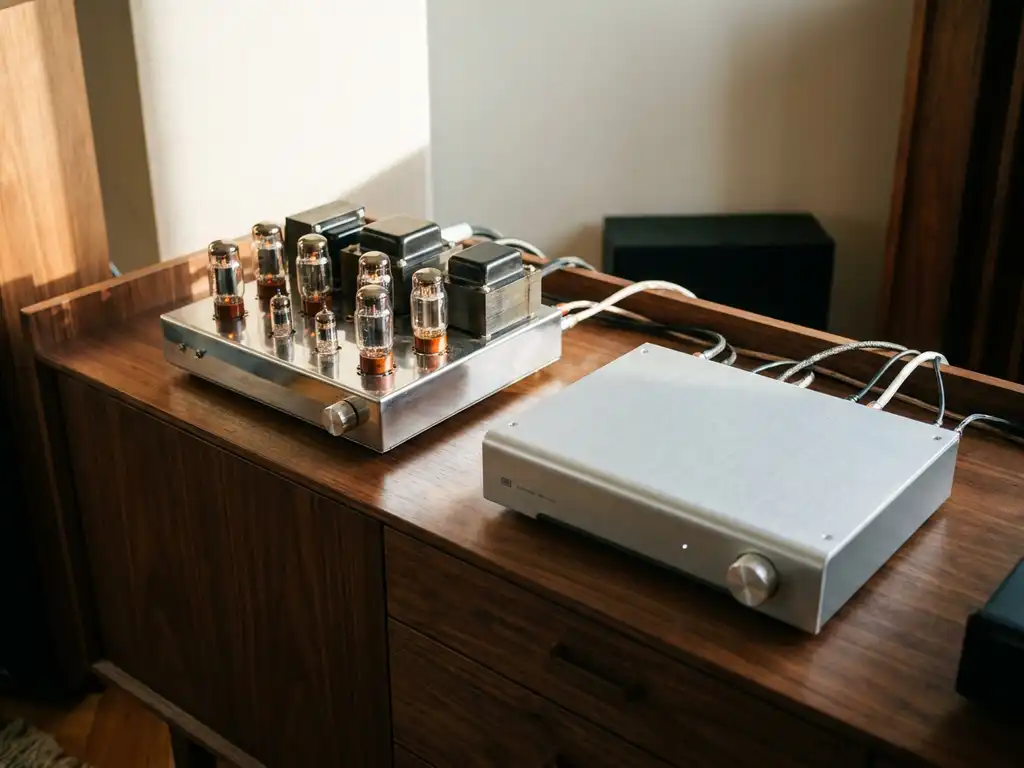
Few areas of consumer electronics have undergone as dramatic a transformation as amplifier technology. From the glowing warmth of early vacuum tubes to the razor-sharp efficiency of modern digital designs, the hi-fi amplifier has been quietly reinvented across a century of engineering ambition. Understanding that journey matters not just as a history lesson, but as a way of appreciating why certain design choices still define the finest audiophile amplifiers available today. The pursuit of absolute sound fidelity has always driven amplifier evolution, and the decisions made along the way continue to shape every listening experience.
Whether someone is exploring high-end audio for the first time or has spent decades refining a reference system, the story of how amplifiers developed offers genuine insight into what separates extraordinary reproduction from merely adequate sound. The choices embedded in amplifier design – topology, components, circuit philosophy – are never arbitrary. They reflect accumulated knowledge, hard-won lessons, and an ongoing conversation between engineering precision and musical truth.
From vacuum tubes to solid-state: a century of change
The amplifier’s story begins with the vacuum tube, which dominated audio electronics from the early twentieth century through the 1960s. Tubes amplified electrical signals by controlling electron flow through a vacuum, producing sound that many listeners described as rich, dimensional, and naturally musical. Early tube amplifier designs were the only option available, and engineers of that era developed extraordinary sophistication within the constraints of the technology.
The arrival of the transistor in the late 1950s and its rapid commercial adoption through the 1960s and 1970s shifted the landscape entirely. Solid-state amplifiers offered greater reliability, lower operating temperatures, and significantly reduced manufacturing costs. They could deliver higher power output from smaller, lighter enclosures, making hi-fi amplifiers more accessible to a broader audience. However, early solid-state designs were sometimes criticised for a perceived hardness or sterility in the upper frequencies, a characteristic that kept the debate between tube and transistor advocates alive for decades.
By the 1980s and 1990s, advances in transistor quality, circuit topology, and component matching had narrowed that gap considerably. High-end solid-state amplifiers began achieving levels of transparency and low distortion that rivalled the most refined tube designs. The audio amplifier history of this period is one of convergence: two distinct philosophies pushing each other toward greater refinement.
Class A, AB, and D: how topology shapes sound
Amplifier topology – the fundamental circuit architecture – has a profound influence on how an amplifier sounds, behaves, and consumes power. The three dominant classes each represent a different set of trade-offs between fidelity, efficiency, and thermal management.
Class A: maximum linearity, maximum heat
A Class A amplifier keeps its output devices conducting throughout the entire audio signal cycle. This continuous conduction eliminates crossover distortion, which occurs when two output devices hand off the signal between them. The result is exceptionally linear, smooth amplification that many audiophiles regard as the gold standard for sonic purity. The trade-off is significant energy inefficiency: a Class A amplifier generates considerable heat, even at idle, because power is always being consumed regardless of output level.
Class AB and Class D: balancing performance and practicality
Class AB designs blend the linearity of Class A operation at low signal levels with the efficiency of Class B at higher outputs. This compromise has made Class AB the most widely used topology in high-end audio, offering excellent sonic performance alongside manageable thermal output. Many of the most celebrated audiophile amplifiers of the past four decades have been Class AB designs.
Class D amplifiers, often called switching amplifiers, operate on an entirely different principle. The output devices switch rapidly between fully on and fully off states, with the ratio of on-to-off time encoding the audio signal. Early Class D designs struggled with high-frequency noise and a perceived lack of musicality, but modern implementations have advanced dramatically. Today, well-engineered Class D amplifiers can achieve remarkable transparency and are particularly valued in applications where efficiency and compact size are priorities.
The rise of hybrid and tube-solid-state designs
As both tube and solid-state technologies matured, a natural question emerged: could the most desirable qualities of each be combined? Hybrid amplifier designs answer that question with considerable success. A typical hybrid configuration uses a tube gain stage – prized for its natural, harmonically rich character – paired with a solid-state output stage that delivers the power, control, and reliability that transistors do so well.
This approach allows designers to capture the organic midrange presence and three-dimensional imaging that tube circuits excel at, while avoiding the limitations of tube output stages such as output transformer coloration and high output impedance. The result is an amplifier that can drive a wide range of loudspeakers with authority, while preserving the emotional engagement that draws listeners to tube designs in the first place.
At Accustic Arts, we have explored hybrid tube-solid-state design as part of our broader commitment to combining the best of proven technologies. Our tube hybrid components reflect the understanding that neither technology has a monopoly on musical truth – the most rewarding amplifier is often the one that draws intelligently from both traditions.
Precision components and modern manufacturing standards
The quality of an amplifier’s individual components has always been as important as its circuit topology. A brilliant design implemented with mediocre parts will consistently underperform a simpler design built with carefully selected, high-grade components. This truth has become even more consequential as modern high-end audio manufacturing has raised the bar for what precision actually means.
Today’s finest amplifiers use resistors, capacitors, and transistors selected not just for their nominal values but for their measured performance characteristics, temperature stability, and long-term reliability. Component matching – ensuring that paired devices in a differential or push-pull circuit track each other closely – reduces distortion and improves channel balance in ways that are genuinely audible. Modern measuring equipment allows manufacturers to verify performance at a level of detail that was simply not possible in earlier decades.
We take this seriously at every stage of production. Each Accustic Arts component undergoes an individual testing process that can last up to two weeks before it leaves our facility. That standard exists because we know that the gap between a component that measures adequately and one that performs at reference level is real, and it matters to the listener who ultimately sits down to hear music through it.
What modern amplifier design still borrows from the past
Despite the extraordinary advances in amplifier technology over the past century, contemporary designers continue to draw on principles established generations ago. The fundamental goal has never changed: to amplify an electrical signal as faithfully as possible, with the least possible addition of noise, distortion, or coloration. The means have evolved, but the destination remains constant.
Many of the circuit topologies that define modern high-end amplifiers trace their lineage directly to mid-twentieth-century engineering. Differential input stages, long-tailed pair configurations, and carefully managed feedback loops all appeared in classic designs and remain central to contemporary practice. What has changed is the quality of components available to implement these ideas, the precision of measurement tools used to evaluate them, and the accumulated understanding of how circuit decisions translate into sonic outcomes.
The emotional engagement that the finest tube amplifiers delivered to listeners sixty years ago remains the benchmark that serious amplifier designers pursue today. The technologies available to reach that benchmark have multiplied and improved, but the standard itself has not shifted. That continuity is part of what makes high-end audio so compelling: it is a field where the past is not discarded but refined, where experience from recording studios and live performance venues informs the engineering decisions that shape every listening session. The best modern amplifiers do not ignore history. They build on it.
Ähnliche Artikel
- Wie beeinflusst die Komponentenabstimmung die Gesamtklangqualität?
- Was ist Jitter in der Digitalaudio und wie verschlechtert er den Klang?
- Welche Rolle spielt die Erdung in einer High-End-Audioanlage?
- Warum brauchen Audiogeräte eine Einspielzeit?
- Wie recreiert man das Gefühl eines Live-Konzerts zu Hause?