

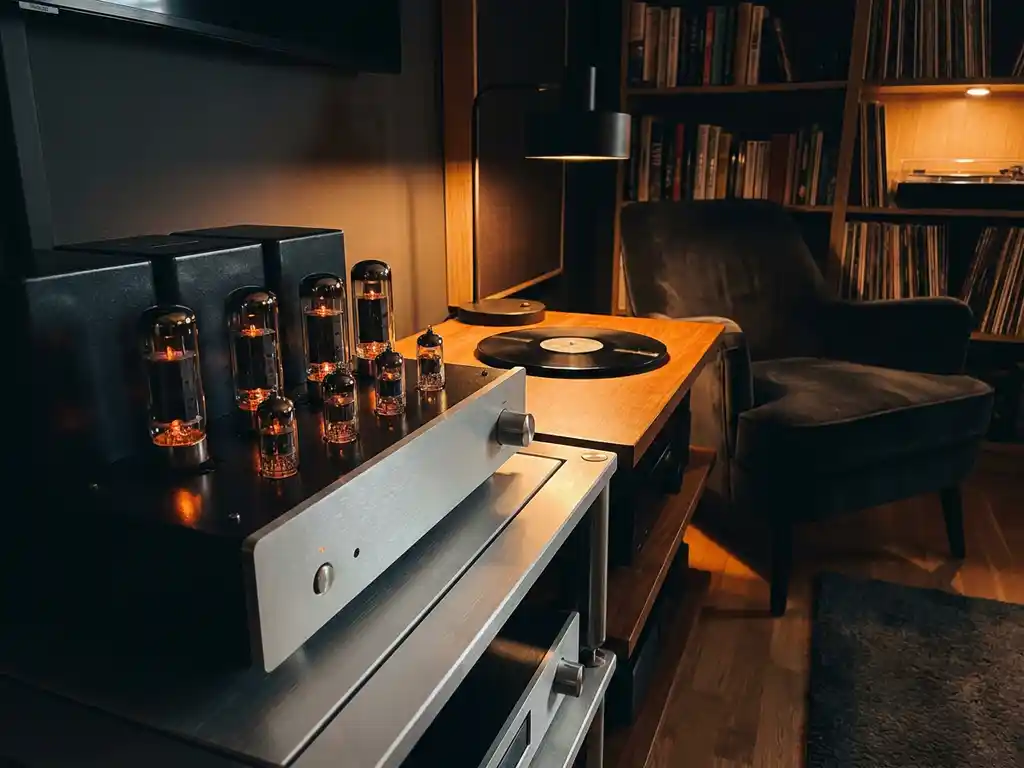
Most amplifiers need between 20 and 45 minutes of warm-up time before they perform at their best for critical listening. The exact duration depends on the amplifier’s design, topology, and the ambient temperature of the room. Solid-state amplifiers typically stabilize faster than tube designs, which can take considerably longer to reach their thermal sweet spot. The sections below walk through the science behind warm-up, the differences between amplifier types, and what this means for your listening sessions.
What actually happens inside an amplifier during warm-up?
During warm-up, the internal components of an amplifier, transistors, resistors, capacitors, and in tube designs, the valves themselves, gradually reach their intended operating temperatures. Until those temperatures stabilize, the electrical characteristics of these components shift, which means the amplifier is not yet performing within the tolerances its designer intended. Warm-up is essentially the process of bringing the entire circuit into its calibrated operating state.
Resistors change their resistance slightly with heat. Capacitors alter their effective impedance. Transistors and output devices shift their bias points as they warm. In a well-engineered amplifier, these shifts are accounted for in the design, but they only cancel out correctly once the circuit has reached thermal equilibrium. Before that point, the amplifier is working with components that are still moving targets.
Bias current is one of the most important factors here. The bias sets the quiescent operating point of the output stage, and it drifts as temperature rises. An amplifier that is cold will have a different effective bias than one that has been running for half an hour, which directly affects how the output stage handles the audio signal, particularly at low listening levels where crossover distortion becomes more audible.
How long does an amplifier need to warm up?
For most solid-state hi-fi amplifiers, a warm-up period of 20 to 30 minutes is sufficient for critical listening. Higher-powered amplifiers with large output stages may benefit from closer to 45 minutes. Tube amplifiers generally require at least 30 minutes, and some audiophiles prefer to allow 45 to 60 minutes before sitting down to evaluate the sound seriously.
The room temperature also plays a role. An amplifier in a cold room in winter will take longer to reach thermal equilibrium than the same unit in a warm, climate-controlled listening space. If you notice that your system sounds noticeably better after an hour than it did when you first switched it on, you are hearing exactly this effect in practice.
A practical approach is to switch your system on when you begin your listening preparation, adjusting the room, selecting your recordings, and settling in, so that by the time you are ready to listen critically, the amplifier has had adequate time to stabilize. This small habit makes a consistent and audible difference, particularly with high-resolution audio components that resolve fine detail.
Does warm-up time differ between solid-state and tube amplifiers?
Yes, warm-up time differs significantly between solid-state and tube amplifiers. Solid-state amplifiers typically stabilize within 20 to 30 minutes. Tube amplifiers require longer, often 30 to 60 minutes, because the valves themselves must reach operating temperature, and the high-voltage power supply needs time to settle fully.
Solid-state amplifiers
In solid-state designs, the warm-up process is primarily about the output transistors and bias circuitry reaching thermal equilibrium. Many modern solid-state amplifiers include automatic bias compensation that adjusts as the amplifier heats up, which can shorten the time before the circuit is performing optimally. Even so, the first 20 minutes should be treated as a settling period rather than peak performance time.
Tube amplifiers
Tube amplifiers involve a more complex warm-up sequence. The cathodes inside each valve must reach the temperature at which they emit electrons efficiently, and the high-voltage anode supply needs time to stabilize. Many tube amplifier users also notice that the sound continues to open up and become more fluid well beyond the initial warm-up phase, sometimes over 45 to 60 minutes, as the valves settle into their operating state. Tube hybrid designs, which combine valve and solid-state stages, generally fall somewhere between the two in terms of required warm-up time.
Why does a cold amplifier sound different from a warmed-up one?
A cold amplifier sounds different because its components are operating outside their intended thermal range, which affects bias stability, distortion characteristics, and the behavior of the output stage. The result is often a sound that feels slightly constrained, less dynamic, or lacking in midrange presence compared to a fully warmed-up unit.
The midrange is particularly sensitive to this effect. Audiophiles often describe a cold amplifier as sounding somewhat flat or closed-in, with less three-dimensional imaging and reduced textural detail. As the amplifier warms, the soundstage tends to open up, transient response improves, and the music takes on greater presence and emotional weight.
This is not a placebo effect. The shift in bias current, the stabilization of component values, and the settling of the power supply all have measurable consequences on how the amplifier handles the audio signal. The improvements you hear after warm-up are a direct result of the circuit operating as its designer intended, rather than in a transitional state.
Should you leave your amplifier on all the time?
Leaving a solid-state amplifier on continuously is a practice many serious audiophiles follow, and it does offer the benefit of always-ready thermal stability. However, it increases power consumption, generates heat over long periods, and adds to component wear over time. Whether it is worthwhile depends on how frequently you listen and how much you value immediate peak performance.
For tube amplifiers, leaving the unit on continuously is generally not recommended. Tubes have a finite lifespan measured in hours of use, and running them around the clock will shorten that lifespan considerably. The practical approach for tube owners is to switch on well ahead of a listening session rather than leaving the amplifier on indefinitely.
For solid-state designs, a reasonable middle ground is to switch the amplifier on at least 30 minutes before you intend to listen critically, and to switch it off when you know you will not be listening for several hours. Many audiophiles who listen daily simply leave their solid-state amplifier on during waking hours and switch it off overnight.
How Accustic Arts supports your best listening experience
At Accustic Arts, we design our amplifiers with thermal stability and consistent performance as core engineering priorities. Every component we use is selected and tested to ensure that the gap between cold start and full operating performance is as narrow as possible, without compromising the sonic qualities that matter most to serious listeners.
- Rigorous component selection: We use only high-grade components with tight tolerances, so thermal drift during warm-up has a minimal effect on the circuit’s behavior.
- Extended testing before dispatch: Every amplifier we build undergoes individual testing that can last up to two weeks, ensuring it performs exactly as designed once it reaches your listening room.
- Tube hybrid engineering: Our tube hybrid components are designed to combine the warmth and dimensionality of valve stages with the stability and control of solid-state design, offering a warm-up experience that is both manageable and musically rewarding.
- Studio-informed design philosophy: Our experience in recording studios and live sound environments means our amplifiers are built to reveal music accurately, not to flatter it, so every minute of warm-up time is rewarded with sound that reflects the recording as it was intended.
If you are ready to experience what a properly engineered amplifier sounds like at its best, explore our full range of amplifiers and audio components, or get in touch with us to find the right component for your system and listening goals.