

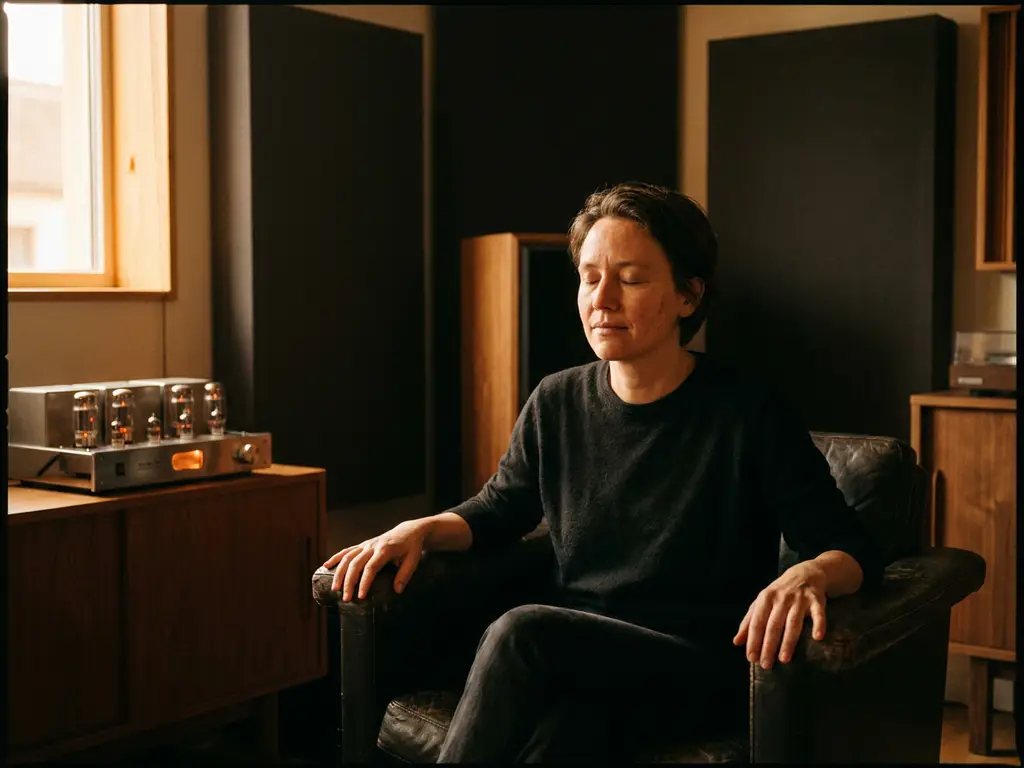
There is a moment every music lover knows, when a song stops being background noise and becomes something you feel in your chest. The melody lands differently, the silence between notes carries weight, and for a few minutes, the outside world disappears entirely. That moment is not accidental. It is the product of many things working together: the artistry of the musician, the quality of the recording, and perhaps most importantly, the fidelity of the system reproducing it. Understanding the difference between hearing music and feeling it is at the heart of what high-end audio is really about.
For audiophiles and serious music lovers, the pursuit of an emotional music experience through reproduction is a lifelong journey. It is not about chasing specifications or collecting expensive equipment for its own sake. It is about closing the gap between a recorded performance and the lived experience of being present for it. That gap is real, and the quality of your audio chain determines how wide or how narrow it becomes.
What separates passive listening from emotional immersion
Passive listening happens when music plays in the room but does not quite reach you. It is audible, recognizable, and perhaps even pleasant, but it does not pull you in. Emotional immersion is something entirely different. It is the state where the music commands your full attention without demanding it, where your body responds before your mind catches up.
The distinction comes down to engagement. When a system reproduces music with genuine accuracy, the brain stops working to fill in gaps or compensate for distortion. Instead of processing an approximation of the performance, the listener receives something much closer to the real thing. That shift from analytical hearing to emotional absorption is the defining experience of audiophile listening, and it is why so many people who discover high-fidelity audio find it genuinely difficult to go back.
How audio reproduction quality shapes emotional response
The emotional impact of music is not purely psychological. It is deeply tied to the physical accuracy of what reaches your ears. When timing is slightly off, when frequencies are compressed or colored, or when fine detail is lost in the noise floor, the brain registers something subtly wrong. That subtle wrongness creates distance. The music becomes a representation rather than an experience.
Sound fidelity matters because music communicates through nuance. The breath before a vocal phrase, the natural decay of a piano note, the spatial relationship between instruments in a recording, these are the cues that make a performance feel alive. High-fidelity audio reproduction preserves those cues. Low-fidelity reproduction strips them away, often without the listener consciously noticing, but always at the cost of emotional depth. The connection to music that people describe as „chills“ or „being moved“ is, in part, a response to information that only accurate systems can deliver.
The role of midrange in conveying musical emotion
Of all the frequency ranges in audio reproduction, the midrange carries the greatest emotional weight. This is where the human voice lives, where most melodic instruments speak most naturally, and where the character of a performance is most clearly expressed. It is the range most sensitive to coloration, distortion, and inaccuracy, and it is the range most immediately felt when it is reproduced well.
A system with a rich, accurate midrange does not just sound better. It communicates more. Vocal inflection becomes expressive rather than merely audible. The texture of a cello string, the warmth of a brass instrument, the intimacy of an acoustic guitar close-miked in a studio, these qualities emerge fully only when the midrange is handled with precision and care. For us at Accustic Arts, the midrange has always been a signature focus. Our engineering philosophy treats it not as one frequency range among many, but as the emotional core of music reproduction. The warmth listeners often describe in our components is not artificial coloring. It is what accurate midrange reproduction genuinely sounds like.
Why engineering precision translates to emotional authenticity
It might seem counterintuitive that something as technical as engineering precision connects directly to something as personal as an emotional connection to music. But the relationship is direct and well understood among serious audio designers. Every source of distortion, every timing error, every component that introduces noise or coloration creates a layer between the listener and the original performance. Removing those layers requires precision. And precision, at its best, produces authenticity.
This is why the approach to manufacturing at Accustic Arts involves individual testing periods of up to two weeks per component. Not because a checklist demands it, but because a component that passes a brief bench test may still fail to perform consistently under the full range of real-world conditions. The goal is not a product that measures well on paper. It is a product that disappears into the music, leaving nothing between the listener and the recording. That kind of engineering discipline is, ultimately, an act of respect for the music itself.
Building a listening environment that closes the gap
The electronics are only part of the equation. Even a reference-grade system will underperform in a room that works against it. Room acoustics, speaker placement, vibration control, and the quality of every component in the signal chain all contribute to how close the final experience comes to the emotional truth of the recording.
Practical steps make a meaningful difference here. Treating first reflection points with acoustic panels reduces smearing and improves stereo imaging. Isolating components from vibration preserves low-level detail that would otherwise be masked. Choosing cables and connections with care ensures that nothing in the signal path introduces unnecessary coloration. These are not audiophile myths. They are the conditions under which high-end electronics can actually do what they were designed to do.
The deeper point is that high-fidelity audio is a system, not a single product. Building a listening environment that closes the gap between reproduction and reality means attending to every link in the chain with the same seriousness that went into designing the electronics themselves. When everything works together, the reward is exactly what this pursuit has always been about: music that does not just play in the room, but genuinely moves the people in it.
Ähnliche Artikel
- Was verursacht schlechte Klangqualität in einer Heimanlage?
- Why do high-end audio components use premium internal parts?
- Was ist eine Bühnenabbildung und wie entsteht sie in einer Hi-Fi-Anlage?
- Was sind die Vorzüge von hochwertigen CD-Spielern gegenüber Streaming?
- How does digital-to-analog conversion shape the emotion in music?