
Few topics spark more debate among audiophiles than the role of cables in a high-end audio system. Some dismiss cable quality as irrelevant, while others consider it the final piece of the puzzle that unlocks a system’s true potential. The truth lies somewhere in between, and understanding exactly how cables influence sound reproduction helps you make informed, confident decisions about your listening environment.
Why does cable quality matter for sound reproduction?
Cable quality matters for sound reproduction because every audio signal traveling through your system passes through cables, and the physical properties of those cables directly affect what reaches your speakers or headphones. A cable is never truly neutral. It introduces resistance, capacitance, and inductance into the signal path, all of which can subtly alter frequency response, timing, and dynamic detail.
In a mid-fi system, these differences may be masked by other limiting factors in the chain. But in a resolving, high-end audio setup, where components are engineered to reveal every nuance of a recording, the cable becomes audible. Poor cable quality can introduce noise, degrade transient response, and compress the sense of space and air around instruments. Upgrading cables in such a system is not about chasing marginal gains. It is about removing a bottleneck that prevents the rest of your equipment from performing as designed.
How does a cable actually affect an audio signal?
A cable affects an audio signal through three primary electrical properties: resistance, capacitance, and inductance. Resistance causes signal loss and can dull high-frequency detail. Capacitance affects how quickly the signal changes, which influences treble extension and transient speed. Inductance interacts with the source impedance of your components and can affect bass definition and overall tonal balance.
Beyond these measurable properties, the physical construction of a cable also determines how well it shields the signal from electromagnetic interference (EMI) and radio frequency interference (RFI). In a home environment surrounded by wireless routers, power supplies, and household appliances, shielding is not optional. Poorly shielded cables act as antennas, introducing a noise floor that obscures low-level detail, the very detail that separates a deeply engaging musical experience from a flat, uninvolving one.
Skin effect is another factor worth understanding. At audio frequencies, electrical current tends to travel along the outer surface of a conductor. Cable designers address this through geometry, using multiple smaller conductors or specific winding patterns to ensure even current distribution across the full audio bandwidth.
What are the differences between cable types for audio systems?
The main cable types in an audio system are interconnects, speaker cables, and power cables, and each plays a distinct role in signal transmission. Interconnects carry low-level signals between components such as a DAC and preamplifier. Speaker cables carry amplified signals to the loudspeakers. Power cables deliver mains electricity to each component and, despite carrying AC rather than audio signals, can influence the cleanliness of the power supply and therefore the noise floor of the entire system.
Interconnects
Interconnects are the most signal-sensitive cables in the chain. They carry unamplified, low-voltage signals, which makes them particularly vulnerable to noise pickup and capacitive loading. Balanced interconnects using XLR connectors offer superior noise rejection over long runs and are preferred in professional and serious audiophile applications.
Speaker cables
Speaker cables carry high-current, amplified signals and must handle significant power transfer with minimal resistance. The gauge (thickness) of the conductor matters here, as does the quality of the termination at both ends. Poorly terminated connections introduce resistance and oxidation over time, degrading contact quality and dulling dynamics.
Power cables
Power cables are often overlooked but can have a meaningful effect on a system’s background noise level. A well-constructed power cable with effective shielding and quality connectors helps prevent mains-borne interference from entering your components through the power supply, preserving the dynamic headroom and clarity of the audio signal.
What materials and construction make a cable high-end?
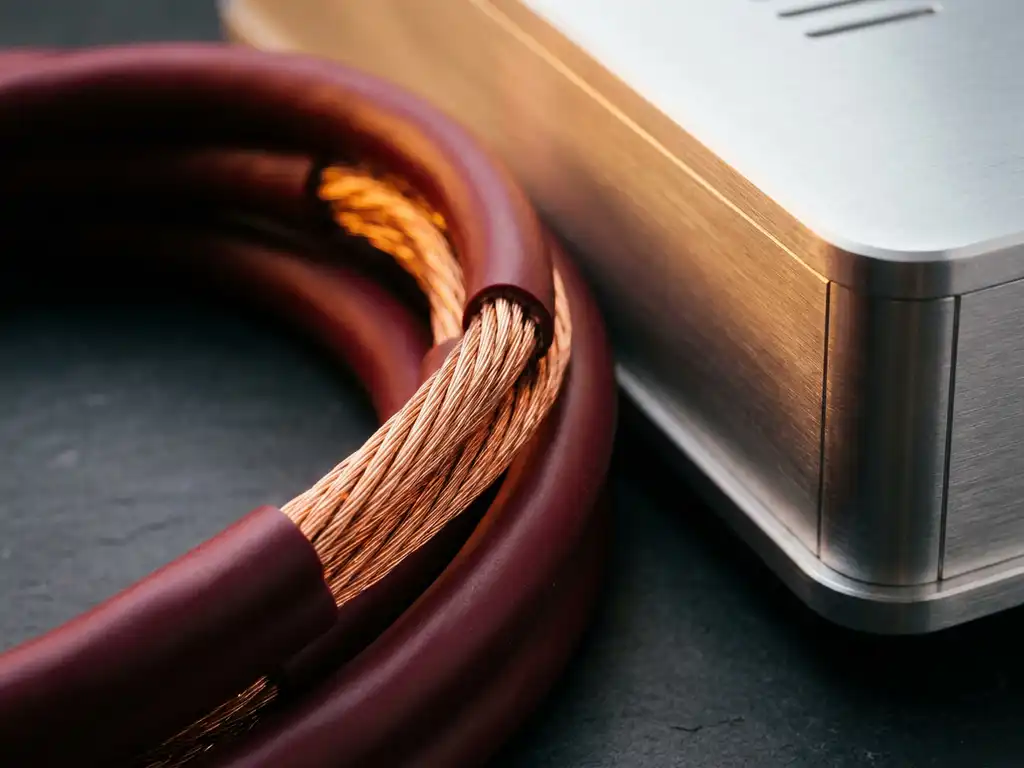
High-end audio cables are distinguished by conductor purity, dielectric quality, geometry, and termination standards. The conductor material is the starting point. Oxygen-free copper (OFC) is the baseline for quality cables, removing impurities that can impede electron flow. Higher-grade options include single-crystal copper and silver conductors, which reduce grain boundaries within the metal and allow the signal to travel with fewer micro-distortions.
The dielectric, the insulating material surrounding the conductor, also plays a role. Materials like polytetrafluoroethylene (PTFE) have low dielectric absorption, meaning they store and release less energy from the signal compared to cheaper PVC insulation. This preserves timing accuracy and transient definition.
Construction geometry, whether a cable uses twisted pairs, coaxial geometry, or braided conductors, determines how well it manages capacitance, inductance, and noise rejection. Finally, the quality of the connectors and the precision of the termination are critical. A world-class conductor terminated with a poorly fitting or oxidation-prone connector will underperform compared to a well-matched, carefully assembled cable using more modest materials.
How do you choose the right cables for a high-end audio system?
Choosing the right cables for a high-end audio system starts with matching cable quality to the resolution of your components. There is little benefit in investing in reference-grade cables for an entry-level system, just as there is little sense in bottlenecking a reference system with budget cables. The cable should be capable of transmitting everything your source and amplification can reveal.
Consider these practical steps when selecting cables:
- Audit your system’s resolution first. Identify the weakest link in your chain before spending on cables. Cables reveal what is already there; they do not add qualities your components cannot produce.
- Match impedance and capacitance to your components. Some amplifiers and DACs are sensitive to cable capacitance. Check the specifications of your components and choose interconnects with compatible electrical characteristics.
- Prioritize the signal path from source to amplifier. Interconnects between your source components and preamplifier carry the most delicate signals and are often the most rewarding place to start an upgrade.
- Listen before you commit. In a resolving system, differences between cables are audible. Whenever possible, audition cables in your own system before purchasing.
- Do not neglect power cables. If your system is sensitive enough to reveal cable differences in the signal path, it is likely sensitive enough to benefit from cleaner power delivery as well.
You can explore the full range of high-end audio components to better understand the level of resolution your cables need to support.
What mistakes should audiophiles avoid when upgrading cables?
The most common mistake audiophiles make when upgrading cables is changing multiple cables at once, which makes it impossible to identify which change produced which result. Upgrade one cable at a time, listen carefully over several sessions, and only then move to the next change. Audio memory is short, so give yourself enough time with each change to form a reliable impression.
Other mistakes worth avoiding include:
- Overspending on cables relative to the system. A cable that costs more than your amplifier is unlikely to be a rational investment. Cable quality should be proportional to the resolution of the overall system.
- Ignoring connector maintenance. Even the finest cable degrades at the connection point if connectors are allowed to oxidize. Clean your connectors periodically with an appropriate contact cleaner to maintain optimal signal transfer.
- Assuming more expensive always means better synergy. Cable performance is system-dependent. A cable that performs brilliantly in one setup may not suit another due to differences in component impedances and sensitivities.
- Overlooking cable dressing and routing. Running power cables and signal cables in parallel or allowing them to cross at acute angles can introduce hum and interference. Route cables thoughtfully, keeping power and signal paths separated where possible.
- Dismissing burn-in time. Many audiophiles and manufacturers observe that cables, particularly those with high-purity conductors and low-dielectric materials, benefit from a period of use before they settle into their final sonic character. Allow new cables adequate run-in time before drawing conclusions.
How ACCUSTIC ARTS approaches system-level audio performance
At ACCUSTIC ARTS, we understand that cables are one part of a larger system where every component must work in harmony to achieve absolute sound fidelity. Our philosophy, „Absolute Sound Fidelity Through Reproduction,“ is built on the belief that nothing in the signal chain should be compromised, including the quality and integrity of the connections between components.
When you invest in our electronics, you are investing in components engineered to the highest standards of German precision manufacturing, tested rigorously for up to two weeks before leaving our facility. To hear everything our components are capable of delivering, the cables connecting them must be equally uncompromising. Here is how we support you in building a complete, high-performance system:
- Reference-grade component design: Our preamplifiers, DACs, power amplifiers, and integrated amplifiers are built to reveal every nuance of a recording, making cable quality a genuinely audible factor in system performance.
- Expert guidance on system matching: We help audiophiles understand how our components interact with the rest of their signal chain, including cable selection considerations.
- A complete product ecosystem: From source to amplification, our product range is designed to work cohesively, simplifying the process of building a system where cables can perform their role without compromise.
- Connection to a global audiophile community: With our 2024 expansion into North America and a growing international presence, our network of authorized distributors can provide hands-on guidance tailored to your listening room and system goals.
If you are ready to explore what a truly resolving, emotionally engaging audio system sounds like, get in touch with us and let us help you build a system where every element, including your cables, is working at its full potential.
—
Disclaimer: This article was created with the assistance of Artificial Intelligence and has been reviewed by our editorial team.
Ähnliche Artikel
- How do you match an integrated amplifier to your speakers?
- How much should you budget for a high-end amplifier?
- How does component quality inside an amplifier affect its lifespan and sound?
- What does an amplifier actually do in a hi-fi system?
- Why does the same music sound different on different systems?