

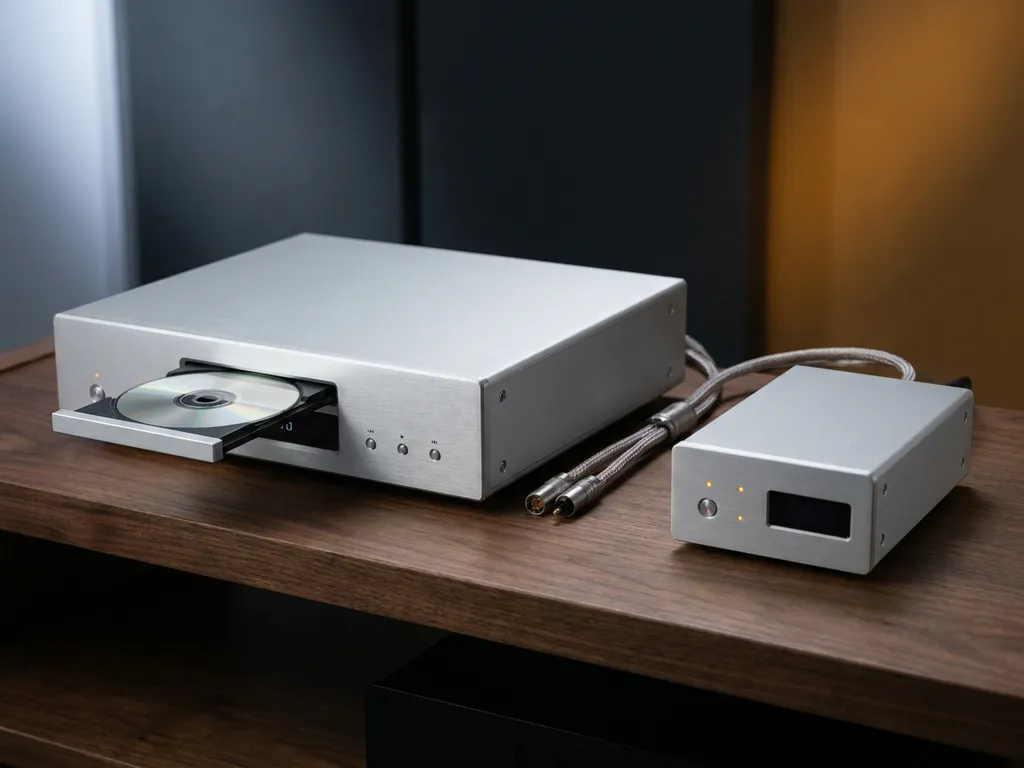
If you’re exploring the world of high-end digital audio, you’ve likely come across both the terms CD transport and DAC — and wondered what exactly separates them. Understanding the difference between a DAC and a CD transport is one of the most useful things you can do before investing in a serious digital audio setup. Whether you’re building a new system from scratch or upgrading an existing one, knowing what each component does and why audiophiles treat them as distinct pieces of equipment will help you make smarter, more satisfying choices.
What is a CD transport and what does it do?
A CD transport is a device that reads the digital data stored on a compact disc and outputs that data as a raw digital signal. Unlike a traditional CD player, a transport contains no internal digital-to-analog conversion circuitry. Its sole purpose is to retrieve the digital bitstream from the disc as accurately and cleanly as possible, then pass it on to a separate DAC for conversion.
The mechanical and electronic engineering inside a CD transport is entirely focused on one task: reading data. This includes the laser mechanism, the disc drive motor, error correction processing, and the digital output stage. High-end transports invest heavily in vibration isolation, precision servo control, and low-jitter clocking to ensure the data stream leaving the device is as stable and accurate as the original recording allows.
Common digital output formats from a CD transport include S/PDIF (coaxial), AES/EBU (XLR), and optical (TOSLINK), all of which carry the digital signal to an outboard DAC for the actual conversion to analog audio.
What is a DAC and how does it work?
A DAC, or digital-to-analog converter, is a device that takes a digital audio signal and converts it into an analog electrical signal that can be amplified and played through speakers or headphones. The DAC is the component responsible for transforming the binary data of a digital recording into the continuous waveform that represents sound.
Inside a DAC, the incoming digital bitstream is processed through a series of stages. Oversampling and digital filtering prepare the signal before it reaches the conversion chip itself, which reconstructs the analog waveform from discrete digital samples. After conversion, an analog output stage conditions the signal and passes it to a preamplifier or integrated amplifier.
In a standard CD player, the transport mechanism and DAC circuitry are combined into a single chassis. Separating them into dedicated components allows each to be optimized independently, which is why standalone DACs are a cornerstone of high-end audio system design. A high-quality DAC can also accept digital inputs from multiple sources, including CD transports, streaming devices, and computers, making it a versatile hub in a modern digital audio chain.
What’s the difference between a DAC and a CD transport?
The core difference between a DAC and a CD transport is their function: a CD transport reads and outputs digital data from a compact disc, while a DAC converts that digital data into an analog signal. Neither component produces listenable audio on its own — they work together as a two-part digital audio chain.
To put it plainly:
- CD transport: Reads the disc, extracts the digital bitstream, and transmits it via a digital connection
- DAC: Receives the digital bitstream, converts it to analog voltage, and passes it to an amplifier
A traditional CD player combines both functions in one box, which is convenient but introduces design compromises. When both the mechanical drive and the sensitive analog conversion circuitry share the same chassis, vibrations and electromagnetic interference from the transport mechanism can degrade the DAC’s performance. Separating them eliminates this shared-chassis problem and allows each component to be engineered to its fullest potential.
Why do audiophiles separate the transport from the DAC?
Audiophiles separate the CD transport from the DAC because doing so allows each component to be designed, built, and optimized without compromise. A transport can focus entirely on mechanical precision and low-jitter data retrieval, while a DAC can dedicate all its engineering to clean, accurate analog conversion without interference from a spinning disc mechanism.
There are several compelling reasons why this separation matters in a high-end audio context:
- Vibration isolation: CD transports generate mechanical vibration. When housed separately, that vibration cannot affect the sensitive analog circuitry inside the DAC.
- Power supply independence: Each component can have its own dedicated, optimized power supply rather than sharing one between a motor and a conversion circuit.
- Upgradability: Separating the two means you can upgrade your DAC when better conversion technology becomes available without replacing your transport, and vice versa.
- Source flexibility: A standalone DAC accepts digital signals from multiple sources, so the same high-quality conversion stage can serve your CD transport, a network streamer, or a computer audio setup.
For listeners who are deeply invested in the emotional quality of musical reproduction, these engineering advantages translate directly into a more natural, detailed, and engaging listening experience. The nuances that make music feel alive — the decay of a piano note, the breath before a vocal phrase — are far more likely to survive the digital-to-analog journey when each stage of that journey is handled by purpose-built equipment.
What should you look for in a high-end CD transport and DAC?
In a high-end CD transport, prioritize mechanical stability, low jitter, and output quality. In a high-end DAC, focus on conversion chip quality, analog output stage design, and input flexibility. Together, these two components form the foundation of a reference-grade digital audio system, so each deserves serious evaluation on its own merits.
What to look for in a CD transport
- Vibration control: Look for chassis damping, isolated drive mechanisms, and high-mass construction that minimize the effect of mechanical noise on the digital output
- Clock accuracy: Low-jitter clocking is critical — even small timing errors in the digital stream can degrade the final sound
- Output options: High-quality coaxial (S/PDIF) and AES/EBU outputs are preferred for their lower susceptibility to interference compared to optical connections
- Build quality: Precision engineering and high-grade components in the drive mechanism directly affect long-term reliability and data accuracy
What to look for in a DAC
- Conversion architecture: Whether R-2R ladder, delta-sigma, or another topology, the conversion design shapes the fundamental character of the sound
- Analog output stage: This stage has a significant influence on the final sound — look for discrete, high-quality circuitry rather than off-the-shelf integrated solutions
- Input options: Multiple digital inputs (coaxial, AES/EBU, USB, optical) give you flexibility to integrate different sources
- Power supply quality: A well-regulated, low-noise power supply is one of the most important factors in DAC performance
Pairing a well-matched transport and DAC is one of the most rewarding investments in high-end audio, and the synergy between the two components is something experienced listeners can hear immediately.
How Accustic Arts Approaches CD Transports and DACs
At Accustic Arts, we design both CD transports and DACs as dedicated, purpose-built components — because we believe that uncompromising separation of function is the only path to genuine sound fidelity. Our approach is grounded in decades of experience in recording studios and professional audio environments, and every product we build reflects that real-world understanding of what accurate musical reproduction actually demands.
Here is what sets our approach apart:
- Rigorous testing: Every component undergoes individual testing that can last up to two weeks before it leaves our facility in Lauffen am Neckar, Germany
- Precision engineering: We use only high-grade components and apply the latest construction principles across every product line
- Emotionally engaging midrange: Our signature achievement is midrange reproduction that allows the emotional content of music to come through with natural warmth and detail — never artificial, always honest
- Complete system thinking: Our product range covers every component in the signal chain, so a transport and DAC from us are designed to work together at the highest level
If you are ready to experience what a dedicated CD transport and DAC can do for your listening room, we invite you to get in touch with us or explore our full product range to find the combination that is right for your system.
—
Disclaimer: This article was created with the assistance of Artificial Intelligence and has been reviewed by our editorial team.