

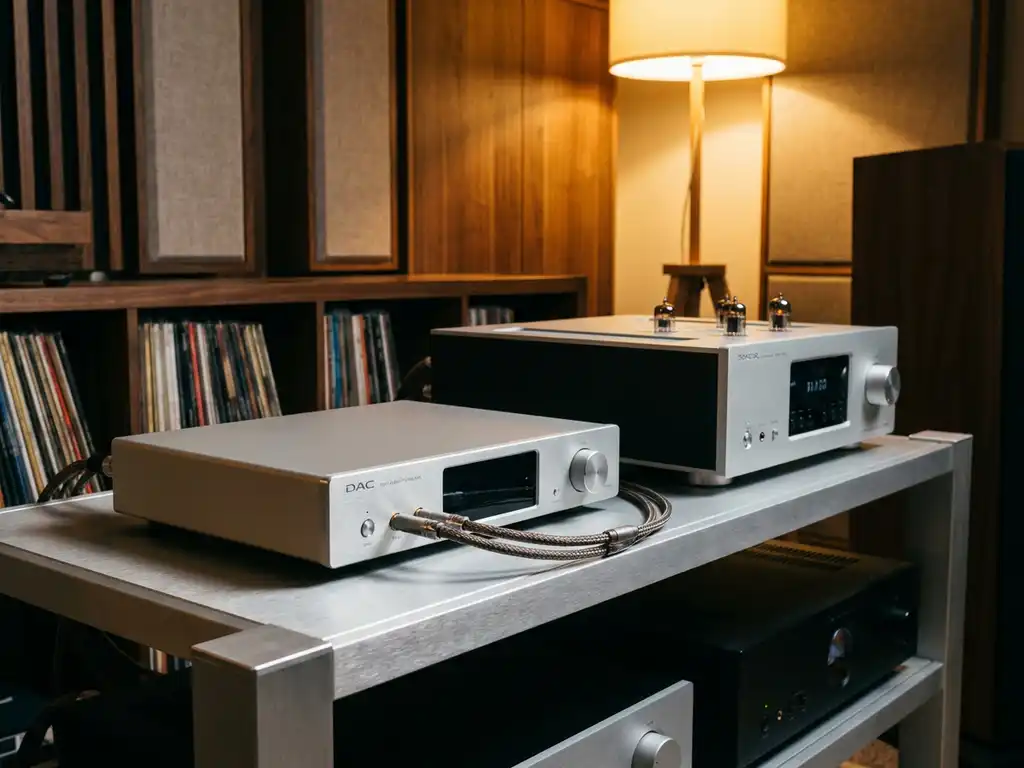
Digital music has never sounded better, and yet getting it right in a high-end audio system remains one of the most nuanced challenges an audiophile can face. The source, the conversion chain, the clocking, the cables, every decision compounds. For listeners who have invested seriously in their systems and who care deeply about the emotional truth of music, understanding how digital playback actually works is not just useful. It is essential.
Whether the goal is to extract every last detail from a lossless file, breathe new life into a CD collection, or stream high-resolution audio without compromise, the principles that govern audiophile digital playback remain consistent: precision matters, noise is the enemy, and emotion is the measure of success.
Streaming, CD, or file playback: which source wins?
There is no single winner in the CD player vs streaming debate, the best digital audio source depends on the quality of implementation, not the format itself. Each delivery method has genuine strengths, and each introduces its own set of challenges.
CD playback, when handled by a well-engineered transport and read mechanism, offers bit-perfect retrieval of a known, stable format. The Red Book standard may be decades old, but a high-quality CD player extracts data with exceptional consistency, and the physical medium introduces no network-related interference. For listeners with extensive disc libraries, a reference-grade CD player remains a deeply satisfying and musically coherent source.
Streaming has matured considerably. Services offering lossless and hi-res audio now deliver files that are technically on par with or exceed CD resolution. The convenience is undeniable, and the library depth is extraordinary. However, streaming introduces variables that physical playback does not: network noise, inconsistent buffering, and the quality of the streaming device’s internal clock all affect the final sound. A dedicated streamer with a clean power supply and strong isolation will outperform a laptop connected directly to a DAC.
Local file playback sits in an interesting middle ground. A well-organized library of high-resolution FLAC or AIFF files, played back through a quality music server or network-attached storage system, combines the stability of physical media with the flexibility of digital access. For many serious listeners, this represents the most controlled and rewarding approach to digital music playback.
How a DAC shapes the sound of digital music
The digital-to-analogue converter is the heart of any high-end audio system built around digital sources. Its job is to translate binary data into the analogue voltage swings that drive an amplifier, and the way it performs that translation defines the character of everything the listener hears.
Not all DAC chips sound the same, and the chip itself is only part of the story. The analogue output stage, the power supply design, the filtering approach, and the quality of the I/V (current-to-voltage) conversion stage all contribute to the final sound. A high-end DAC implementation treats each of these elements with equal seriousness, because a weak output stage can undermine even the finest conversion chip.
Filter choices also shape the listening experience in meaningful ways. Steep brick-wall filters eliminate aliasing cleanly but can introduce pre-ringing that some listeners find unnatural. Gentler minimum-phase filters preserve time-domain coherence but require careful design to avoid other artefacts. The best implementations offer thoughtful engineering choices rather than off-the-shelf solutions, and the result is a DAC that does not merely process data but genuinely serves the music.
The role of jitter, clocking, and digital noise
Jitter is one of the most consequential and least visible problems in digital audio. It refers to timing errors in the digital signal, small variations in when each sample arrives relative to when it should. Even tiny amounts of jitter translate into audible distortion, manifesting as a loss of focus, reduced soundstage depth, and a subtle but persistent sense of strain in the music.
A high-quality master clock, whether built into the DAC or supplied externally, is the primary defence against jitter. The clock governs when each sample is converted, and the more stable that timing reference, the more accurately the analogue output reflects the original recording. This is why the clocking architecture of a hi-fi digital source deserves as much attention as its conversion topology.
Digital noise is a related but distinct problem. Switching power supplies, USB interfaces, network components, and even the display screens on audio devices all generate electromagnetic interference that can contaminate the analogue signal path. Effective isolation, whether through galvanic separation on USB inputs, linear power supplies, or careful PCB layout, makes a genuine and audible difference. In a serious system, the goal is to deliver the cleanest possible digital signal to the conversion stage so that what emerges on the analogue side reflects the recording, not the noise floor of the electronics.
Building a digital playback chain that preserves emotion
A well-designed digital playback chain is built with intention at every link. The source, the transport or streaming device, the DAC, and the connection between them all contribute to whether the final sound moves the listener or merely impresses them technically.
Starting with the source, consistency and cleanliness of the digital signal matter more than format alone. A quality transport or streamer with a stable clock and a low-noise power supply gives the DAC the best possible input to work with. From there, the choice of digital interconnect, whether USB, AES/EBU, S/PDIF, or I2S, affects both signal quality and susceptibility to interference. Balanced connections and short cable runs tend to perform best in high-resolution systems.
The DAC then hands off to the preamplifier or integrated amplifier, and this transition is where the emotional character of the system is often decided. A DAC with a refined analogue output stage that partners well with the downstream amplification preserves the harmonic richness and dynamic nuance that make lossless audio genuinely compelling. We design our own DAC and CD player components with this complete chain in mind, ensuring that each product is engineered not just to measure well in isolation, but to contribute to a system that communicates music with honesty and feeling.
Common mistakes that undermine high-end digital sound
Even in systems built around exceptional components, a handful of recurring errors consistently diminish the listening experience. Recognising them is the first step to avoiding them.
- Using a computer as a direct source without isolation. Laptops and desktop computers are electrically noisy environments. Connecting one directly to a DAC via USB without a quality interface or galvanic isolator introduces ground noise and jitter that degrades the sound noticeably.
- Overlooking the power supply. Digital components are sensitive to power quality. A streamer or DAC fed by a noisy switched-mode supply will always sound worse than the same component powered cleanly. Linear power supplies or high-quality aftermarket regulators can make a meaningful difference.
- Treating all lossless formats as equal. Not all lossless audio is delivered with the same care. Sample rate conversion, volume normalisation applied by streaming services, and poor ripping practices all affect the integrity of the data before it reaches the DAC. Bit-perfect playback, where the file is delivered to the converter without alteration, should always be the goal.
- Neglecting system synergy. A reference-grade DAC paired with an amplifier that does not match its output impedance or gain structure will not perform at its best. The chain matters as much as any individual component.
- Ignoring room and setup basics. Even the finest digital source cannot overcome a poorly positioned speaker or an untreated room that smears timing and destroys imaging. The playback chain and the acoustic environment work together.
Getting digital audio right in a high-end system is a rewarding pursuit precisely because the gains are audible and emotionally meaningful. When every element is chosen and configured with care, the result is not just technically accurate sound. It is music that reaches the listener the way the artist intended it to, with all the nuance, dynamics, and feeling intact.
Ähnliche Artikel
- Wie beeinflusst das Bassmanagement den Gesamtklang einer Anlage?
- Wie prägt die Digital-Analog-Wandlung die Emotion in der Musik?
- Woran erkennt man, dass der Hörraum den Klang beeinträchtigt?
- Warum beeinflusst die Raumgröße den Bassfrequenzgang einer Hi-Fi-Anlage?
- Was ist der hörbare Unterschied zwischen 16-Bit- und 24-Bit-Audio?