

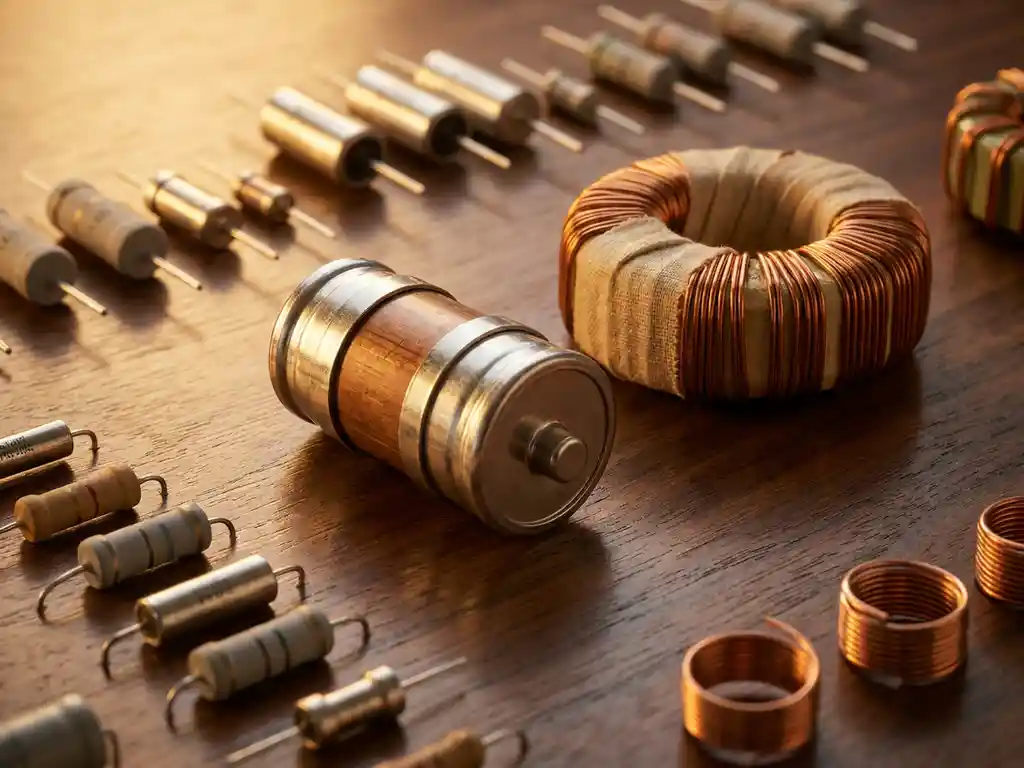
The quality of components inside an amplifier directly affects both how it sounds and how long it lasts. Higher-grade capacitors, resistors, transformers, and transistors produce more accurate, emotionally engaging audio while also tolerating heat, current stress, and time far better than budget alternatives. The sections below break down exactly which components matter most, how they degrade, and what separates a well-built amplifier from one that merely looks the part.
Which internal components have the biggest impact on amplifier sound?
The components with the greatest influence on amplifier sound quality are the power supply (particularly its transformer and capacitors), the output-stage transistors or tubes, and the signal-path resistors and capacitors. These parts directly shape how faithfully an amplifier captures, amplifies, and delivers the original audio signal to your speakers.
Starting with the power supply: a robust, well-designed transformer delivers clean, stable voltage to every stage of the circuit. When the power supply is underpowered or poorly filtered, noise and interference bleed into the audio signal, muddying the sound and compressing dynamic range. Large, high-quality reservoir capacitors smooth out voltage fluctuations, giving the amplifier the headroom it needs during demanding musical passages.
In the output stage, the transistors or output tubes are responsible for driving your speakers with enough current and voltage to move the drivers accurately. Premium output devices track the input signal more linearly, meaning they introduce less distortion across the audible frequency range. This is where the midrange reproduction, the frequency range where voices, guitars, and most instruments live, either comes alive or falls flat.
Signal-path components such as film capacitors and metal-film resistors play a subtler but real role. Cheaper ceramic capacitors and carbon resistors introduce coloration and noise that accumulate across multiple circuit stages. Swapping these for precision-grade alternatives tightens the noise floor and preserves the fine detail that makes a recording feel present and three-dimensional.
How does component quality affect an amplifier’s lifespan?
Component quality is one of the strongest predictors of amplifier longevity. High-grade components are rated for tighter tolerances, higher operating temperatures, and longer service hours, which means they degrade far more slowly under the thermal and electrical stress that normal use generates. A well-specified amplifier built with quality parts can remain in reliable service for decades.
Electrolytic capacitors are the most common failure point in aging amplifiers. Budget-grade capacitors use thinner dielectric materials and lower-quality electrolyte, which dries out faster under heat. A quality capacitor from a reputable manufacturer, properly rated for the circuit’s voltage and temperature, can last two to three times longer before its capacitance drifts outside acceptable limits.
Resistors, solder joints, and PCB materials also contribute to amplifier longevity. Cheaper carbon-composition resistors drift in value as they age, subtly shifting the amplifier’s operating point and increasing distortion over time. Precision metal-film resistors hold their values far more consistently. Similarly, lead-free solder applied with proper technique forms durable joints that resist cracking under thermal cycling, whereas poorly executed joints can develop intermittent failures that are frustrating to diagnose.
The mechanical quality of connectors, binding posts, and internal wiring matters too. Oxidation-resistant contacts and heavy-gauge internal wiring reduce resistance and heat buildup, both of which accelerate wear. When every part of the signal and power chain is specified generously, the amplifier runs cooler, stresses its components less, and rewards its owner with years of trouble-free listening.
What’s the difference between budget and high-end amplifier components?
The key difference between budget and high-end amplifier components is the precision of their specifications and the consistency of their manufacturing. High-end components are selected for tighter tolerance grades, lower noise figures, higher voltage and temperature ratings, and longer rated service lives. Budget components meet minimum functional requirements but leave little margin for stress, aging, or variation between units.
Tolerances and consistency
A resistor labeled 10k ohms might actually measure anywhere from 9,500 to 10,500 ohms in a budget batch, a five-percent tolerance that is perfectly acceptable for many applications but audible in a precision audio circuit. High-end designs often specify one-percent or even 0.1-percent-tolerance components, ensuring that matched pairs in differential or balanced circuits track each other closely. This consistency translates directly into lower distortion and a quieter noise floor.
Material and construction quality
Premium capacitors use higher-purity foils, better dielectrics, and more stable electrolytes. High-end transformers are wound with thicker copper wire, use grain-oriented silicon steel cores, and are often potted or shielded to minimize electromagnetic interference. These material choices cost more to source and manufacture, but they produce measurably better electrical performance and far greater durability. The gap between a budget electrolytic capacitor and a high-grade film capacitor, for example, is not a matter of marketing; it shows up clearly in distortion measurements and in the listening experience.
Why do high-end amplifiers go through extended testing before shipping?
High-end amplifiers undergo extended testing before shipping because component interactions, thermal behavior, and subtle circuit instabilities only reveal themselves under sustained real-world operating conditions. A short bench test confirms basic functionality; a multi-day burn-in and evaluation process confirms that the amplifier will perform consistently and reliably throughout its service life.
During extended testing, an amplifier cycles through heating and cooling repeatedly. This thermal cycling stresses solder joints, capacitors, and transistors in ways that expose marginal components or marginal workmanship before the unit reaches a customer. Any part that is going to fail early is far more likely to show signs of weakness during a rigorous factory test than after the product has been packed and shipped.
Sound quality evaluation is equally important. Measurements alone do not capture everything that matters to a discerning listener. Experienced engineers listen critically for imaging, tonal balance, dynamic coherence, and the quality of the midrange, comparing each unit against a reference standard. This subjective evaluation catches issues that graphs might miss and ensures that every unit leaving the factory sounds as intended.
For audiophiles investing in reference-grade audio components, this level of pre-shipment scrutiny is not optional; it is the foundation of the trust they place in a brand.
How can you tell if an amplifier is built with quality components?
You can assess an amplifier’s build quality by examining the internal layout, the brands and grades of key components, the quality of the chassis and connectors, and the manufacturer’s transparency about their construction and testing process. A well-built amplifier has nothing to hide and typically invites scrutiny.
If you have access to internal photos or can open the unit, look for these indicators:
- Recognizable component brands in the capacitors, resistors, and semiconductors, premium manufacturers use parts from suppliers with established reputations for audio-grade quality
- Clean, organized PCB layout with adequate spacing between components and no signs of rushed or dense packing that traps heat
- Heavy-gauge wiring for power and speaker connections, with secure terminations rather than thin, loosely routed cables
- A substantial transformer that feels heavy relative to the chassis size, undersized transformers are a common cost-cutting measure that limits dynamics and longevity
- Quality binding posts and input connectors that feel solid and resist oxidation
Beyond the physical inspection, the manufacturer’s documentation tells you a great deal. Brands that publish detailed specifications, explain their component selection philosophy, and describe their testing procedures are demonstrating confidence in their engineering. Brands that are vague about internal construction often have reasons to be. Warranty terms are also a useful signal: a longer warranty reflects a manufacturer’s confidence in their amplifier’s reliability and willingness to stand behind their work.
How Accustic Arts approaches amplifier component quality
At Accustic Arts, our approach to component quality and amplifier build quality is not a marketing position; it is embedded in every decision we make from circuit design through to final dispatch. Here is what that looks like in practice:
- Precision component selection: We use only high-grade, carefully specified parts across every product line, chosen for their electrical performance, thermal stability, and long-term reliability.
- Up to two weeks of individual product testing: Every unit undergoes an extended evaluation process before it is approved for shipment, covering both measured performance and critical listening by experienced engineers.
- Studio-informed engineering: Our experience in professional recording studios and live PA environments has shaped our understanding of what accurate, emotionally engaging sound actually requires from the components inside an amplifier.
- Audiophile label integration: Through Accustic Arts Audiophile Recordings, we test our electronics against real high-resolution music productions, ensuring our components perform in the context that matters most.
- No-holds-barred quality with an optimized price-value ratio: We believe uncompromising build quality should not require compromise on value, and our product range reflects that balance.
If you would like to learn more about our amplifiers and how our component philosophy translates into real listening experiences, explore our full product range or get in touch with us directly, we are always happy to talk about the engineering behind the music.