

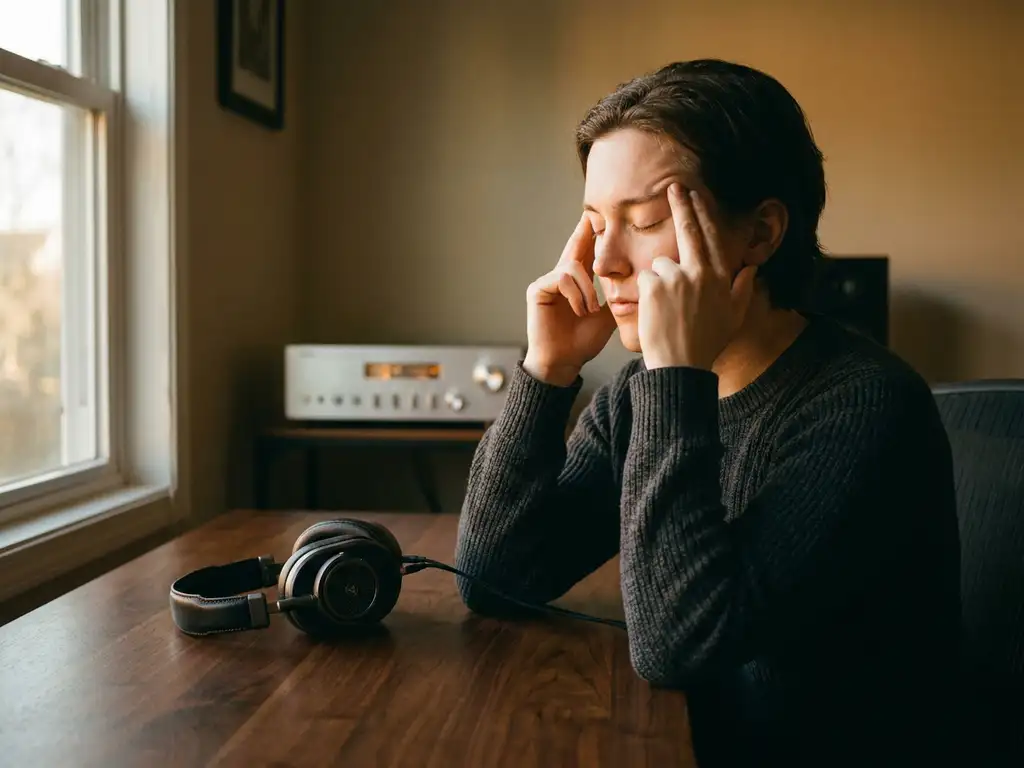
Most music lovers have experienced it: you sit down for a long listening session, everything sounds wonderful at first, but after an hour or two something shifts. The music starts to feel tiring, details blur together, and what once sounded engaging now feels like an effort to follow. That experience has a name — listening fatigue — and understanding it can genuinely transform the way you enjoy music at home.
What is listening fatigue and what does it feel like?
Listening fatigue, also called audio fatigue or ear fatigue, is a state of mental and physical tiredness caused by prolonged or stressful sound exposure. It is not simply the result of playing music too loudly. Instead, it describes a gradual deterioration in your ability to perceive and enjoy sound clearly, even at moderate volume levels, after extended listening sessions.
The symptoms are recognisable once you know what to look for. You might notice that music starts to sound flat or uninteresting despite nothing objectively changing. High frequencies can begin to feel sharp or irritating. Voices and instruments that sounded natural and full at the start of a session may seem harsh or congested. Some listeners also report a mild sense of pressure in the ears, difficulty concentrating on the music, or a general feeling of mental heaviness. The experience is often described as the audio equivalent of eye strain after spending too long in front of a screen.
What causes listening fatigue in audio systems?
Listening fatigue is caused by the brain working overtime to process sound signals that are unnatural, distorted, or overly compressed. When audio contains artefacts, harshness, or missing information, your auditory system and brain must compensate continuously, and that sustained effort leads to fatigue faster than relaxed, natural listening would.
Several factors contribute to this overload:
- Distortion: Even low levels of harmonic distortion, often inaudible as an obvious flaw, force the brain to filter and reconcile conflicting sonic information.
- Dynamic compression: Heavily compressed recordings leave little contrast between loud and quiet passages, which removes the natural breathing room that gives ears a chance to rest.
- Excessive high-frequency energy: Bright, overly forward treble reproduction is one of the most common triggers of sound fatigue during long sessions.
- Poor imaging and soundstage: When instruments are not clearly placed in the stereo field, the brain works harder to locate and separate them.
- Volume levels: Sustained exposure above comfortable listening levels accelerates fatigue, even when the sound quality is otherwise good.
How does poor audio equipment contribute to ear fatigue?
Poor audio equipment contributes directly to ear fatigue by introducing distortion, colouration, and inaccuracies into the signal that the listener’s brain must continuously compensate for. Equipment that cannot accurately reproduce dynamics, tonal balance, or spatial information places a measurable extra burden on the auditory system throughout a listening session.
Budget or mid-range components often struggle in specific areas that matter most for long-term listening comfort. Amplifiers with high noise floors, DACs that introduce digital harshness, or speakers with uneven frequency responses all create subtle but cumulative stress on the listener. The result is that even a well-recorded album can feel tiring when the system adds its own sonic character on top of the music.
Interestingly, the problem is not always loudness or obvious distortion. Some equipment sounds impressive in a short audition but becomes difficult to live with over hours. This is often because the system emphasises certain frequencies or adds a kind of artificial excitement that initially sounds engaging but is ultimately unsustainable for the ear. True long-term listening comfort comes from accuracy, not from flattery.
What’s the difference between digital and analogue fatigue?
Digital fatigue and analogue fatigue refer to different sonic characteristics that cause ear fatigue through different mechanisms. Digital fatigue typically results from harshness, grain, or a kind of brittle quality in the high frequencies, often associated with poor digital-to-analogue conversion or low-quality streaming. Analogue fatigue tends to arise from distortion, noise, or tonal colouration introduced by poorly designed or poorly maintained analogue components.
In practice, digital sources are more commonly cited as a cause of listening fatigue, particularly when the conversion from digital to analogue is handled carelessly. Poor DAC design can produce what many audiophiles describe as a „digital glare“ — a hardness in the upper midrange and treble that makes extended listening uncomfortable. This is not an inherent property of digital audio itself, but rather a symptom of inadequate implementation.
Well-implemented digital sources, by contrast, can be extraordinarily natural and fatigue-free. The key distinction is not the format but the quality of execution. A high-quality DAC or CD player that handles the conversion with precision and care can deliver hours of effortless listening, while a poorly designed one may cause fatigue within a single album. The same principle applies to analogue: a well-maintained, accurately designed analogue chain can be deeply relaxing, while a noisy or distorting one becomes exhausting quickly.
How can you reduce listening fatigue during long sessions?
You can reduce listening fatigue during long sessions by managing volume levels, taking regular breaks, choosing well-recorded music, and ensuring your listening environment is acoustically comfortable. The single most effective habit is keeping the volume at a level where conversation would still be possible without shouting, which is typically the range where the ear is most at ease.
Beyond volume control, these practical steps make a meaningful difference:
- Take listening breaks: Even ten minutes of quiet every hour allows your auditory system to reset and reduces cumulative strain significantly.
- Choose well-mastered recordings: Heavily compressed or poorly mastered recordings accelerate fatigue. Seek out recordings with genuine dynamic range.
- Treat your room: Reflective, reverberant rooms create a confused and tiring soundstage. Basic acoustic treatment, such as rugs, bookshelves, and soft furnishings, can make a room far more listenable.
- Avoid ear canal pressure: If you use headphones, choose over-ear designs with a comfortable fit rather than in-ear monitors for long sessions, as pressure fatigue adds to sonic fatigue.
- Vary your listening: Alternating between demanding, complex recordings and simpler, quieter music gives your brain natural rest periods within a session.
What type of audio system helps prevent listening fatigue?
An audio system that prevents listening fatigue is one that reproduces music accurately, with low distortion, natural tonal balance, and sufficient dynamic range to preserve the contrast between quiet and loud passages. The key qualities to look for are transparency, controlled treble energy, low noise, and the ability to resolve fine detail without introducing artificial brightness or harshness.
Systems built around these principles allow the music to flow naturally without the listener’s brain needing to work to make sense of the sound. The midrange is particularly important: it carries the majority of vocal and instrumental information, and a system that reproduces it cleanly and naturally is far less tiring than one that colours or congests it. This is why experienced audiophiles often prioritise midrange quality above all other specifications.
High-end electronics also tend to have significantly lower distortion figures than mass-market alternatives, and this matters more than most people realise. Even distortion levels that are technically inaudible as discrete tones can contribute to a sense of strain over time. A quiet, clean, accurate system is one you can listen to all evening without ever feeling the need to turn it off.
How Accustic Arts helps you listen longer without fatigue
At Accustic Arts, we have spent decades designing electronics with long-term listening comfort as a core goal, not an afterthought. Our philosophy of Absolute Sound Fidelity Through Reproduction means that every component we build is engineered to get out of the way of the music and let it speak for itself. The result is a sound that is detailed and revealing without ever becoming tiring.
Several principles define how our products address listening fatigue directly:
- Exceptional midrange reproduction: Our signature strength is a natural, emotionally engaging midrange that carries voices and instruments with warmth and accuracy, reducing the strain of long listening sessions.
- Low distortion across the signal chain: From our full range of high-end audio components including DACs, preamplifiers, and power amplifiers, every product is built to minimise the colouration and artefacts that cause fatigue.
- Rigorous quality control: Every component undergoes individual testing for up to two weeks before it leaves our facility, ensuring that what reaches your listening room performs exactly as intended.
- Natural tonal balance: We do not design for showroom impressiveness. We design for hours of effortless, emotionally satisfying listening.
If you are ready to experience music the way it was meant to be heard, we invite you to get in touch with us to find out which Accustic Arts components are the right fit for your listening room and musical taste.
—
Disclaimer: This article was created with the assistance of Artificial Intelligence and has been reviewed by our editorial team.
Ähnliche Artikel
- Wie beeinflusst elektromagnetische Störung die Audioqualität?
- Was sind die Vorzüge von hochwertigen CD-Spielern gegenüber Streaming?
- How does an integrated amplifier compare to a separates system?
- What is total harmonic distortion and how does it affect sound?
- Why does room size affect bass response in a hi-fi system?