

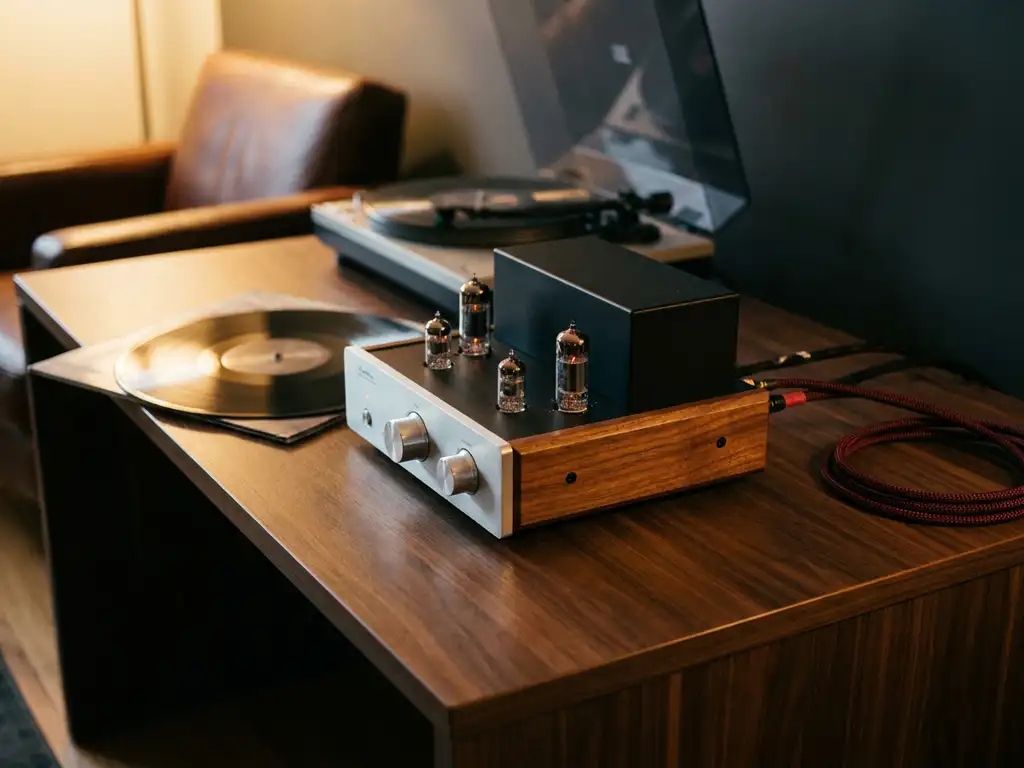
Vinyl has made a remarkable comeback, and for good reason. There is something deeply satisfying about the ritual of placing a record on a turntable, lowering the stylus, and letting the music fill the room. But many listeners who invest in a quality turntable and cartridge overlook one of the most consequential components in the entire playback chain: the phono stage. Understanding how a phono preamp works and what it does to your turntable sound can genuinely transform the way you listen to vinyl.
The phono stage sits quietly between your turntable and your amplifier, yet its influence on vinyl sound quality is anything but quiet. From tonal balance to noise floor, from dynamic punch to the fine texture of a vocalist’s breath, the phono stage shapes virtually every aspect of what reaches your ears. Whether you are new to vinyl playback or refining a high-end audio system, knowing what this component does is essential to making the right choices.
The signal chain between stylus and speaker
When a stylus traces the grooves of a vinyl record, it generates a tiny electrical signal. This signal is extraordinarily small, typically measured in millivolts for a moving magnet cartridge and even smaller for a moving coil design. Before that signal can drive an amplifier and, ultimately, your speakers, it needs to be amplified significantly. That is precisely what the phono stage does: it takes this fragile, microscopic signal and raises it to a level that the rest of your system can work with.
Without a phono preamp, the signal from your cartridge would be far too weak and tonally incorrect to use directly. The phono stage bridges that gap, acting as the first active component in the signal chain after the cartridge itself. Because it handles such a delicate signal at the very start of the chain, any coloration, distortion, or noise introduced here will be amplified along with the music all the way to your speakers. This is why the quality of the phono stage matters so profoundly.
RIAA equalization and tonal balance
Beyond simple amplification, the phono stage performs a second critical function: RIAA equalization. When vinyl records are cut, the audio signal is deliberately shaped according to the RIAA (Recording Industry Association of America) standard. Bass frequencies are reduced and treble frequencies are boosted during the cutting process. This is done to allow more music to fit on a record and to keep the stylus tracking correctly in the grooves.
The phono preamp reverses this process, applying an inverse RIAA curve that restores the correct tonal balance. Bass is boosted back up, treble is rolled off, and the result should be a flat, natural frequency response. If the RIAA equalization in a phono stage is inaccurate, the tonal character of everything you listen to will be skewed. A poorly implemented curve might make music sound thin and bright, or heavy and congested. Accurate RIAA correction is therefore not a luxury but a fundamental requirement for faithful vinyl playback.
Gain, noise floor, and dynamic range
Gain and noise are two sides of the same coin in phono stage design. The amount of amplification a phono stage provides must be matched to the output level of the cartridge. A moving magnet cartridge typically outputs around 2 to 5 millivolts and needs moderate gain, while a low-output moving coil cartridge may output as little as 0.2 millivolts and requires considerably more amplification.
The challenge is that as gain increases, so does the potential for noise. A phono stage must amplify the signal without amplifying background hiss, hum, or electronic interference to an audible level. The noise floor of the phono stage directly determines how much low-level musical detail is preserved and how quiet the silences between notes feel. A low noise floor allows the full dynamic range of the recording to emerge, from the softest pianissimo passage to the most powerful orchestral climax, without any veil of electronic noise obscuring the music.
How component quality shapes the listening experience
The internal components of a phono stage have a direct and audible effect on the character of the sound. Resistors, capacitors, operational amplifiers, and the circuit topology all contribute to how the music is rendered. High-grade passive components tend to preserve more of the fine detail and spatial information in a recording, while lower-quality parts can smear transients, reduce imaging precision, and add a subtle but persistent coloration.
The power supply is another often-overlooked factor. A stable, well-regulated power supply keeps the circuit operating consistently regardless of what is happening in the music. Inadequate power supply design can introduce low-frequency hum or a sense of compression that robs the music of its energy and dynamics. In the world of high-end audio, it is these seemingly small decisions, made at the component level, that separate a phono preamp that merely functions from one that genuinely moves you.
Matching a phono stage to your cartridge and system
Choosing the right phono stage for your turntable setup starts with understanding your cartridge. The two main types, moving magnet (MM) and moving coil (MC), have different output levels and impedance characteristics, and not every phono stage accommodates both. Many entry-level phono preamps are designed for MM cartridges only, while higher-end designs often include switchable gain and loading options to accommodate a wide range of MC cartridges as well.
Impedance loading is particularly important for moving coil cartridges. The load presented by the phono stage affects the cartridge’s frequency response and overall sonic character. Too low or too high a load resistance can make a cartridge sound dull or edgy. The best phono stages allow the listener to experiment with different loading values to find the combination that brings out the best in a specific cartridge. Beyond the cartridge, it is worth considering how the phono stage integrates with the rest of your system. Its output impedance should be compatible with your preamplifier or integrated amplifier, and its gain structure should allow for comfortable volume control without running the amplifier at extreme settings. A well-matched phono stage and system creates a coherent signal path where every component works in harmony.
How Accustic Arts elevates your vinyl playback
At Accustic Arts, we understand that the phono stage is not an afterthought. It is a foundational element of any serious vinyl listening system, and we approach its design with the same uncompromising philosophy we bring to every component we build. Our engineering team works with only precise, high-grade components, and every unit undergoes an individual testing process that can last up to two weeks before it leaves our facility. The result is a phono preamp that does not merely amplify a signal but allows the full emotional truth of a recording to come through.
Here is what sets our approach apart:
- Accurate RIAA equalization engineered to exacting tolerances, ensuring tonal balance that is true to the original recording
- Ultra-low noise floor achieved through careful component selection and circuit design, preserving the finest musical details
- Flexible gain and loading options to accommodate both moving magnet and moving coil cartridges across a wide range of output levels
- Premium power supply design for stable, consistent performance that lets the music breathe naturally
- German engineering heritage informed by decades of experience in recording studios and professional audio environments
If you are serious about getting the most from your vinyl collection, the phono stage deserves the same attention as your turntable and speakers. We invite you to explore our full product range to discover how Accustic Arts components can elevate your listening experience, or get in touch with us directly to discuss which solution is the right fit for your system.